I first got to know The Cinematic Orchestra through their album Man with a Movie Camera, which served as a soundtrack to a re-released version of the experimental 1929 silent documentary film of the same name by Soviet director Dziga Vertov.
Although they have been around since 1999, The Cinematic Orchestra have only released 3 studio albums (Motion – 1999, Every Day – 2002, Ma Fleur – 2007) next to other projects such as remixes, soundtracks, or live recordings.
I had the chance to watch the British nu-jazz/electronic band perform live in Barcelona’s Apolo venue, and it was quite an experience. Although their studio recordings are perfectly capable of creating a unique atmsophere and setting the mood, watching them on stage felt different and somewhat special.
Led by founder Jason Swinscoe, the band was joined by a number of highly skilled instrumentalists including violinist Miguel Atwood-Ferguson, saxophonist Tom Chant, drummer Luke Flowers, as well as vocalists Heidi Vogel and Larry Brown who added an ethereal tone to the performance. Next to more well-known and classic numbers, the setlist also included some pretty impressive new material (such as J Bird), which left me looking forward to their next album release.
The band’s way of combining live jazz improvisation with electronica was a pleasure to watch, and though the show could have been longer, it was nevertheless an excellent performance from a group of truly remarkable musicians.
[As a side note, since this was my first time at Apolo: at times the hall resembled a classroom where the kids had to be shushed by the teacher -in this case the artist- in order to make silence. Not sure yet if this is typical Barcelonan audience behavior, but I suspect so!]
Born in 1987 in Volos, Greece, Dimitrios Skyllas started playing the piano at an early age and went on to study musicology and piano performance at the University of Kingston, London. He has also studied composition and aesthetics at the University of Edinburgh, and holds a second postgraduate degree in composition from the Royal Conservatoire of Scotland in Glasgow.
Currently based in London, Skyllas is a collaborator (composer in residence) with KYKLOS ENSEMBLE and also performs as a solo pianist next to his compositional and teaching activities.
Earlier this year, the composer’s popularity saw a sharp rise following a successful performance of his piece GRIEF GESTURES by KYKLOS ENSEMBLE in Athens. The work, originally premiered on May 26th 2012 and based on traditional laments from the region of Epirus, was particularly inspired by Greek clarinetist Petroloukas Chalkias, one of the greatest exponents of the Epirotic clarinet tradition.
The premiere
For his new organ piece EARTH MINUS, laments of Epirus (such as “Siko Mariola”) served once again as a source of inspiration for Skyllas, together with two artists who have deeply influenced and enriched his creative viewpoint: Icelandic songwriter Björk and American video artist Bill Viola.
Dimitrios Skyllas with organist Ourania Gassiou
The world premiere of EARTH MINUS took place on Sunday, September 27th at the Westminster Abbey, where London-based organist Ourania Gassiou performed the organ piece together with works by Johannes Brahms and Pierre Cochereau.
“I met Ourania a few months ago and she showed true interest in the fact that I composed an Epirus lament, especially because she is originally from that area of Greece! After a few discussions, she asked me if I would be interested in composing a lament for organ to be presented at the Westminster Abbey”, says Skyllas, who gladly took on the challenge. “I feel privileged to have met Ourania; she is an extraordinary musician, and I hope we keep our collaboration for future projects. I feel that my piece is absolutely ‘safe’ in her hands!”
From Epirus to the world
As to the influence Greek traditional music has had upon his work, Skyllas explains: “When I started composing, I wanted to prove that I can become what we usually call a ‘European avant-garde composer’ without realising that I was actually much closer to the musical tradition of my country. Our tradition is like our mother tongue: we might choose to speak another language, however we cannot and probably shouldn’t try to escape or ignore it.”
He goes on to analyse his fascination with laments in particular: “I started to become interested in the laments from Epirus because inside their sound I discovered some qualities that expressed in depth my emotional stages. In musical terms, the lament is characterized by quite a distinctive sound, the simplicity of the melodic lines, the dialogue between the instruments, the pedal notes that allow space for improvisation, the pulse and atmosphere of its ritual. Besides, it is music about death… and my own obsession with Death and Time was certainly an important parameter.”
“Our tradition is like our mother tongue: we might choose to speak another language, however we cannot and probably shouldn’t try to escape or ignore it”
Epirus is well-known for its folk songs, polyphonic tradition, and highly virtuosic instrumentalists, while its music has managed to attract international attention in large part due to the unique expressivity and emotional depth of its traditional laments – an expression of the universal practice of dealing with grief through musical means.
The fact that elements of this rich tradition are being incorporated into avant-garde compositions by a young contemporary composer with popular appeal is indeed remarkable. And certainly hopeful, since it helps highlight the unity and continuity of music regardless of labels, as Skyllas’s 21st-century laments so tellingly demonstrate.
Besides being the home of the mythical centaurs, Pelion is widely considered one of the most beautiful Greek mountains. It is known for its unique combination of thick forests, hiking trails, natural springs, streams, gorges and amazing beaches, making it a highly popular attraction all year round.
Perhaps not as well-known is the annual “Music Village” event which takes place every August in Agios Lavrentios, a small village situated at an altitude of 600 metres on Pelion’s southern slopes. A place that seems untouched by the passing of time, Agios Lavrentios captivates you instantly with its traditional Pelian architecture, intricate web of cobblestone alleys, and fascinating vistas of the surrounding landscape.
View of Agios Lavrentios
Cobbled street in Agios Lavrentios
Sunset in Agios Lavrentios
The beautiful Hatzini Square
Moreover, thanks to its natural location and the total absence of motor vehicles, it is marked by a special ambience of serenity that invites you to wind down and enjoy the overflowing tranquility. Until the festivities begin, that is.
Themusic
This year marked the 10th consecutive edition of the Music Village, adding a festive flavor to the event’s already celebratory and Dionysian nature. A combination of daily workshops, organized events and performances, as well as spontaneous jams and all sorts of music-related happenings, the festival takes on a dynamic character that transforms the whole village into a vivid, pulsating arena of continuous artistic activity.
This slideshow requires JavaScript.
Throughout the two periods of the Music Village, the various instructors, students, visitors and even village residents all participate in a prolonged musical feast, where learning from one another and enjoying music all together becomes a daily routine.
Every morning I would walk down to the central square of Agios Lavrentios, where the sound of violins in unison would slowly wake me up over a cup of coffee. After tuning in to the village sounds (the murmuring of purling water, a clarinet playing from inside a nearby building), I would move towards the court of St. Athanasios Church (dating from 1777) where our instructor and master percussionist Kostas Anastasiadis would talk to us about the harmony of rhythm.
The rhythm of nature
Listening to Kostas and learning from such a great musician was a privilege: over a period of just a few days, he was able to initiate us into the world of Indian polyrhythmic techniques (some of the new words I learned include tihai and chakradhar), analyze complicated rhythmic patterns and show us how to best tackle them, and -perhaps most importantly- share some of his insights into the philosophy of music and how to become a better musician not by mindless practicing but by listening to the others and help them sound and perform better. For music is not just notes on paper, but the interaction between players, the spontaneous response of the performer to the stimuli he receives from his bandmates and the audience.
Finally, I shall never forget how he kept time to the singing of the nightingale, thus demonstrating that nature is really the most perfect metronome of them all. Machines, after all, are only around for a few hundred years, while nature has been singing long before man started to imitate her…
In a beautiful green setting just a couple of hours away from the hustle and bustle of Athens, a unique get together of different people, sounds, and musical styles took place around mid-August in the 4th edition of the Arvanitsa Music Forest Festival.
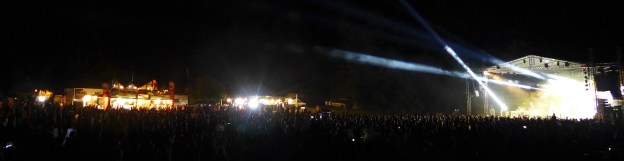
Nestled inside a lush landscape, the stage was surrounded by tall green firs, its powerful projectors and strong lights bringing forth a symbolism that run throughout the festival: the convergence of old and new, traditional and modern, urban and rural.
The stage lights vanishing into the night sky above the forest in Arvanitsa
The music of uprooting
Intensified and increasingly relevant due to the ongoing socio-economic crisis in Greece, the theme of emigration and resettling was recurrent in the performances of several artists who treated it both as a vehicle for artistic expression and socio-political commentary.
Another highlight included the electrifying renditions of popular folk tunes by Villagers of Ioannina City (aka VIC), a Greek band that brings together folk influences with post, stoner and psychedelic rock elements. Songs such as Jiannim or Chalasia combine skilfully the traditional form and emotional undertones of Greek folk song with a contemporary sound and orchestration, thus reaching out to audiences that would otherwise have little or no interest in folk music.
Old folk, new folks
The amplified sound of clarinets, lutes and lyres next to resounding guitars, electric bass and thundering drumming. Familiar lyrics and popular tunes sung again in different ways, performed through different mediums, and heard again through different ears.
This happens when city folks gather in the forest to play, listen and sing to the the new old sound of Greek folk rock music.
It is common to associate certain songs, albums or artists with the occasion and the place where we first listened to them. This is especially true when the first hearing is linked to a place of exceptional beauty, which stays forever intertwined with the tune/artist in question.
I have such a memory from some distant summer holidays in the small island of Elafonisos, just off the Southern coast of Peloponnese in Greece. Known for its sandy beaches and blue-green waters, Elafonisos is an ideal place to wind down and tune in your body and soul with the beautiful, serene scenery.
Elafonisos, Greece
Every day we would walk up to a small beach bar for a snack, casual talk and enjoy the splendid surroundings. To top it all off, there was almost always some intriguing music coming from the bar’s speakers that seemed to blend perfectly with the surrounding space.
One time, while I was enjoying the most delicious karydópita (pecan pie) with fresh vanilla ice cream I have ever tasted, I decided to walk up and ask the bartender/cook/DJ what was the tune we were listening to.
I could tell it was some sort of jazz adaptation of Vivaldi, but I had never heard something like it before. He wrote down the name of the artist on a piece of paper and handed over to me (back then there was no mobile phones, let alone Wi-Fi). The note read “Jacques Loussier”.
That’s how I was introduced to the wonderful world of the Jacques Loussier Trio and their magnificent renditions of classical music (from Bach and Vivaldi to Chopin and Debussy).
To this day, when I listen to Vivaldi’s ‘Four Seasons’ played by Loussier’s jazzy piano trio, my mind flies instantly toward the Greek summer – the most beautiful season of all.








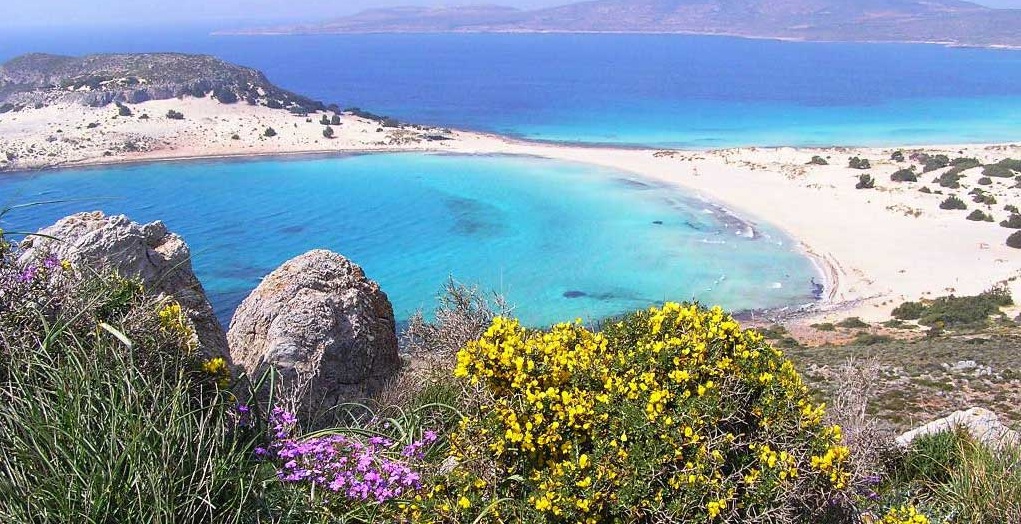 Elafonisos, Greece
 The Muser