I have to admit I don’t go to concerts as often as I used to (or would like to, for that matter). But lately I’ve been trying to get back in touch with Amsterdam’s vibrant music scene. I’m not talking big names or venues here, but mostly intimate gigs of lesser-known local bands.
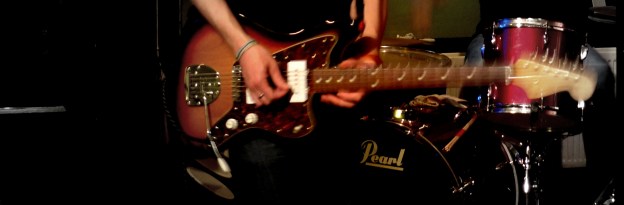
One such case is the blues/garage rock duo The Shady Greys. As both their name and songs suggest, their ‘grey’ sound lies somewhere in between The Black Keys and The White Stripes, marked by fuzzy guitar riffs and the use of the cajón.
I recently had the chance to meet and jam with them during a late night session in one of the city’s blues bars. In that same session I also bumped into a musician friend I hadn’t seen in quite some time. I was glad to hear that he’s busy doing gigs and playing guitar for The Crowns, an Amsterdam-based rock group built on the “foundations of Dutch liberty & freedom.”
More on the psychedelic side of things, The Full Wonka is another local band whose atmospheric, experimental sound produces a hypnotizing effect. Watching them live and listening to their tunes brings to mind bands like The Brian Jonestown Massacre and The Velvet Underground.
Only a fragment of Amsterdam’s alternative rock music scene, these bands nevertheless capture most of its essential qualities: energy, enthusiasm, spontaneity and -perhaps most importantly- genuine expression of feeling coupled with lots of fun.
Although I grew up in a house with a fair number of vinyl records lying around, I belong to the compact disc generation. The first music album I ever bought was in CD format, and so were the countless others that followed over the years. That is, until fairly recently, when I finally got around to buying my own record player.
I only started getting seriously involved with vinyl around 2008, after already having moved to rainy Amsterdam from my sunny hometown, Athens. It was not the change of climate, however, that did the trick. It was the city’s amazing vinyl market and the enchanting, vintage black discs with the cool artwork that kept catching my eye even though going back to vinyl in our digital age seemed to be a clearly retrogressive move, like reverting to agriculture from industrialization (which actually doesn’t sound that bad I have to confess).
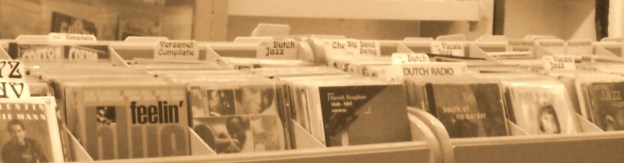
Getting to know Amsterdam’s record stores has been an ongoing adventure, and a most pleasurable one. I’m mostly talking about independent record stores, with their special charm and character, like the fictional Championship Vinyl in Nick Hornby’s High Fidelity.
Inside ‘Concerto’, one of Amsterdam’s oldest record stores
Fortunately, such stores are still amongst us, and record hunting around there as well as the city’s flea markets has been a favorite pastime ever since I got my record player (if you want to know more about the unique world of Amsterdam’s record stores, check out my survey about the top vinyl spots in town).
The unique culture of indie record stores is celebrated through Record Store Day. Originally conceived in 2007, it is now celebrated the third Saturday every April (it was officially kicked off by Metallica at Rasputin Music in San Francisco on April 19, 2008).
On Record Store Day (April 20 this year) the participating independently-owned record stores organize various events and festivities, while special vinyl/CD releases and live performances from hundreds of artists also take place (you can check here to see if there is a participating store near you).
In the words of Sir Paul McCartney: “There’s nothing as glamorous to me as a record store. When I recently played Amoeba in LA, I realized what fantastic memories such a collection of music brings back when you see it all in one place. I hope that these kinds of stores will be there for us all for many years to come.”
It is simply impossible to overstress the enormous influence of Cuban music and its contribution to the development of various genres around the world, from jazz and salsa to the Argentine tango and the Spanish nuevo flamenco.
Known for its extensive blending of diverse styles and rhythms, Cuban music was in return also influenced by popular US music, as in the case of filín, a Cuban fashion of the 1940s and 1950s. Although Cuban jazz had also started in Havana around 1910-1930 it was not until the 1940s that the big band era arrived, owing much to great bandleaders like Armando Romeu Jr. and Damaso Perez Prado.
It was in the 1950s that Benny Moré, widely regarded as the greatest Cuban singer of all time, reached his heyday with his orchestra Banda Gigante (Big Band). Playing at the dance halls La Tropical and El Sierra in Havana, Moré and the group enjoyed immense popularity and went on to tour Venezuela, Jamaica, Haiti, Colombia, Panama, Mexico and the United States, where they performed at the Oscars.
The aftermath of the Cuban Revolution in 1959 saw the closing down of several night clubs and venues for popular music. As a result, many musicians were left without employment and emigrated to Puerto Rico, Florida and New York. Meanwhile in Cuba, artistic activity came increasingly under the control of the socialist regime, and with the movement of nueva trova music started to acquired a more political edge, combining traditional folk elements with often politicized lyrics.
A breakthrough for many legendary local musicians whose performing careers had come to a halt after the rise of Fidel Castro was the release of Buena Vista Social Club (1997). The album was the project of American guitarist and producer Ry Cooder, who visited Havana in 1996 to seek out and record these performers. Wim Wenders also captured the sessions on film, together with sell-out live performances of the group in Amsterdam and New York.
Following the album’s astonishing commercial and critical success, a number of its key performers (including singer Ibrahim Ferrer, guitarist/singer Compay Segundo, pianist Rubén González and trumpeter Manuel “Guajiro” Mirabal) set out to record solo albums, despite of their advanced age (all of them had been active in the Cuban music scene since the 1940s-50s).
Fifteen years after the release of Buena Vista Social Club, its reverberations arestill felt quite strongly. As a result of its international success, younger audiences across the globe have had the chance to watch and listen live to these extraordinary musicians, while getting to know some of the younger talents of the contemporary Cuban music scene.
The Havana Lounge live in Paradiso, Amsterdam (15/02/2013)
It appears, then, that Ry Cooder’s fateful visit to Havana in 1996 managed indeed to rekindle the interest in Cuban tradition, opening a large window for international audiences with a vista to the horizon of Cuban music. A music so rich in its warmth, expression and feeling that surely makes for a most enjoyable view.
Written in 1937 by Richard Rodgers and Lorenz Hart, My Funny Valentine would go on to become a popular jazz standard, appearing on more than 1300(!) albums in total and performed by such great artists as Frank Sinatra, Ella Fitzgerald and Miles Davis.
One of its earliest and most memorable recordings was by the Gerry Mulligan Quartet in 1952, which featured a captivating solo by Chet Baker. It was a major hit, and became a tune closely associated with Baker until the end of his turbulent life.
Plaque in memory of Chet Baker outside Hotel Prins Hendrik in Amsterdam (photo by Jeroen Coert)
A life that came to an abrupt end on on May 13, 1988, when the American trumpeter, flugelhornist and vocalist was found dead on Prins Hendrikkade, the street below his room at Hotel Prins Hendrik in Amsterdam (nearby the city’s Central Station). An autopsy found heroin and cocaine in his body and these drugs were also found in his hotel room. His death was ruled an accident.
I also happened to live on Prins Hendrikkade for one year when I first came to study in the Dutch capital, oblivious of the grim connection between the street and Baker’s death. Ever since I found out about it, memories of my student days mingle with Baker’s melodies as I pass by the area around Hotel Prins Hendrik.

 On Record Store Day (April 20 this year) the participating independently-owned record stores organize various events and festivities, while special vinyl/CD releases and live performances from hundreds of artists also take place (you can check


 The Muser