The new EP by JoalzHello Darkness My Friend is exactly what its name suggests: An intriguing invitation to explore dark, otherworldly soundscapes.
Sharing their time between Greece and Germany, Joalz decribe their music as “a weird kind of obscure indietronica.” Recorded in Berlin and Athens between March 2011 – June 2012, Hello Darkness My Friend is influenced by the sound of early Krautrock, psychedelia and progressive rock (think of Amon Düül, Can or Aphrodite’s Child).
Each song has a completely unique atmosphere; the opening track ‘Oh darling Margaret’ is haunted by the sound of the theremin, whereas in ‘Outspoken you are’ Mary Tsoni’s powerful reciting soars against a dazzling sonic background (the song’s B&W video was shot in Manhattan’s Chinatown).
I found particularly interesting the band’s rendition of ‘Alligator Wine’ (originally recorded by Screamin’ Jay Hawkins in 1958), where Tsoni’s theatrical performance and the fuzzy guitars blend into a peculiar kind of post-apocalyptic blues with dark overtones.
Next to a remarkable new wave of Greek artists, Joalz with their Hello Darkness My Friend offer yet another example of how creativity and experimentation can spring up amidst such grim times for Greek society.
“You’re never really done for, as long as you got a good story and someone to tell it too.”
(Max Tooney in The Legend of 1900)
In his theater monologue Novecento, Italian writer Alessandro Baricco gives a fascinating account of the life and times of Danny Boodman T. D. Lemon 1900, a fictional piano wunderkind born on the ocean liner Virginian who was destined never to set foot on land.
Baricco’s relationship with music is intimate (he has published a book on Gioachino Rossini and worked as a music critic for La Repubblica) and his Novecento is a joy to read. I particularly enjoyed his reflections on the nature and limitless possibilities of music making:
“We were playing because the Ocean is vast and scares you, we were playing so that people could forget the passing of time, forget where they were and who they were. We were playing so as to make people dance, because if you dance you feel like God and cannot die. And we were playing ragtime, because that’s the music God dances along when nobody watches.”
“So think now: a piano. Its keys start somewhere. And end somewhere. You know they are eighty-eight, nobody can tell you otherwise. They are not infinite. You are infinite, and so is the music you can make on these keys.”
Baricco’s story was made into a film in 1998 calledThe Legend of 1900, starring Tim Roth and directed by Giuseppe Tornatore. The film’s magnificent soundtrack is composed almost entirely by Ennio Morricone and it contains some truly captivating piano music. Alongside the Italian maestro, Roger Waters also contributed to the film’s soundtrack by performing and writing the lyrics for the piece Lost Boys Calling.
In the story’s heartbreaking finale, leaving the Virginian and facing the immensity of real life proves too overwhelming for the legendary pianist. Still, his unique music lives on, if only in the memories of all those who were once blessed to be among his audience.
These last few days, after reading the news about Storm Thorgerson’s passing away (the man responsible for several iconic record sleeves), I have been pondering on the very special relationship between music and cover art.
Aesthetically speaking, I have always regarded the artwork of an album at least as important as the music it contains. Great album covers often attracted my attention and curiosity while I would browse through records in some store, resulting in my acquaintance with many exciting and undiscovered soundscapes.
In fact, the cover’s artwork has often been my very first impression of a music album. It was through their intriguing, mystifying covers that I was first introduced to many classic records such as Houses of the Holy, Wish You Were Here or Dark Side of the Moon, all designed by Storm Thorgerson.
Another work by Thorgerson I have always admired is his cover design for Pink Floyd’s A Momentary Lapse of Reason. The cover shows 800 hospital beds, arranged in a river-like form on a beachfront location (which is Saunton Sands in Devonshire, UK). The image took about two weeks to create and won the photographer Robert Dowling a gold award at the Association of Photographers Awards.
The association between sound and image can be crucial for an album’s thematic coherence, conceptual effect and aesthetic value. It is hard to imagine someone listening to The Wall, Sticky Fingers or The Velvet Underground & Nico without simultaneously thinking of their accompanying cover art.
Some of the best album covers, as in Thorgerson’s work, have their origins in progressive rock. One of my all-time favorites is the artwork for King Crimson’s In the Court of the Crimson King, which so powerfully captures the atmosphere of impending paroxysm and paranoia described in the album’s opening track 21st Century Schizoid Man (Barry Godber, who painted the album cover, died in 1970 of a heart attack shortly after the album’s release).
King Crimson, ‘In the Court of the Crimson King’ (1969)
Another artist I have always admired is Roger Dean, whose designs have been on album covers by bands such as Babe Ruth, Budgie, Uriah Heep and Gentle Giant.
Gentle Giant, ‘Octopus’ (1972)
A truly imaginative and original artist, Dean is most well known for the amazing fantasy landscapes he has produced for the progressive rock bands Asia and Yes.
Yes, ‘Tales from Topographic Oceans’ (1974)
Examples like the collaboration between Pink Floyd and Storm Thorgerson or Yes and Roger Dean illustrate how cover art can play an integral part in shaping a band’s identity. Masterful works of art in their own right, albums covers can both complement and enhance a band’s artistic image.
This art form, however, has been traditionally associated with vinyl, where the cover design has the necessary breathing space in order to create the desired aesthetic effect. In the era of digital music and massive downloading, it is doubtful whether cover art for music albums will continue to have the same prominence and importance. I, for one, sincerely hope it will.
Although I grew up in a house with a fair number of vinyl records lying around, I belong to the compact disc generation. The first music album I ever bought was in CD format, and so were the countless others that followed over the years. That is, until fairly recently, when I finally got around to buying my own record player.
I only started getting seriously involved with vinyl around 2008, after already having moved to rainy Amsterdam from my sunny hometown, Athens. It was not the change of climate, however, that did the trick. It was the city’s amazing vinyl market and the enchanting, vintage black discs with the cool artwork that kept catching my eye even though going back to vinyl in our digital age seemed to be a clearly retrogressive move, like reverting to agriculture from industrialization (which actually doesn’t sound that bad I have to confess).
Getting to know Amsterdam’s record stores has been an ongoing adventure, and a most pleasurable one. I’m mostly talking about independent record stores, with their special charm and character, like the fictional Championship Vinyl in Nick Hornby’s High Fidelity.
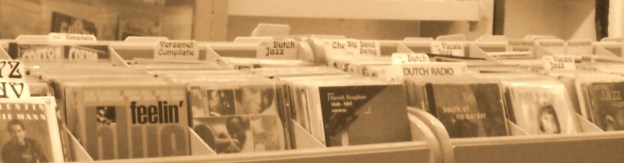
Inside ‘Concerto’, one of Amsterdam’s oldest record stores
Fortunately, such stores are still amongst us, and record hunting around there as well as the city’s flea markets has been a favorite pastime ever since I got my record player (if you want to know more about the unique world of Amsterdam’s record stores, check out my survey about the top vinyl spots in town).
The unique culture of indie record stores is celebrated through Record Store Day. Originally conceived in 2007, it is now celebrated the third Saturday every April (it was officially kicked off by Metallica at Rasputin Music in San Francisco on April 19, 2008).
On Record Store Day (April 20 this year) the participating independently-owned record stores organize various events and festivities, while special vinyl/CD releases and live performances from hundreds of artists also take place (you can check here to see if there is a participating store near you).
In the words of Sir Paul McCartney: “There’s nothing as glamorous to me as a record store. When I recently played Amoeba in LA, I realized what fantastic memories such a collection of music brings back when you see it all in one place. I hope that these kinds of stores will be there for us all for many years to come.”
In case you are already familiar with Nick Hornby’s work, High Fidelity (published in 1995) needs no further introduction. A brilliantly entertaining and yet remarkably insightful take on life, relationships and pop music, it remains a classic of its genre. In 2000 it was also made into a film starring John Cusack as the audiophile Rob Gordon. Rob (whose last name in the book is actually Fleming) is the novel’s main character and a music geek who takes pleasure in coming up with top 5 lists of ex-girlfriends, records, films, artists and pretty much everything else.
A big plus to Hornby’s novel are the many musical tips scattered across the text. A whole playlist full of soulful and funky tunes that can still be enjoyed long after the reading is over, and which also served as a basis for the film’s groovy soundtrack.
So here are my all-time, top five most memorable musical references in High Fidelity in chronological order:
Followed by my top five, most memorable quotes from Hornby’s book in order of appearance:
1) “What came first, the music or the misery? Did I listen to music because I was miserable? Or was I miserable because I listened to music? Do all those records turn you into a melancholy person?”
2) “I reorganize my record collection; I often do this at periods of emotional stress. When I’ve finished I’m flushed with s sense of self, because this, after all, is who I am.”
3) “To me, making a tape is like writing a letter – there’s a lot of erasing and rethinking and starting again. A good compilation tape, like breaking up, is hard to do.”
4) “You know the worst thing about being rejected? The lack of control. If I could only control the when and how of being dumped by somebody, then it wouldn’t seem as bad. But then, of course, it wouldn’t be rejection, would it? It would be by mutual consent. It would be musical differences. It would be leaving to pursue a solo career.”
5) “How can you like Art Garfunkel and Solomon Burke? It’s like saying you support the Israelis and the Palestinians.”



 On Record Store Day (April 20 this year) the participating independently-owned record stores organize various events and festivities, while special vinyl/CD releases and live performances from hundreds of artists also take place (you can check
 A big plus to Hornby’s novel are the many musical tips scattered across the text. A whole playlist full of soulful and funky tunes that can still be enjoyed long after the reading is over, and which also served as a basis for the
 The Muser