
Tag Archives: jazz

Vivaldi, jazz and the Greek summer

It is common to associate certain songs, albums or artists with the occasion and the place where we first listened to them. This is especially true when the first hearing is linked to a place of exceptional beauty, which stays forever intertwined with the tune/artist in question.

I have such a memory from some distant summer holidays in the small island of Elafonisos, just off the Southern coast of Peloponnese in Greece. Known for its sandy beaches and blue-green waters, Elafonisos is an ideal place to wind down and tune in your body and soul with the beautiful, serene scenery.
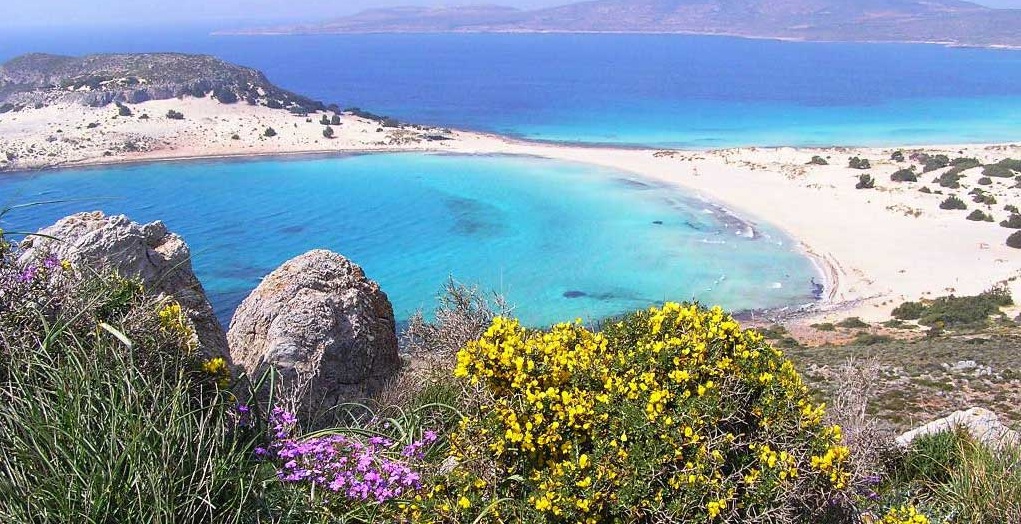
Elafonisos, Greece

Every day we would walk up to a small beach bar for a snack, casual talk and enjoy the splendid surroundings. To top it all off, there was almost always some intriguing music coming from the bar’s speakers that seemed to blend perfectly with the surrounding space.

One time, while I was enjoying the most delicious karydópita (pecan pie) with fresh vanilla ice cream I have ever tasted, I decided to walk up and ask the bartender/cook/DJ what was the tune we were listening to.

I could tell it was some sort of jazz adaptation of Vivaldi, but I had never heard something like it before. He wrote down the name of the artist on a piece of paper and handed over to me (back then there was no mobile phones, let alone Wi-Fi). The note read Jacques Loussier”.

That’s how I was introduced to the wonderful world of the Jacques Loussier Trio and their magnificent renditions of classical music (from Bach and Vivaldi to Chopin and Debussy).

To this day, when I listen to Vivaldi’s ‘Four Seasons’ played by Loussier’s jazzy piano trio, my mind flies instantly toward the Greek summer – the most beautiful season of all.
How a -great- record taught me an important life lesson

I first listened to it some years ago, not exactly sure when or where anymore. But I fell in love with it instantly, from the first hearing. I knew immediately that this was a record I could listen to again and again, without ever getting tired of it.

And so it happened. To this day, Keith Jarrett’s The Köln Concert remains one my favorite albums; not just as far as jazz is concerned, but from any music genre.  What I didn’t know until recently is the fascinating story behind the making of this remarkable record.

Jarrett had originally requested a Bösendorfer 290 Imperial concert grand piano for his performance at Cologne’s Opera House. However, when he arrived at the venue (tired from not sleeping well in several nights and in pain from back problems), he was in for a surprise: due to some confusion by the opera house staff a different, much smaller baby grand piano was waiting for him instead.

Although the instrument was in quite poor condition (thin in the upper registers, weak in the bass register, the pedals not working properly), Jarrett eventually decided to go on with the concert. And in spite -or rather, because- of the adverse circumstances, he delivered an inspiring performance that later went on to become the best selling piano album of all times.

Köln was different because there was just so many negative things in a row”

Keith Jarrett

As producer Manfred Eicher, who recorded the performance, has commented on Jarrett’s magnificent playing: “Probably he played it the way it sounds now because it was not a good piano. Because he could not fall in love with the instrument, he found another way to get the most out of it.”

I think the way Jarrett managed to create something so beautiful under such unlikely circumstances can be seen as a valuable lesson – not just for pianists, jazz musicians or improvisers but for all of us. No matter how hard or unfavorable the conditions, one can always manage to make the best out of a situation. And, furthermore, even excel exactly because of the obstacles presented to him or her.

Something to ponder on next time you happen to listen to Jarrett’s inspired and seemingly effortless improvisation…

Singing it like it is

Meet Lara Eidi and the band

Lara Eidi is a singer-songwriter of Lebanese-Canadian-Greek background. She first got involved with music the moment she “learned how to mimic” through trying to sing and recreate any sound she happened to hear. She started with classical piano at the age of 8 and also had harmony and theory lessons at the conservatory. Next to her piano and singing skills she is also an accomplished guitar player and the founder of Lara Eidi Band, a small jazz-folk-pop trio comprised of Lara, Stavros Parginos (cello, loops) and  Giotis Paraskevaidis (guitars, loops, beatboxing).

Tell it like it is

The band just released their second EP  Tell it like it is to an amazing crowd at Athen’s Numismatic Museum, and it seems like the musical adventures of the promising trio are only beginning to unfold.

So how did Lara Eidi Band come about? Here’s the story in Lara’s own words:

It came at a point when I was close to packing it all in, music wise, after being disheartened by how little one could accomplish in the music scene in Greece. I had just returned to Greece from Scotland naively thinking I could achieve something. So after being a session singer, piano player and songwriter for a multitude of bands I retreated from the music scene thinking: ‘What can I do to change this course I’ve chosen?’ And then it hit me: 2 years ago I stayed at a friend’s house in Athens, locked inside a beautiful musical basement, writing tons of songs and feeling like a kid discovering toys for the first time. After that I called Stavros Parginos, a wonderful cellist and multi-instrumentalist who I had worked with before, and asked him if he would like to work on some of my songs with his cello. He said yes with a smile. So a year ago we started gigging around Athens, traveled abroad to Beirut, Lebanon, and Edinburgh , and recorded my first EP, “Little People” (Irida Studios). Then we met the third member of our band, guitarist Giotis Paraskevaidis. I heard him play at a gig, not knowing who he was, and approached him to ask if he would like to play my music. He was super positive about it – and also turned out to be a very good friend of Stavros! All of a sudden the music was reborn with this incredible energy. After doing a few cover songs on YouTube (incl. Nina Simone’s Be my Husband, filmed on a rooftop in Athens by videographer Dimitris Stamatiou and our sound guy Iraklis Vlachakis), we were eventually inspired to create “Tell it like it is” (Sierra Studios, In a Jam Studios) which is about just that: My personal way of saying that the music I write, and the way it’s developed together with the guys, doesn’t really fit into an roster and that’s OK. And so we found ourselves going from a singer-songwriter to a band formation. I told the guys I wanted to call the band LSG (laughs) but they insisted on Lara Eidi Band!

A beautiful challenge

Music for Lara is a “life force”, a kind of challenge that “needs to be embraced in its fullest and most beautiful forms”. And it seems she is indeed taking up the challenge – Lara will be going to London to follow a Masters in Jazz Voice Performance at the Guildhall School of Music, while at the same time keep performing with her band in both UK and Greece.

And what if Lara’s record collection was on fire? Here’s what she would save first:

I would save my Woodstock Full Two Volumes CD. I have to zone out to this more times than I care to mention! I’m a girl. I also have to save Sheryl Crow, Sarah Ann McLachlan and Alanis Morissette .

You can find Lara Eidi Band on:

FacebookSpotify SoundCloudReverbNation

Memories of Valentine

https://www.youtube.com/watch?feature=player_embedded&v=jvXywhJpOKs

Written in 1937 by Richard Rodgers and Lorenz Hart, My Funny Valentine would go on to become a popular jazz standard, appearing on more than 1300(!) albums in total and performed by such great artists as Frank Sinatra, Ella Fitzgerald and Miles Davis.

One of its earliest and most memorable recordings was by the Gerry Mulligan Quartet in 1952, which featured a captivating solo by Chet Baker. It was a major hit, and became a tune closely associated with Baker until the end of his turbulent life.

Plaque in memory of Chet Baker outside Hotel Prins Hendrik in Amsterdam (photo by Jeroen Coert)

A life that came to an abrupt end on on May 13, 1988, when the American trumpeter, flugelhornist and vocalist was found dead on Prins Hendrikkade, the street below his room at Hotel Prins Hendrik in Amsterdam (nearby the city’s Central Station).  An autopsy found heroin and cocaine in his body and these drugs were also found in his hotel room. His death was ruled an accident.

I also happened to live on Prins Hendrikkade for one year when I first came to study in the Dutch capital, oblivious of the grim connection between the street and Baker’s death. Ever since I found out about it, memories of my student days mingle with Baker’s melodies as I pass by the area around Hotel Prins Hendrik.