It is common to associate certain songs, albums or artists with the occasion and the place where we first listened to them. This is especially true when the first hearing is linked to a place of exceptional beauty, which stays forever intertwined with the tune/artist in question.
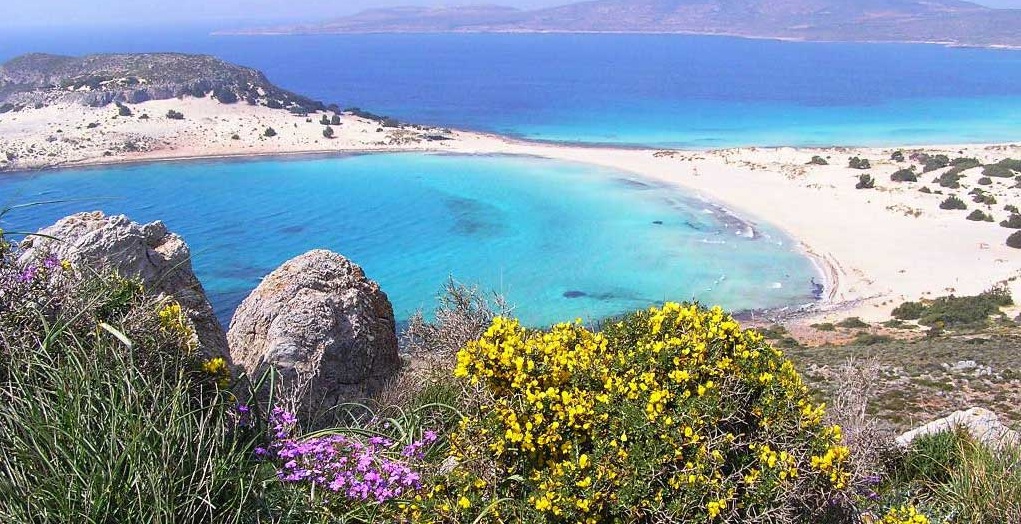
I have such a memory from some distant summer holidays in the small island of Elafonisos, just off the Southern coast of Peloponnese in Greece. Known for its sandy beaches and blue-green waters, Elafonisos is an ideal place to wind down and tune in your body and soul with the beautiful, serene scenery.
Elafonisos, Greece
Every day we would walk up to a small beach bar for a snack, casual talk and enjoy the splendid surroundings. To top it all off, there was almost always some intriguing music coming from the bar’s speakers that seemed to blend perfectly with the surrounding space.
One time, while I was enjoying the most delicious karydópita (pecan pie) with fresh vanilla ice cream I have ever tasted, I decided to walk up and ask the bartender/cook/DJ what was the tune we were listening to.
I could tell it was some sort of jazz adaptation of Vivaldi, but I had never heard something like it before. He wrote down the name of the artist on a piece of paper and handed over to me (back then there was no mobile phones, let alone Wi-Fi). The note read “Jacques Loussier”.
That’s how I was introduced to the wonderful world of the Jacques Loussier Trio and their magnificent renditions of classical music (from Bach and Vivaldi to Chopin and Debussy).
To this day, when I listen to Vivaldi’s ‘Four Seasons’ played by Loussier’s jazzy piano trio, my mind flies instantly toward the Greek summer – the most beautiful season of all.
It was one of those gigs where everything sounded just right. Already from the opening act, the -crowded- main hall of Amsterdam’s Paradiso was filled with music of both otherworldly beauty and great intensity.
The dynamic duo Xylouris White (consisting of Cretan lute player and singer Giorgos Xylouris and Australian drummer Jim White) set the tone for the rest of the evening. An exemplary blend where tradition meets innovative forms and improvisational mood, the duo’s musical explorations took the audience on a journey from the Greek island of Crete all the way to Australia and New York.
This slideshow requires JavaScript.
A real master of his instrument, Giorgos Xylouris comes from a celebrated musical family (his father is the Cretan singer and lyra player Psarantonis, and his late uncle was the legendary singer Nikos Xylouris). His virtuosity combined with White’s exceptional skill in complementing and conversing with his partner’s playing resulted in a technically demanding performance delivered with passion and rigor.
Following Xylouris White, the Canadian post-rock band Godspeed You! Black Emperor took the stage to perform songs from their latest album Asunder, Sweet and Other Distress. Using film loop projections to accompany their performance (as is customary in their live shows), the band created a unique atmosphere and went on to give a truly memorable show.
As is often the case when post-rock is at its best (think of Moqwai or Sigur Rós), the music of Godspeed You! Black Emperor invites the listener to partake both mentally and physically in the live experience. This is made possible by the wide range of dynamics and extensive build-ups that create the necessary space for this kind of engagement, leading to powerful peaks and climaxes.
It is perhaps this quality of total absorption that lies in the heart of this music’s beauty and mystery – leading to a sense of deep satisfaction for both mind and ears.
Born in 1959, Thanasis Papakonstantinou slowly emerged in the Greek music scene around the early 1990s. Influenced by folk and world music, he progressively developed his own style incorporating jazz, rock and electronic elements. This fusion has led to the creation of a unique and highly distinctive sound, establishing him as one of today’s most original Greek songwriters.
The prophet’s (hoarse) voice
The release of the album Vrachnos Profitis (‘Hoarse Prophet’) in 2000 was a turning point for Papakonstantinou’s career as a songwriter. Throughout the following years he turned increasingly experimental with regards to the production and orchestration of his records. Meanwhile, collaborating with major Greek musicians and singers has enabled him to enrich his sound and complement his own hoarse voice and limited vocal range.
His efforts have yielded some truly remarkable results, as testified by the aesthetic and artistic merits of albums like Agrypnia (‘Vigil’, 2002), O elachistos eaftos (‘The Minimal Self’, 2011), or his latest release Prosklisi se Deipno Kianiou (‘Invitation to Cyanide Dinner’, 2014).
Vigil in Amsterdam
Next to his low profile, modest media presence, and unpretentious nature, Thanasis is characterized by his relaxed stage presence and direct communication with his audience during his live performances.
This was also the case during his recent gig at Amsterdam’s Paradiso, which went on to last for more than 2 hours after an atmospheric opening with the highly evocative Agrypnia.
Shortly after the gig was over, Thanasis came down from the stage and performed a song by Greek composer Markos Vamvakaris (known as the “patriarch of the rebetiko”) to a small group of people that gathered around him to listen.
It was an intimate closing to a long evening full of enthusiasm, emotion and great music.
In many cultures lamentation has found expression in art, and is often associated with song. There are instances, however, where the grief is unleashed by means of music alone and the haunting presence of human voice is replaced by musical instruments that assume the role of mourners.
The violin’s lament
The region of Epirus, in the northwest of Greece, is renowned for its long musical tradition associated with skilled local musicians and various distinctive (mostly pentatonic and polyphonic) folk songs. Among these, lament songs (mirolóyia) occupy a prominent place, having been sung for centuries beside grave sites and during mourning rituals.
One such lament from Epirus (“Epirotiko Mirologi”) was recorded on September 20, 1926 by Greek violinist Alexis Zoumbas, who was born in the hinterlands of Epirus in 1883 and immigrated to New York City in 1910. In this highly emotive recording, one can feel through Zoumbas’s emotionally charged playing an intense grief, no doubt sparked by the deep yearning for his home soil.
Moreover, from a musical standpoint, it is interesting to trace the direct influence of such instrumental treatments on subsequent non-folk Greek music, as in the case of Socrates and their popular song Mountains.
The clarinet’s mourning
In neighboring Turkey, the song “Yemen Türküsü” mourns the death of Turkish soldiers in Yemen during the First World War. The well known folk song can be found in several different versions, and it has been also performed by Taksim Trio, a band of accomplished instrumentalists (Hüsnü Şenlendirici – clarinet, Aytaç Doğan – qanun, İsmail Tunçbilek – baglama) that has been part of Istanbul’s diverse and vibrant music scene.
The guitar’s outcry
One of the oldest and most despondent forms of flamenco music, siguiriyas is characterized by its profound, expressive style and tragic nature. When sung, thelyrics reflectthe sufferingof human relationships, love and death; however, it is also encountered as an instrumental piece with great potential for emotional outlet in the hands of the capable and sensitive artist – as in this performance by flamenco composer and guitarist Manolo Sanlúcar.
Lara Eidi is a singer-songwriter of Lebanese-Canadian-Greek background. She first got involved with music the moment she “learned how to mimic” through trying to sing and recreate any sound she happened to hear. She started with classical piano at the age of 8 and also had harmony and theory lessons at the conservatory. Next to her piano and singing skills she is also an accomplished guitar player and the founder of Lara Eidi Band, a small jazz-folk-pop trio comprised of Lara, Stavros Parginos (cello, loops) and Giotis Paraskevaidis (guitars, loops, beatboxing).
Tell it like it is
The band just released their second EP Tell it like it is to an amazing crowd at Athen’s Numismatic Museum, and it seems like the musical adventures of the promising trio are only beginning to unfold.
So how did Lara Eidi Band come about? Here’s the story in Lara’s own words:
It came at a point when I was close to packing it all in, music wise, after being disheartened by how little one could accomplish in the music scene in Greece. I had just returned to Greece from Scotland naively thinking I could achieve something. So after being a session singer, piano player and songwriter for a multitude of bands I retreated from the music scene thinking: ‘What can I do to change this course I’ve chosen?’ And then it hit me: 2 years ago I stayed at a friend’s house in Athens, locked inside a beautiful musical basement, writing tons of songs and feeling like a kid discovering toys for the first time. After that I called Stavros Parginos, a wonderful cellist and multi-instrumentalist who I had worked with before, and asked him if he would like to work on some of my songs with his cello. He said yes with a smile. So a year ago we started gigging around Athens, traveled abroad to Beirut, Lebanon, and Edinburgh , and recorded my first EP, “Little People” (Irida Studios). Then we met the third member of our band, guitarist Giotis Paraskevaidis. I heard him play at a gig, not knowing who he was, and approached him to ask if he would like to play my music. He was super positive about it – and also turned out to be a very good friend of Stavros! All of a sudden the music was reborn with this incredible energy. After doing a few cover songs on YouTube (incl. Nina Simone’s Be my Husband, filmed on a rooftop in Athens by videographer Dimitris Stamatiou and our sound guy Iraklis Vlachakis), we were eventually inspired to create “Tell it like it is” (Sierra Studios, In a Jam Studios) which is about just that: My personal way of saying that the music I write, and the way it’s developed together with the guys, doesn’t really fit into an roster and that’s OK. And so we found ourselves going from a singer-songwriter to a band formation. I told the guys I wanted to call the band LSG (laughs) but they insisted on Lara Eidi Band!
A beautiful challenge
Music for Lara is a “life force”, a kind of challenge that “needs to be embraced in its fullest and most beautiful forms”. And it seems she is indeed taking up the challenge – Lara will be going to London to follow a Masters in Jazz Voice Performance at the Guildhall School of Music, while at the same time keep performing with her band in both UK and Greece.
And what if Lara’s record collection was on fire? Here’s what she would save first:
I would save my Woodstock Full Two Volumes CD. I have to zone out to this more times than I care to mention! I’m a girl. I also have to save Sheryl Crow, Sarah Ann McLachlan and Alanis Morissette .

 Elafonisos, Greece


 The Muser