It was a year and a half ago at the London Jazz Festival when I got to see Francisco Sánchez Gomes (better known as Paco de Lucía) play live. It was to be the first and last time I would ever watch him perform, an experience I will always carry with me for the years to come.
Paco de Lucía performing in London (16/11/2012)
There are many things I would like to write about Paco. How he mastered his art from a very young age, expanded the vocabulary of flamenco, experimented with many genres and styles introducing various ‘foreign’ elements into his playing, while acting as an ambassador for flamenco music worldwide and becoming one of the greatest musicians the world has known in recent history.
But perhaps it’s better to let the music speak for itself. Below is a small selection of highlights from Paco’s long and extraordinary career that follow his development as a musician and demonstrate his endless curiosity and constant struggle for perfection and artistic excellence.
Tico-Tico no Fubá is a renowned Brazilian choro music piece (“Tico-Tico” is the name of a bird, the rufous-collared sparrow) which Paco performed in the 1960s.
An intimate performance of a rumba flamenca (a style of Spanish flamenco music derived from the Afro-Cuban rumba) which became immensely popular both in Spain and internationally after the release of Paco’s album Fuente y caudal (1973).
Paco improvising on a famous theme by Georges Bizet in the film Carmen (1983) by Spanish director Carlos Saura.
Paco’s performance of Joaquín Rodrigo’s famous Concierto de Aranjuez was a remarkable achievement (it was released as an album in 1991), showcasing his brilliant technique and ability to infuse a unique flamenco feel in this staple of classical guitar repertoire.
While ever expanding his musical horizons, Paco met and collaborated with numerous great artists including celebrated jazz guitarists Al Di Meola and John McLaughlin with whom he recorded the acclaimed album Friday Night in San Francisco (1981). Thirty years later, Paco would meet Meola again in Germany for an astonishing performance of Mediterranean Sundance.
Hungarian composer Franz Liszt (1811 – 1886) was a key figure in the development of Western music. Mostly remembered today for his legendary virtuosity and his notoriously challenging piano pieces, he was also a prolific composer, a teacher and a conductor with profound influence on subsequent composers such as Hector Berlioz, Edvard Grieg and Richard Wagner (who also married Liszt’s daughter Cosima).
Perhaps one of his lesser-known works is his Missa Solemnis “Graner Mass”, composed for the occasion of the confirmation ceremony of the then still incomplete Basilica of Ezstergom (home to the Hungarian Archbishop in the Diocese of Gran) on August 31, 1856.
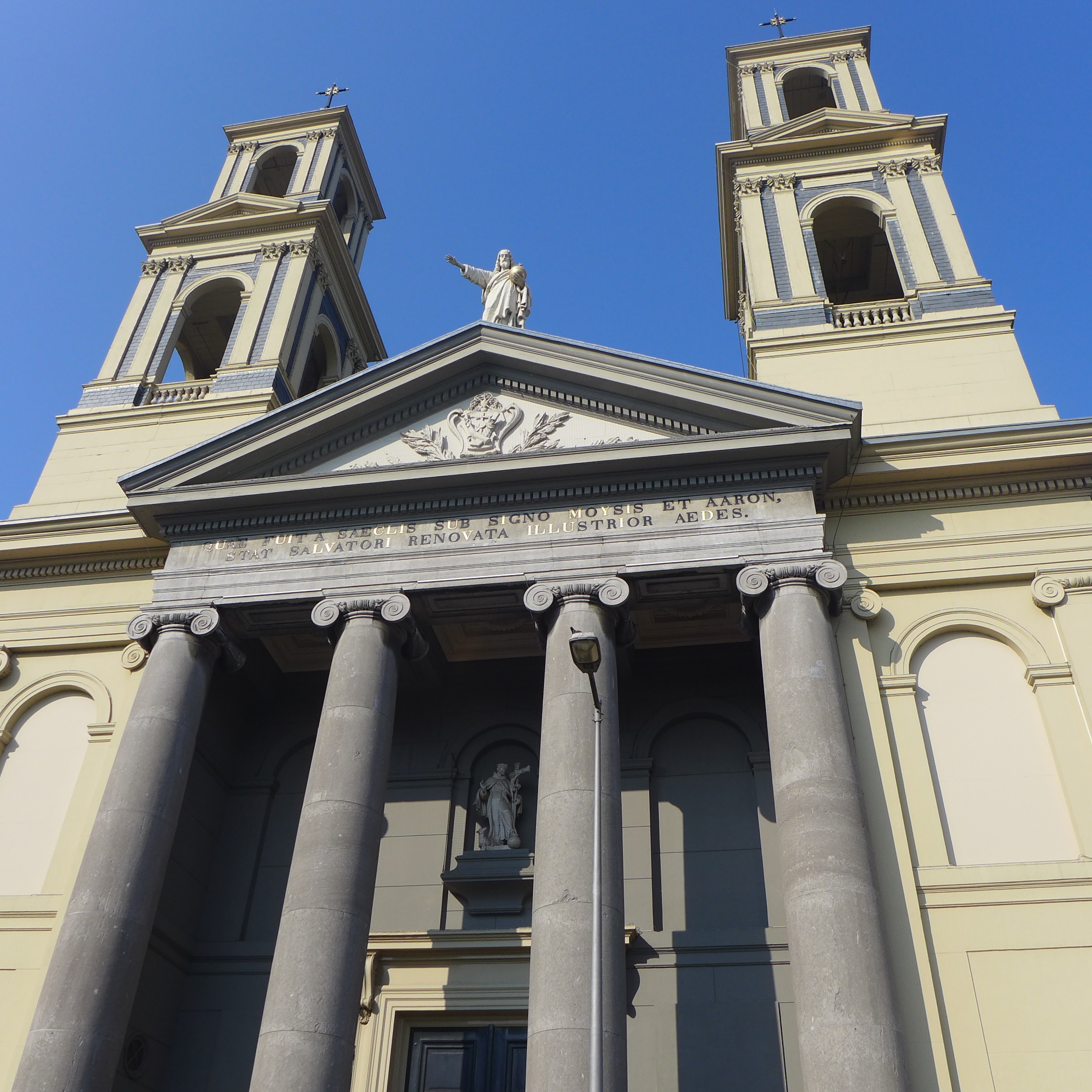
I was completely unaware of Liszt’s sacred choral music until I bumped into a relief on the wall of the Mozes en Aaronkerk church in Amsterdam some days ago. From its inscription I was informed that Franz Liszt attended a performance of his “Graner Mass” inside that very temple on April 29, 1866.
Mozes en Aaronkerk (Waterlooplein, Amsterdam)
It was a pleasant surprise, and one that led me to discover Liszt’s obscure Missa Solemnis. I had been in Waterlooplein countless times in the past to check the excellent outdoor flea market and browse through the various clothes, antiques or records, but had never paid attention to that small relief on the church wall right on the edge of the square. It always feels nice, and sometimes extremely rewarding, to be a tourist in your own city.
Socrates Drank the Conium were undoubtedly the most important exponents of the Greek rock scene throughout the 1970s and up to the early 1980s. Their name has attained a somewhat legendary status and commands considerable respect among Greek rock fans and critics up to this day.
Although the name ‘Socrates Drank the Conium’ first appeared in 1969, the story of the band goes back to the time when fellow high-school students Antonis Tourkogiorgis and Yiannis Spathas formed The Persons. The impeccable synchronization and exemplary blending of Spathas’s guitar playing with Tourkogiorgis’s distinctive use of bass was evident from early on, as was the potential for the remarkable compositions that were about to emerge.
Socrates Drank the Conium (1972)
After releasing three singles and making several live appearances as Persons, they changed their name to Socrates Drank the Conium(or simply Socrates, as friends and fans would end up calling them) and made their recording debut (Socrates Drank the Conium, 1972) as a trio, with Elias Boukouvalas behind the drums. The album is characterized by an explosive mix of blues, heavy rock and psychedelic elements much akin to the sound of bands like The Jimi Hendrix Experience and Cream. Apart from such obvious influences, other artists that had a significant impact on Socrates included Ten Years After, Fleetwood Mac, John Mayal, Free and Led Zeppelin. Despite the rather poor production and the unhelpful recording conditions, which also concern their next album (Taste of Conium, 1972), Socrates’ powerful message got through and resulted in a warm reception from both Greek public and press of the time.
The band’s biggest asset was undeniably the astonishing technique of guitarist John Spathas whose virtuosity and musicality produced results of exceptional power and expressiveness when combined with the band’s rock-solid rhythm session. In addition, the frequent incorporation of traditional Greek elements in Spathas’s guitar passages and solos would also become one of the band’s trademarks and most significant innovations.
The introduction of Live in the Country – the very first song in Socrates’ recording career – is a brilliant demonstration of Spathas’s skillful guitar playing and highly idiomatic musical language, which arises from a combination of a Hendrix-like sound and elements of Greek folk music.
By the time their third album (On the Wings, 1973) hit the shelves, Socrates had already attained a preeminent place amongst contemporary Greek bands. Having played at most of the major venues in Greece but also elsewhere in Europe (including club Paradiso in Amsterdam), Socrates became known for the forcefulness and electrifying atmosphere of their live performances.
The creative course of Socrates culminated in the mid-1970s, when their collaboration with keyboardist and composer Vangelis Papathanassiou (who had also been a member of Aphrodite’s Child) led to the release of Phos (1976). Vangelis’s touch gave the band a more lyrical and elegiac sound that is clearly distinguishable throughout the album. Recorded in London, Phos (“light” in Greek) stands out as the crowning achievement of not just the band, but the entire Greek progressive rock scene of the era.
The album contains pieces of profound beauty such as Queen of the Universe,as well as a popular rendition of Starvation, which had appeared on the band’s debut album. The indisputable highlight, however, is Mountains (which would be re-recorded again in 1980), where Spathas embarks on an improvisatory trip of monumental scale, showcasing his exceptional guitar technique and unique assimilation of Greek folk musical idioms.
In the early 1980s, Socrates returned with two more noteworthy attempts (Waiting for Something and Breaking Through) and a couple of years later the band released its swan song (Plaza, 1983), having a last shot at international fame. Just before the turn of the millennium Socrates came together for a series of concerts which resulted in the release of their live albumLive in Concert ’99, a record that effectively summarizes their long and remarkable career.
Manos Hadjidakis (1925 – 1994) was arguably the greatest Greek composer of the past century. Spanning across 5 decades, his voluminous creative output touches upon many diverse genres and styles, always characterized by a high degree of originality, sensitivity and expressiveness.
Greek composer Manos Hadjidakis (1925 – 1994)
Hadjidakis achieved international fame with his Never on Sunday, which won the Academy Award for Best Original Song in 1960 (a first for a foreign-language picture). The song has been covered in various languages ever since (from Yiddish to Cantonese) and its popularity does not seem to be waning, as testified by more recent versions such as the one by Pink Martini.
While in New York City, where he was living since 1966, Hadjidakis recorded Reflections together with the New York Rock & Roll Ensemble. Featuring English lyrics written by the band and Hadjidakis’s highly personal and emotional melodic lines, the result was an unprecedented fusion of classical, pop, rock, and traditional Greek music.
Released in 1970, the album contains some of Hadjidakis’s most captivating music. The elaborate orchestrations, ethereal melodies and gracefulness of the tunes have raised Reflections to a unique place among the composer’s oeuvre.
A rare musical marriage of seemingly disparate elements, the music of Reflections is characterized by hauntingly beautiful and melancholic overtones, that create a distinctive atmosphere of intimacy and warmth between the work and the listener.
The album’s popularity has always remained high and in 1993 it was re-recorded with Greek lyrics written by Nikos Gatsos, with Aliki Kayaloglou on vocals. More recently, the acclaimed Greek band Raining Pleasure released its own interpretation of the work, reaffirming its status as a timeless classic of Greek art music.