
Category Archives: Various

The time that slips away

One of the things that struck me most when a few months ago I watched The Lobster, the latest film by Greek director Yorgos Lanthimos, was its varied and highly eclectic soundtrack, which features music from Beethoven and Stravinsky to Schnittke and Nick Cave.

The piece, however, that left the strongest impression on me was Apo mesa pethamenos (“Dead from the inside”),  a Greek tune from the 1920s which accompanies what I think is the most beautiful scene in the entire film:

The song, with its melancholy mood and words (alluding to loss and the ensuing pain of past love), was written by Attik (artistic pseudonym of Kleon Triantafyllou), a prominent composer of popular music in Greece in the beginning of the last century, and sang by Danai Stratigopoulou, widely acclaimed for her interpretation of several tunes by Attik.

In fact, the fleeting nature of love and the passing of time are recurring themes in Attik’s songs, as suggested by titles like My Wasted Youth, The Passenger of Life, or Love is a Chimera. Another piece from that era with similar theme is the 1938 valse Poso Lypamai (“How sorry I feel”), written by composer, conductor and pianist Kostas Giannidis, an important figure in Greek art music at the time.  The interpretation by singer and actress Sophia Vembo (who retains legendary status in Greece due to her performances of patriotic songs during World War II) remains an absolute treasure and a personal favorite from that era.

Some years ago, the song  was given a new life through a remix by Imam Baildi, a band that has become famous for its renditions and remixes of old classic Greek tunes, thus contributing to a wider revival of of rebetiko and assorted musical styles (much like Gotan Project and Argentinean tango).

The reemergence of this unique music and its use in new media, as in the case of soundtracks or remixes, is a welcome opportunity to revisit Greek music (as well as social) history and try to familiarize ourselves with the sounds that accompanied the struggles and aspirations of the  generations preceding and following the outbreak of WWII.

And perhaps it shouldn’t come as a big surprise that songs from that troubled era still deal with the same timeless and most human of themes: love, loss, and the time that slips away…
Take a sad song and make it better: Led Zeppelin, Bach, and music plagiarism

Last week, one of the most important legal cases of music plagiarism in recent years came to an end when a jury in Los Angeles cleared British musicians Robert Plant and Jimmy Page (authors of the iconic Stairway to Heaven) of stealing the opening riff of one of rock’s most famous and enduring anthems.

The lawsuit had come from the estate of Randy Wolfe (aka Randy California), guitarist of the  LA-based psychedelic band Spirit, on the grounds that Led Zeppelin had used the intro of Taurus (an instrumental composition by Spirit from 1967) for the opening of Stairway to Heaven (released in 1971), pointing at certain similarities between the two passages.

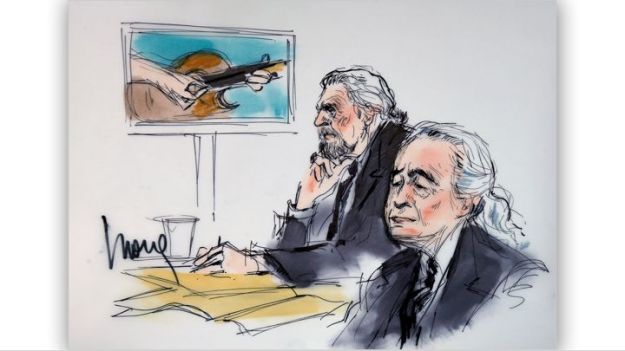
Drawing by Mona Shafer Edwards

A courtroom illustration from the recent trial showing Jimmy Page (right) and Robert Plant (left) / drawing by Mona Shafer Edwards

It is not the first time that Led Zeppelin have been accused of lifting musical passages; other famous examples include claims on behalf of blues masters such as Howlin’ Wolf and Willie Dixon (whose names have subsequently appeared on song credits on some of the band’s reissues), or American songwriter Jake Holmes, whose Dazed and Confused was covered by Led Zeppelin in their debut album without credit (a lawsuit by Holmes was eventually settled out of court in 2012).

News of the latest lawsuit against Led Zeppelin brought to mind some older instances of alleged music plagiarism, such as the copyright infringement suit against George Harrison for his hit song My Sweet Lord in the 1970s (where he was found guilty of ¨subconscious¨plagiarism) or the debate around the similarities between Hotel California and We Used To Know by British rockers Jethro Tull.

As Ian Anderson puts it, ¨it’s not plagiarism, it´s just the same chord sequence… it’s difficult to find a chord sequence that hasn’t been used.¨ Now that’s a very interesting remark because it appears that musical ¨borrowings¨ have actually been around as long as music itself. As  a matter of fact, even Bach himself lifted entire passages or melodies from other composers, a practice that was not uncommon or unknown to musicians before (as well as after) him.

It was only with the advent of modern notions such as intellectual property and copyright infringement that such borrowings came to be considered as violations rather than simply loans. Musicians, not unlike scientists, make advances and breakthroughs by building on previous discoveries. Isaac Newton’s famous maxim “if I have seen further, it is by standing on the shoulders of giants” might as well have come from Bach or, for that matter, Led Zeppelin.

As with all arts, there can be no parthenogenesis in music. Picasso’s ¨good artists copy, great artists steal¨ remains as valid today for visual artists as for music composers. Building on a previously existing body of work should not be reprehensible; on the contrary, it is necessary, if not inevitable. The important thing is not to avoid borrowing from past masters, but to successfully use and mold the old knowledge into something new that has its own value and significance.

Perhaps the essential difference between imitation and originality is best captured by Ernest Hemingway, who once said: “In any art you’re allowed to steal anything if you can make it better.”

The seasons they are a changin’

Earlier this month I visited the beautiful Palau de la Música Catalana for a performance of Vivaldi’s Le Quattro Stagioni (“The Four Seasons”) by German violinist Anne-Sophie Mutter and her ensemble. It was an excellent concert and soon after the last notes of Vivaldi’s “Winter” were heard, the audience burst into a grand, extended applause anticipating Mutter’s return to the stage.

Sure enough, the famous virtuoso and her select group of skilled instrumentalists were soon back for a bis – a treatment of the thunderous Presto from Vivaldi’s “Summer” concerto. Although this could well have been sufficient, the crowd’s enthusiastic response and continuous cheering resulted in yet another encore. This was when things started to get slightly, ehmm, metamodern.

As soon as Mutter and her ensemble started playing (the piece was an arrangement of Bach’s famous Air from his Orchestral Suite No. 3 in D major), I found myself surrounded by people reaching out to their mobile phones, cameras and tablets, struggling to capture as best they could every single second of that final performance. And there I was, hopeless and helpless, utterly incapable of enjoying the beauty of such sublime music and the unique setting.

I know what you are thinking: “This is happening in nearly every concert nowadays, so what’s the big deal?” And yes, I (as I am sure you too, dear reader) have also indulged in similar practices on one occasion or another. But here’s the thing: It’s quite different taking a photo (or video) during a rock gig or a large pop concert than doing the same during an intimate performance where music (classical or otherwise) is played on acoustic instruments and all its color, subtleties, and nuances are of the essence.

As Bach’s Air was about to end, I couldn’t help but think that the uplifting qualities of such magnificent music had somehow been suspended, the atmosphere irreversibly ruined; in short, the magic had been lost.

photo

Thinking back on the incident, an excerpt from Don DeLillo’s 1985 novel White Noise came to mind, where the author relates a visit to a tourist attraction known as “the most photographed barn in America”:

People with cameras left the elevated site, replaced at once by others.

“We’re not here to capture an image. We’re here to maintain one. Can you feel it, Jack? An accumulation of nameless energies.”

There was an extended silence. The man in the booth sold postcards and slides.

“Being here is a kind of spiritual surrender. We see only what the others see. The thousands who were here in the past, those who will come in the future. We’ve agreed to be part of a collective perception. This literally colors our vision. A religious experience in a way, like all tourism.”

Another silence ensued.

“They are taking pictures of taking pictures,” he said.

Although sightseeing is not identical to a concert hall visit, there are certainly some eerie resemblances on how more and more people are experiencing the two. I would like to believe that taking pictures, making selfies or videos, buying postcards and seeing “only what the others see” have not yet displaced the essence of attending a music performance, i.e. nurturing one’s mind and soul with sounds that please, excite and stimulate.

The seasons are changing, and mobile devices have invariably made their way into the concert hall. Still, as much as it is about entertainment, a gig (regardless of music genre) can also be an opportunity for contemplation or the cause of life-changing insights. It can be indeed a religious experience, where one willingly becomes part of a collective perception, to use DeLillo’s words. My hope is that it doesn’t degenerate into “spiritual surrender” or any short of mindless “tourism.”

Lee “Scratch” Perry in concert

Few artists can claim to have played such a defining role in the development of reggae and dub music as Lee “Scratch” Perry (b. 1936). With an astonishing career spanning well over 50 years, the legendary  Jamaican music producer continues to excite audiences despite his advanced age. Just one day after his 80th birthday, Perry performed at the Apolo, Barcelona’s landmark music hall; quite a special gig indeed.

Upsetting the music business

Born into a poor family, Perry’s beginnings were humble.  As he relates:I went to school, first in Kendal, then in Green Island, ‘til fourth grade, around 15. I learned nothing at all. Everything I have learned has come from nature. My father worked on the road, my mother in the fields. We were very poor.”

Perry decided to move to Kingston, Jamaica in order to pursue his passion for music. In the late 1950s he started working at the renowned Studio One hit factory, known as “the Motown of Jamaica.” In 1968 he went on to form his own label, Upsetter Records. Perry, by now an experienced and daring producer, released numerous recordings during the following years, further developing and experimenting with new approaches to music production.

Lee "Scratch" Perry


”Everything I have learned has come from nature”

Lee “Scratch” Perry


The Ark is on fire

In the early 1970s Perry built his his own personal studio, named the Black Ark, in the back yard of his family home. Using basic and unsophisticated equipment compared to the state-of-the-art recording studios of Jamaica’s big producers, he gained total control over the production process, thus giving birth to a diverse array of exciting new sounds and advance innovating recording techniques.

It was during this extremely creative period that Perry worked with notable musicians such as Bob Marley & the Wailers and Max Romeo. Around 1980, however, work at the black Ark was stopped as the studio was burned to the ground. Although there is some controversy about the actual circumstances, Perry has claimed that he set the Black Ark on fire himself in order to “cleanse” it from undesired spirits. In his own words: “[T]he atmosphere in the Black Ark studio was changing; it wasn’t like it used to be. Then I decided to make a sacrifice as the energy wasn’t good anymore.”

The legend lives on

A highly eccentric figure and a man with seemingly inexhaustible resources of both physical and creative energy, Perry continues his long and extraordinary career to this day, having produced several notable albums and collaborated with distinguished musicians over the last years.

What is more, his flamboyant presence and unique performing style make him a great entertainer on stage, as was aptly demonstrated last Monday in Apolo. An eternally young and heretic spirit, Lee “Scratch” Perry has given music his body and soul; as to the rest of us, he has given an abundance of intoxicating sounds, new ways to make and approach music, as well as constant inspiration to listen to it with a new set of ears.

This slideshow requires JavaScript.

All you need is love (and ears)

More than a Beatle

If there ever was someone worthy of the title ‘fifth Beatle’, that man could only have been Sir George Martin (1926-2016). The legendary English producer, arranger and composer not only signed The Beatles and produced almost all of their albums, but also played a key role in shaping their sound, especially after the band stopped performing live and focused on recording and experimenting in the studio.

A token of Martin’s ingenuity and creativity can be found in the story behind the recording of Being for the Benefit of Mr. Kite! from the Sgt. Pepper’s Lonely Hearts Club Band album: John Lennon had asked Martin to give the song a “carnival atmosphere”, and wanted to “smell the sawdust on the floor.” After putting together multiple recordings of fairground organs and calliope music and a great deal of unfruitful experimentation, Martin and recording engineer Geoff Emerick finally achieved the desired effect by chopping the tape into pieces with scissors, throwing them up in the air, and re-assembling them at random. Now that’s quite an imaginative recording technique!

But George Martin was much more than the fifth Beatle. A classically-trained musician (he had studied piano and oboe at the Guildhall School of Music and Drama), he worked for the BBC before joining EMI in 1950, where he produced numerous comedy and novelty records working with artists such as Peter Ustinov, Peter Sellers, and Sophia Loren.

A visionary producer

Following his collaboration with The Beatles, Martin went on to produce many successful records and worked with acclaimed musicians such as Shirley Bassey, Stan Getz, Jeff Beck, and Elton John. He also worked as a producer with the rock band America, the jazz-rock fusion group Mahavishnu Orchestra (Apocalypse, 1974) and the experimental jazz ensemble Paul Winter Consort whose album Icarus (1972) was according to Martin “the finest record” he had ever made.

A few years ago I read Martin’s marvelous autobiography All You Need Is Ears, first published in 1979. It is an exciting  account of his personal story and an excellent read I highly recommend not just for Beatles fans or aspiring record producers, but for anyone interested in the cultural history of the 1960s (much like White Bicycles by American producer Joe Boyd).

A true visionary who changed the musical landscape of the second half of the 20th century  and pushed the boundaries of  music production and studio recording, Sir George Martin knew well that, distinct genres and labels aside, all music basically aspires toward the same goal: “Rock and roll has the same function as classical music,” he once said, “to make sounds that are appealing to a mass of people and are of some worth.”

God only knows where pop music would be without George Martin’s unmistakable ears and love for melody…