Category Archives: Film & Music

Art under a cloudy sky

Although cloud watching seems to be reaching ever-higher levels of popularity nowadays, this noble activity has been a favorite pastime of sensitive and artistically inclined individuals long before the advent of modern photographic techniques.

In his nocturnal composition Nuages (“Clouds”), Claude Debussy tried to capture “the immutable aspect of the sky and the slow, solemn motion of the clouds, fading away in grey tones lightly tinged with white.

Debussy’s visual, descriptive language brings to mind impressionistic images of similar themes. Conversely, painters would also use music as a way to better illustrate the effects of their own art. In a letter to his brother Theo in 1888, Vincent Van Gogh wrote: “…in a picture I want to say something comforting, in the way that music is comforting.”

Vincent van Gogh, ‘Wheat Field Under Cloudy Sky’ (Oil on canvas, 1890)

A somewhat darker, and at times even disturbing, vision arises in some of Akira Kurosawa’s cinematic masterpieces, such as Rashomon (1950) and Ran (1985). Here, the depiction of imposing cloud formations serves as a symbol for the futility and the ephemeral status of human affairs, signifying the tragic dimensions of man’s passing from this world.

Ran-stills

Stills from Akira Kurosawa’s ‘Ran’ (1985)

In the dedication of Paris Spleen, one of the founding texts of literary modernism, Charles Baudelaire had dreamed “of the miracle of a poetic prose, musical, without rhythm and without rhyme” that could “adapt itself to the lyrical impulses of the soul, the undulations of reverie, the jibes of conscience.”

In the opening piece, L’étranger (“The Stranger”), Baudelaire’s enigmatic figure rejects received truths, certainties and conventions, retaining faith only to one’s self and the beauty of passing clouds…

“Tell me, enigmatical man, whom do you love best, your father, your mother, your sister, or your brother?

I have neither father, nor mother, nor sister, nor brother.

Your friends? Now you use a word whose meaning I have never known.

Your country? I do not know in what latitude it lies.

Beauty? I could indeed lover her, Goddess and Immortal.

Gold? I hate it as you hate God.

Then, what do you love, extraordinary stranger?

I love the clouds… the clouds that pass… up there… up there… the wonderful clouds!”

A pianist amidst the ocean

“You’re never really done for, as long as you got a good story and someone to tell it too.”

(Max Tooney in The Legend of 1900)

In his theater monologue Novecento Italian writer Alessandro Baricco gives a fascinating account of the life and times of Danny Boodman T. D. Lemon 1900, a fictional piano wunderkind born on the ocean liner Virginian who was destined never to set foot on land.

Baricco’s relationship with music is intimate (he has published a book on Gioachino Rossini and worked as a music critic for La Repubblica) and his Novecento is a joy to read. I particularly enjoyed his reflections on the nature and limitless possibilities of music making:

“We were playing because the Ocean is vast and scares you, we were playing so that people could forget the passing of time, forget where they were and who they were. We were playing so as to make people dance, because if you dance you feel like God and cannot die. And we were playing ragtime, because that’s the music God dances along when nobody watches.”

“So think now: a piano. Its keys start somewhere. And end somewhere. You know they are eighty-eight, nobody can tell you otherwise. They are not infinite. You are infinite, and so is the music you can make on these keys.”

Baricco’s story was made into a film in 1998 called The Legend of 1900, starring Tim Roth and directed by Giuseppe Tornatore. The film’s magnificent soundtrack is composed almost entirely by Ennio Morricone and it contains some truly captivating piano music. Alongside the Italian maestro, Roger Waters also contributed to the film’s soundtrack by performing and writing the lyrics for the piece Lost Boys Calling.

http://youtu.be/7-ufYvXeEKs

In the story’s  heartbreaking finale, leaving the Virginian and facing the immensity of real life proves too overwhelming for the legendary pianist. Still, his unique music lives on, if only in the memories of all those who were once blessed to be among his audience.

The High Fidelity lists

“As everyone knows, Al Green Explores your Mind is as serious as life gets.”

(Nick Hornby, High Fidelity)

In case you are already familiar with Nick Hornby’s work, High Fidelity (published in 1995) needs no further introduction. A brilliantly entertaining and yet remarkably insightful take on life, relationships and pop music, it remains a classic of its genre. In 2000 it was also made into a film starring John Cusack as the audiophile Rob Gordon. Rob (whose last name in the book is actually Fleming) is the novel’s main character and a music geek who takes pleasure in coming up with top 5 lists of ex-girlfriends, records, films, artists and pretty much everything else.

A big plus to Hornby’s novel are the many musical tips scattered across the text. A whole playlist full of soulful and funky tunes that can still be enjoyed long after the reading is over, and which also served as a basis for the film’s groovy soundtrack.

So here are my all-time, top five most memorable musical references in High Fidelity in chronological order:

1) Solomon Burke – Got To Get You Off My Mind

2) Otis Redding – You Left The Water Running

3) Smokey Robinson and the Miracles – It’s a Good Feeling

4) Donny Hathaway – The Ghetto

5) Elvis Costello – Alison

Followed by my top five, most memorable quotes from Hornby’s book in order of appearance:

1) “What came first, the music or the misery? Did I listen to music because I was miserable? Or was I miserable because I listened to music? Do all those records turn you into a melancholy person?”

2) “I reorganize my record collection; I often do this at periods of emotional stress. When I’ve finished I’m flushed with s sense of self, because this, after all, is who I am.”

3) “To me, making a tape is like writing a letter – there’s a lot of erasing and rethinking and starting again. A good compilation tape, like breaking up, is hard to do.”

4) “You know the worst thing about being rejected? The lack of control. If I could only control the when and how of being dumped by somebody, then it wouldn’t seem as bad. But then, of course, it wouldn’t be rejection, would it? It would be by mutual consent. It would be musical differences. It would be leaving to pursue a solo career.”

5) “How can you like Art Garfunkel and Solomon Burke? It’s like saying you support the Israelis and the Palestinians.”

Sounds of Istanbul

Great music is often born when different cultures meet and intermingle. Such is the case with Istanbul, this unique crossroads of diverse civilizations and musical traditions.

My first encounter with the music of Istanbul was made through Fatih Akin’s excellent film Crossing the Bridge (2005), a documentary about Istanbul’s contemporary music scene. Akin follows German musician Alexander Hacke as he wanders around Istanbul with a mobile recording studio, trying to capture the musical identity of the city  in all its manifestations. In the process, they meet and record several bands and musicians from a variety of genres, ranging from traditional Turkish music to rap, indie and experimental rock.

One of the film’s highlights is a performance by the psychedelic band Baba Zula together with Hacke and Canadian folk musician Brenna MacCrimmon, all aboard a small boat on the Bosporus, their music gracefully accompanied by the glorious sunset…

I would get to see Baba Zula perform live in Istanbul’s famous music venue Babylon in 2011, when I had the opportunity to spend a good few weeks in the Genoese neighborhood around Galata Tower.

Baba Zula live in Istanbul

Baba Zula performing in Istanbul (25/11/2011)

It didn’t take long before I fell in love with Istanbul’s vibe and unique character. It felt as the whole city pulsated with music. A music of a very peculiar kind, comprised of all the sounds emanating from the Sea of Marmara and the countless little alleys, intertwined with the city’s buzz and the tunes played by street musicians, eventually meeting the muezzin’s call to prayer, thus forming a unified whole the reverberations of which seemed to be felt everywhere.

Memories of Istanbul and its music were recently brought back to me by listening to Istanbul Twilight, a remarkable depiction of the city’s diverse soundscape. Offering a musical panorama of Istanbul, this compilation includes music from Baba Zula and other prominent Turkish artists such as Burhan Öçal, Mercan Dede, and Taksim Trio.

It is almost impossible to fully grasp and absorb such a dynamic and vibrant music scene. It is perhaps best to let go, and simply immerse one’s self in the richness and beauty of Istanbul’s sounds; not unlikely one follows the muezzin’s mesmerizing voice in order to reach -even momentarily- heavenly, outworldly realms.

Blame it on the moonlight

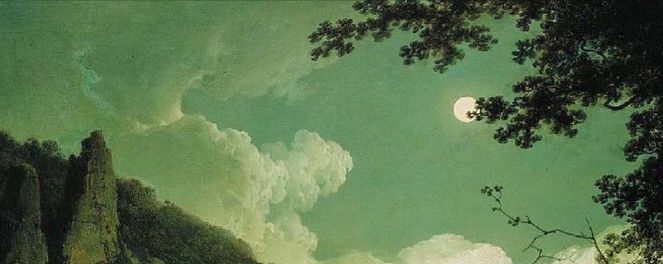
The moon has been a source of awe and admiration since times immemorial, and the fascination of man by its mysterious nature and changing phases can be shown by the multitude of lunar deities identified in mythological accounts all around the world.

It was the same fascination that would inspire the art of Romanticism, which placed new emphasis on the intense emotions arising from the confrontation with the sublimity of the natural world. Captivating depictions of the moon can be found in several romantic works, as in the paintings of Caspar David Friedrich (1774 – 1840) or the poetry of Percy Bysshe Shelley (1792 – 1822).

“Dovedale by Moonlight” (detail), by Joseph Wright of Derby (1734-1797)

In music, the most popular composition associated with the moon is most probably Beethoven’s Moonlight Sonata, written in 1801. The composer, however, would never get to know it by this name (its original title is Sonata quasi una fantasia); the nickname ”Moonlight” only came about some five years after Beethoven’s death, thanks to a description by Ludwig Rellstab, a German poet and music critic, who referred to the composition in terms of “a vision of a boat on Lake Lucerne by moonlight.” Even though Beethoven did not necessarily share Rellstab’s vision, the sonata would be thereafter associated with moonlight and its mesmerising first movement would serve as a prototype for many nocturnes during the 19th century.

It was in 1890 that Claude Debussy started to compose his Suite Bergamasque. Its third and most famous movement was inspired by Paul Verlaine’s poem Clair de Lune (French for “moonlight”) and carries the same name. Originally written for the piano, Debussy’s suite has been orchestrated by many composers including André Caplet, Lucien Cailliet (whose arrangement was used in the closing scene of Ocean’s Eleven), and Leopold Stokowski.

Stokowski’s version was actually meant to feature in Disney’s Fantasia, however the scene was eventually deleted due to length limitations.

The mystique and magical quality of moonlight have continued to inspire and fuel artistic creation up to modern times.  One of the most beautiful examples can be found in Paco de Lucía’s album Fuente y Caudal, which brought him international fame. It is the wonderful granaína Reflejo de luna (“reflection of moon”), a true gem that reveals the seemingly limitless capacity of flamenco guitar for expression and color. It is, after all, no accident that the strings of the guitar have been called the “six silver moonbeams”…