Drag pianos out into the streets
Drums with boat hooks from windows dash.
Smash pianos and drums to smithereens
Let there be thunder –Vladimir Mayakovsky, ‘An Order to the Art Army’
One hundred years have passed since the October Revolution, one of the last century’s defining events with profound repercussions that can still be felt to this day. Its far-reaching social and political implications aside, the revolution also had a powerful impact on Russian culture and art. Music, in particular, would play an important role both emotionally and ideologically in this tumultuous new chapter of Russian history.
Folklore and ideology
In the decades directly preceding the revolution, the writings of thinkers like Nikolay Chernyshevsky and Leo Tolstoy had a considerable influence on the debate surrounding the meaning and purpose of art.
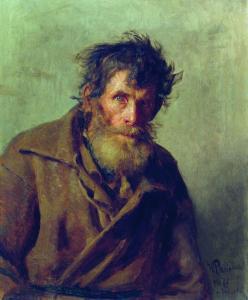
A Shy Peasant (1877), by Ilya Repin
According to Chernyshevsky, “the true function of art is to explain and comment on life”, an idea that lies behind many depictions of peasantry and everyday life in Russian realist art of this period.
Furthermore, the views expressed by Tolstoy in his book What is Art? (1897), wherein he stresses the moral as well as social function of art, would remain highly influential well into the Soviet years. For Tolstoy, art is not about emotionalism, pleasure or entertainment; it is, rather, “a means of union among men, joining them together in the same feelings, and indispensable for the life and progress toward well-being of individuals and of humanity.”
Despite Tolstoy’s stated preference for the simplicity and sincerity of folk music, he was far from indifferent or knowledgeable regarding more refined forms. He admired Chopin and also liked listening to Mozart and Haydn. His more ambivalent relationship with Beethoven is reflected in some of his writings, such as his famous novella The Kreutzer Sonata (named after Beethoven’s violin sonata of the same name).
An amateur pianist himself, Tolstoy also knew personally several distinguished musicians who at times visited and played for him, including seminal figures of Russian classical music such as Anton Rubinstein, Alexander Scriabin, Sergei Rachmaninoff, and Nikolai Rimsky-Korsakov.
Leo Tolstoy at the piano
Meanwhile, the late 19th century saw the rise of folk music ensembles. Folk choirs, in particular, were extremely popular and song was thus turned into a powerful ideological force. Favorites included several revolutionary songs, and a musical collection of Russian Revolutionary Songs was even printed in Berlin prior to 1905. In Soviet times, the distinction between folk and art music would play a crucial role, along with the demarcation of “the people’s” or “proletarian” art as opposed to “bourgeois” and “formalist” tendencies.
“Art belongs to the people”
Although Lenin considered himself a “barbarian” with regards to new tendencies in art, he took a keen interest in cultural affairs. He admired much of Beethoven’s music, as well as pieces by Chopin, Bizet, Gounod, and Tchaikovsky.
In a characteristic incident related by Maxim Gorky (which was dramatized for Soviet television in the 1960s), the famous writer records Lenin’s reaction after listening to Beethoven’s Appassionata sonata: “I know the Appassionata inside out and yet I am willing to listen to it every day. It is wonderful, ethereal music. On hearing it I proudly, maybe somewhat naively, think: See! people are able to produce such marvels!”
According to Gorky, however, Lenin continued on a somewhat darker tone: “But I cannot listen to music too often, it affects one’s nerves, makes one want to say kind, stupid things and stroke the heads of those who, living in such a foul hell, can create such beauty. Nowadays if one strokes someone’s head, he’ll get his hand bitten off! Better to beat the person unmercifully over the head, although ideally we oppose the use of force in human relations. Hm, hm, our task is infernally hard!”
Above all, Lenin was concerned with the ideological and educational aspects of art. As he put it: “Art belongs to the people. It must penetrate with its deepest roots into the very midst of the broad working masses. It must unite the feeling, thought and will of these masses, must elevate them. It must awaken the artists among them and stimulate them.”
Following the October Revolution of 1917, Lenin appointed Anatoly Lunacharsky as People’s Commissariat for Education, responsible for cultural and educational affairs. An art connoisseur and prolific critic, Lunacharsky shared Lenin’s admiration for Beethoven. Stressing the revolutionary and heroic aspects of Beethoven’s music and -with the notable exception of the 9th Symphony- centering on the works of his middle period (thus excluding the more “difficult” late works), this led to the appropriation and glorification of the German composer as one of the pillars of Soviet musical culture.
The rise of the avant-garde
The period following the revolution was an extraordinary one for Russian culture. It was during this time that the groundbreaking Russian avant-garde would reach both its creative peak and widest appeal. While many musicians left Russia after the revolution (including Sergei Rachmaninoff, Vladimir Horowitz, Feodor Chaliapin, and Jascha Heifetz) or were already working abroad (like Igor Stravinsky), a new wave of avant-garde composers was emerging, mirroring the revolutionary developments in Russian art and literature as expressed in the works of Kandinsky, Goncharova, Rodchenko, Malevich, Mayakovsky, Blok and many others.
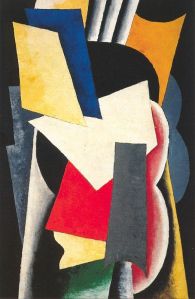
Still Life with Instruments (1916), by Lyubov Popova
A major influence among many of these upcoming composers was Alexander Scriabin (1871-1915), whose highly innovative and dissonant music featured overtones of mysticism and theosophy. Some of the composers who followed in Scriabin’s footsteps include Nikolai Roslavets (sometimes referred to as “the Russian Schoenberg”), Samuil Feinberg, Sergei Protopopov, and Alexander Mosolov.
Radical political developments notwithstanding, 1917 was a very productive year for the young Sergei Prokofiev (1891-1953), who was fast becoming one of the era’s major composers. In that same year, he completed his “Classical” Symphony, the Third and Fourth Piano Sonatas, as well as the Visions Fugitives for piano. Prokofiev, who left Russia in 1918 with the blessings of Lunacharsky, would eventually return to USSR 18 years later (he died on 5 March 1953, the same day as Joseph Stalin).
A champion of musical modernism and known as “the musical conscience of Moscow”, Nikolai Myaskovsky (1881-1950) would become a prominent figure in Soviet musical life in the 1920s and the 1930s. The son of an ex-Tsarist general who was murdered by Red Army soldiers, Myaskovsky himself served in the Red Army from 1917 to 1921 and was inspired by the revolutionary events for his Sixth Symphony (composed during 1921–1923), the only choral symphony and the longest of his 27 symphonies. The work’s finale contains two French revolutionary songs (La carmagnole and Ah ça ira), along with the Dies Irae and a Russian Orthodox burial hymn on the parting of body and soul.
Technology and experimentation
Next to the earth-shattering sociopolitical developments, the revolution taking place in the arts often employed the use of newly developed technology. In October 1920, Russian physicist Léon Theremin invented the first mass-produced musical electronic instrument, the theremin (also known as termenvox). Theremin demonstrated his invention to Lenin, who was impressed and sent Theremin across the country in order to display this new fascinating instrument (and promote the progress of electrification which was under way in Russia).
In 1922, the Persimfans conductorless orchestra was founded in Moscow by violinist Lev Zeitlin. A bold experiment that aspired to apply egalitarian concepts to music performance, Persimfans operated for ten years and, according to Prokofiev, “coped splendidly with difficult programs and accompanied soloists as competently as any conducted orchestra”.

A sketch depicting the Persimfans conductorless orchestra with its cyclical sitting arrangement
The orchestra, which performed on stage in a circle so that each musician was visible to the rest of the group, achieved worldwide acclaim during the 1920s. As historian Richard Stites put it: “Persimfans and its seventy musicians was a Utopia in miniature, a tiny republic, and a model workshop for the communist future. Like many practicing Utopias of the 1920s, it was an island in the midst of persistent inequality, a laboratory of communism, a beacon of early idealism, an inspiration for the future, and a graphic demonstration of how egalitarian mechanisms could actually work if given the opportunity.”
Shostakovich, Stalin and the whisper of history
Throughout the 1920s, Dmitri Shostakovich (1906-1975) rose to prominence as the indisputable star among the younger generation of Soviet composers. At the age of 18 he had completed his First Symphony, which became hugely successful. His Second Symphony, subtitled To October and written in 1927 as a commission for the 10th anniversary of the October Revolution, was a patriotic -yet experimental- piece with a pro-Soviet choral finale that praised Lenin and the revolution. Many years later, Shostakovich would revisit the revolutionary events in his Twelfth Symphony (subtitled The Year 1917).
Following the tightening of control regarding cultural matters and the official endorsement of “socialist realism” in the early 1930s, Russian art would enter a long and troubled new era as the revolutionary ideals would be increasingly left behind. Perhaps more than any other, the case of Shostakovich represents the complicated and problematic relationship between individual creative freedom and official state censorship that would develop under Stalin’s rule (and described brilliantly in Julian Barnes’s The Noise of Time).
Today, much of Shostakovich’s music remains extremely popular, his oeuvre representing a whisper of Soviet history that time has bestowed upon all those eager to listen. As Barnes puts it in his novel:
“Art belongs to everybody and nobody. Art belongs to all time and no time. Art belongs to those who create it and those who savour it. Art no more belongs to the People and the Party than it once belonged to the aristocracy and the patron. Art is the whisper of history, heard above the noise of time.”
 The Muser