While also connected with the 1960s Civil Rights movement, Paul McCartney’s Blackbird is said to have been originally inspired from the experience of being woken by a blackbird’s song just before sunrise.
Musically speaking, McCartney was influenced by J.S. Bach’s Bourrée from the Suite in E minor for Lute (BWV 996), a piece often performed on the classical guitar. George Harrison and Colin Manley had taught him how to play Bach’s Bourrée at Liverpool Institute. As Sir Paul later put it: “I bastardized it, but it was the basis of how I wrote Blackbird.”
In this recording I’ve tried to bring the two pieces together, accompanied by the singing of birds on a sunny day…
Antonio Vivaldi composed The Four Seasons (‘Le quattro stagioni’) in 1723. A work of unmatched artistry and elegance, it would become one of the most popular pieces of baroque music, if not classical music in general. It is also an early example of program music, with the four concertos named after the different seasons and following closely a set of corresponding sonnets.
The Four Seasons is an integral part of the violin repertoire, a work literally hardwired in the brain of every violinist. As might be expected, there is an abundance of recordings: approximately 1,000(!) different recorded versions of The Four Seasons have made their appearance since 1939 by various soloists and orchestras.
My personal favorites include the recording by Yehudi Menuhin and Camerata Lysy Gstaad from 1981, as well as Nigel Kennedy’s popular 1989 recording with the English Chamber Orchestra. Kennedy had studied with Menuhin as a child, and his recording of the The Four Seasons would become one of the best-selling classical works of all time. An eccentric figure, Kennedy has never hesitated to introduce improvisatory elements in his playing, which often makes his live performances electrifying.
Inevitably, some approaches to Vivaldi’s great composition have proved to be more daring and stylistically innovative than others. This is the case with French pianist and composer Jacques Loussier (b. 1934), whose main claim to fame have been his magnificent jazz adaptations of J.S. Bach. Apart from its sheer musicality, the fact that Loussier’s rendition manages to capture the essence of the original work by means of a piano trio alone is impressive.
More recently, British composer Max Richter (b. 1966) offered us a truly astonishing re-composition of Vivaldi’s The Four Seasons (its premiere was on 31 October 2012). In describing the 1st movement of his Summer, Richter talks about “relentless pulsed music”, adding that perhaps he “was also thinking about John Bonham’s drumming.” He has also referred to the connection between the harpsichord’s sound in the 2nd movement of his Autumn and the style of various pop recordings, including Abbey Road and several albums by the Beach Boys.
The metamorphoses of The Four Seasons throughout the ages show how a baroque masterpiece can survive in modern times through assuming different forms and incorporating elements from such diverse genres as jazz, pop, hard rock and minimalism. Seasons may keep changing, yet Vivaldi’s music remains.
When I was still a little child, my acquaintance with the world of classical ballet (and I suspect not just mine) was made through The Nutcracker. It was love at first sight (and hearing), as the delightful music of Tchaikovsky coupled with a most extraordinary set of characters such as the Mouse King, the Nutcracker Prince with his soldiers, and of course the Sugar Plum Fairy.
One of Tchaikovsky’smost celebrated works, theimmense popularity of The Nutcracker owes much to a tradition that started in 1954, when the New York City Ballet first performed the balletchoreographed by George Balanchine. The company has since performed the ballet every year during the Christmas season with great success, paving the way for a growing number of performances across the world by several ballet companies in the years that followed.
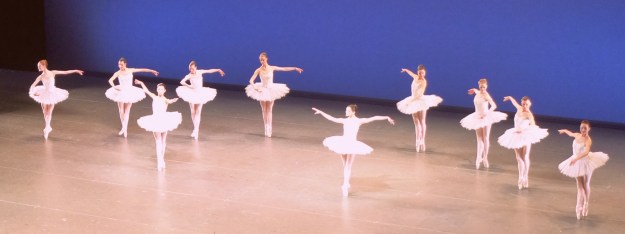
‘Best of Balanchine’, performed by the Dutch National Ballet in the Amsterdam Music Theater
In 1965, the British orchestral composer Arthur Wilkinson made a very special arrangement of music by The Beatles, blending some of their well-known tunes with movements from Tchaikovsky’s NutcrackerSuite. The result of this peculiar musical marriage was called the Beatle Cracker Suite.
A musical allusion to Tchaikovsky’s popular ballet can also be found in the film Magical Mystery Tour. It was the Beatles’ producer George Martin who, seeing that the opening strain of All My Loving is almost identical to the melody from Nutcracker’s Pas de deux but turned upside down, decided to arrange the song à la Tchaikovsky for the film’s background music.
The most intriguing manifestation of the unique relationship between the Russian master and the British pop stars was perhaps one not made through notes. It would be, however, captured on record through the soft, rather lazy and yet mysterious-sounding voice of Lennon, as he was whispering “sugar-plum-fairy, sugar-plum-fairy” into the microphone during the intro of the epic A Day in the Life (as can be heard in the Love version of the song).
It appears the little fairy’s dance had taken her all the way from Russia’s imposing music theaters to the Abbey Road Studios in London amidst the swinging sixties. What an honor indeed to have been summoned by The Beatles on such a special day in their life. No doubt Tchaikovsky would not have minded her leaving home!
It is simply impossible to overstress the enormous influence of Cuban music and its contribution to the development of various genres around the world, from jazz and salsa to the Argentine tango and the Spanish nuevo flamenco.
Known for its extensive blending of diverse styles and rhythms, Cuban music was in return also influenced by popular US music, as in the case of filín, a Cuban fashion of the 1940s and 1950s. Although Cuban jazz had also started in Havana around 1910-1930 it was not until the 1940s that the big band era arrived, owing much to great bandleaders like Armando Romeu Jr. and Damaso Perez Prado.
It was in the 1950s that Benny Moré, widely regarded as the greatest Cuban singer of all time, reached his heyday with his orchestra Banda Gigante (Big Band). Playing at the dance halls La Tropical and El Sierra in Havana, Moré and the group enjoyed immense popularity and went on to tour Venezuela, Jamaica, Haiti, Colombia, Panama, Mexico and the United States, where they performed at the Oscars.
The aftermath of the Cuban Revolution in 1959 saw the closing down of several night clubs and venues for popular music. As a result, many musicians were left without employment and emigrated to Puerto Rico, Florida and New York. Meanwhile in Cuba, artistic activity came increasingly under the control of the socialist regime, and with the movement of nueva trova music started to acquired a more political edge, combining traditional folk elements with often politicized lyrics.
A breakthrough for many legendary local musicians whose performing careers had come to a halt after the rise of Fidel Castro was the release of Buena Vista Social Club (1997). The album was the project of American guitarist and producer Ry Cooder, who visited Havana in 1996 to seek out and record these performers. Wim Wenders also captured the sessions on film, together with sell-out live performances of the group in Amsterdam and New York.
Following the album’s astonishing commercial and critical success, a number of its key performers (including singer Ibrahim Ferrer, guitarist/singer Compay Segundo, pianist Rubén González and trumpeter Manuel “Guajiro” Mirabal) set out to record solo albums, despite of their advanced age (all of them had been active in the Cuban music scene since the 1940s-50s).
Fifteen years after the release of Buena Vista Social Club, its reverberations arestill felt quite strongly. As a result of its international success, younger audiences across the globe have had the chance to watch and listen live to these extraordinary musicians, while getting to know some of the younger talents of the contemporary Cuban music scene.
The Havana Lounge live in Paradiso, Amsterdam (15/02/2013)
It appears, then, that Ry Cooder’s fateful visit to Havana in 1996 managed indeed to rekindle the interest in Cuban tradition, opening a large window for international audiences with a vista to the horizon of Cuban music. A music so rich in its warmth, expression and feeling that surely makes for a most enjoyable view.
Written in 1937 by Richard Rodgers and Lorenz Hart, My Funny Valentine would go on to become a popular jazz standard, appearing on more than 1300(!) albums in total and performed by such great artists as Frank Sinatra, Ella Fitzgerald and Miles Davis.
One of its earliest and most memorable recordings was by the Gerry Mulligan Quartet in 1952, which featured a captivating solo by Chet Baker. It was a major hit, and became a tune closely associated with Baker until the end of his turbulent life.
Plaque in memory of Chet Baker outside Hotel Prins Hendrik in Amsterdam (photo by Jeroen Coert)
A life that came to an abrupt end on on May 13, 1988, when the American trumpeter, flugelhornist and vocalist was found dead on Prins Hendrikkade, the street below his room at Hotel Prins Hendrik in Amsterdam (nearby the city’s Central Station). An autopsy found heroin and cocaine in his body and these drugs were also found in his hotel room. His death was ruled an accident.
I also happened to live on Prins Hendrikkade for one year when I first came to study in the Dutch capital, oblivious of the grim connection between the street and Baker’s death. Ever since I found out about it, memories of my student days mingle with Baker’s melodies as I pass by the area around Hotel Prins Hendrik.


 The Muser