Author Archives: The Muser

Sounds of Istanbul

Great music is often born when different cultures meet and intermingle. Such is the case with Istanbul, this unique crossroads of diverse civilizations and musical traditions.

My first encounter with the music of Istanbul was made through Fatih Akin’s excellent film Crossing the Bridge (2005), a documentary about Istanbul’s contemporary music scene. Akin follows German musician Alexander Hacke as he wanders around Istanbul with a mobile recording studio, trying to capture the musical identity of the city  in all its manifestations. In the process, they meet and record several bands and musicians from a variety of genres, ranging from traditional Turkish music to rap, indie and experimental rock.

One of the film’s highlights is a performance by the psychedelic band Baba Zula together with Hacke and Canadian folk musician Brenna MacCrimmon, all aboard a small boat on the Bosporus, their music gracefully accompanied by the glorious sunset…

I would get to see Baba Zula perform live in Istanbul’s famous music venue Babylon in 2011, when I had the opportunity to spend a good few weeks in the Genoese neighborhood around Galata Tower.

Baba Zula live in Istanbul

Baba Zula performing in Istanbul (25/11/2011)

It didn’t take long before I fell in love with Istanbul’s vibe and unique character. It felt as the whole city pulsated with music. A music of a very peculiar kind, comprised of all the sounds emanating from the Sea of Marmara and the countless little alleys, intertwined with the city’s buzz and the tunes played by street musicians, eventually meeting the muezzin’s call to prayer, thus forming a unified whole the reverberations of which seemed to be felt everywhere.

Memories of Istanbul and its music were recently brought back to me by listening to Istanbul Twilight, a remarkable depiction of the city’s diverse soundscape. Offering a musical panorama of Istanbul, this compilation includes music from Baba Zula and other prominent Turkish artists such as Burhan Öçal, Mercan Dede, and Taksim Trio.

It is almost impossible to fully grasp and absorb such a dynamic and vibrant music scene. It is perhaps best to let go, and simply immerse one’s self in the richness and beauty of Istanbul’s sounds; not unlikely one follows the muezzin’s mesmerizing voice in order to reach -even momentarily- heavenly, outworldly realms.


Soundtrack to a crisis

It seems that today, music news is pretty much the only good news coming from Greece. Amidst the harsh political, financial and social crisis, a new wave of young Greek artists is emerging, whose music manages to capture the widespread anger, disillusionment and insecurity, channeling and transforming these feelings  into something both beautiful and hopeful.

Influenced by such bands as The White Stripes and The Black Keys, the blues duo Boogieman & Little Tonnie (aka The Big Nose Attack) have developed their own ‘dirty’ yet powerful sound. Wandering the streets of crisis-struck Athens, they sing about “how things change”…

Things have changed indeed, and things need to change anew, but this time for the better. How this transition can take place has been a subject of endless debate and speculation – perhaps a voodoo state of mind is indeed necessary, as Baby Guru claim,  so as to move “away from your darkest times” to “a new thing going on.”

Minor Project have been one of the most promising bands to spring up in this flourishing new age of Greek art music. Their ethereal melodies and colorful tunes serve as a much needed reminder that hopes and dreams can still survive even in the darkest of times.

To find the the way out of the darkness and into the light remains the ultimate challenge for Greek society right now. The light wherein “everything looks beautiful and bright”, as upcoming singer-songwriter Irene Skylakaki sings rather melancholically. And “the clock is ticking”

More info and music:

www.thebignoseattack.tumblr.com

www.soundcloud.com/babyguruband

www.minor-project.com

www.jumpingfish.gr/Irene_Skylakaki

Blame it on the moonlight

The moon has been a source of awe and admiration since times immemorial, and the fascination of man by its mysterious nature and changing phases can be shown by the multitude of lunar deities identified in mythological accounts all around the world.

It was the same fascination that would inspire the art of Romanticism, which placed new emphasis on the intense emotions arising from the confrontation with the sublimity of the natural world. Captivating depictions of the moon can be found in several romantic works, as in the paintings of Caspar David Friedrich (1774 – 1840) or the poetry of Percy Bysshe Shelley (1792 – 1822).

“Dovedale by Moonlight” (detail), by Joseph Wright of Derby (1734-1797)

In music, the most popular composition associated with the moon is most probably Beethoven’s Moonlight Sonata, written in 1801. The composer, however, would never get to know it by this name (its original title is Sonata quasi una fantasia); the nickname ”Moonlight” only came about some five years after Beethoven’s death, thanks to a description by Ludwig Rellstab, a German poet and music critic, who referred to the composition in terms of “a vision of a boat on Lake Lucerne by moonlight.” Even though Beethoven did not necessarily share Rellstab’s vision, the sonata would be thereafter associated with moonlight and its mesmerising first movement would serve as a prototype for many nocturnes during the 19th century.

It was in 1890 that Claude Debussy started to compose his Suite Bergamasque. Its third and most famous movement was inspired by Paul Verlaine’s poem Clair de Lune (French for “moonlight”) and carries the same name. Originally written for the piano, Debussy’s suite has been orchestrated by many composers including André Caplet, Lucien Cailliet (whose arrangement was used in the closing scene of Ocean’s Eleven), and Leopold Stokowski.

Stokowski’s version was actually meant to feature in Disney’s Fantasia, however the scene was eventually deleted due to length limitations.

The mystique and magical quality of moonlight have continued to inspire and fuel artistic creation up to modern times.  One of the most beautiful examples can be found in Paco de Lucía’s album Fuente y Caudal, which brought him international fame. It is the wonderful granaína Reflejo de luna (“reflection of moon”), a true gem that reveals the seemingly limitless capacity of flamenco guitar for expression and color. It is, after all, no accident that the strings of the guitar have been called the “six silver moonbeams”…

Music of the spheres

It was Pythagoras who first proposed that the Sun, Moon and planets all emit a unique resonance based on their orbital revolution, a theory that became known as the “Harmony of the Spheres”. In his Republic, Plato also alluded to the connection between music and astronomy: “As the eyes, said I, seem formed for studying astronomy, so do the ears seem formed for harmonious motions: and these seem to be twin sciences to one another, as also the Pythagoreans say”.

Fascinated and inspired by this idea of ‘spherical music’ (or musica universalis), British violinist Daniel Hope set out to record Spheres, which was released last February by Deutsche Grammophon. As Hope puts it: “My aim was to make an album touching on this sublime theme, while also discovering what composers nowadays might write when thinking in this context.” The final result is remarkable not only for its original concept, but also for its incorporation and imaginative combination of many diverse, yet equally intriguing, compositions.

For the purposes of this special recording, old and new composers were drawn together and some of the works appearing on the album were given their world premiere or special new arrangements. Spheres features music from a wide range of styles and composers including J.S. Bach, Gabriel Fauré, Ludovico Einaudi, Phillip Glass, Michael Nyman, and Max Richter (who also collaborated with Hope on his interpretation of Vivaldi’s The Four Seasons).

Beautiful, mysterious and captivating, the music of Spheres can be seen as an ideal companion to the visual artistry of abstract filmmakers like Jordan Belson (1926-2011), who had also made a film named Music of the Spheres in 1977 (you can watch a clip here).

Images from Music of the Spheres artwork, 1977, (c) Estate of Jordan Belson

For those who find classical music passé or contemporary composers too difficult, listening to Spheres is certainly bound to make them reconsider.

Music for the eyes

Oskar Fischinger (1900 – 1967) was one of the most visionary and innovative figures to emerge in the filmmaking world during the first half of the 20th century. Acclaimed for his abstract animation films, his work anticipated in many ways modern-day music videos and motion graphics.

Fischinger is also recognized as the father of “visual music” (Raumlichtmusik), a new art form developed in the 1920s in which he envisioned the merging of all the arts – a new kind of figurative, non-objective Gesamstkunstwerk. As he described it: “Of this art everything is new and yet ancient in its laws and forms. Plastic – Dance – Painting – Music become one.  The Master of the new Art forms poetical work in four dimensions… Cinema was its beginning… Raumlichtmusik will be its completion.”

After Hitler’s denigration of abstract art, Fishinger moved to Los Angeles in 1936, where he worked on animated films for Paramount, MGM and Walt Disney Studios (he designed the J.S. Bach Toccata and Fugue in D Minor sequence for Disney’s Fantasia, but quit without credit because his designs were rejected as too abstract). Although he faced several difficulties with his filmmaking efforts in America, he managed to create significant compositions such as An Optical Poem (1937) (set to Franz Liszt’s Hungarian Rhapsody No. 2).

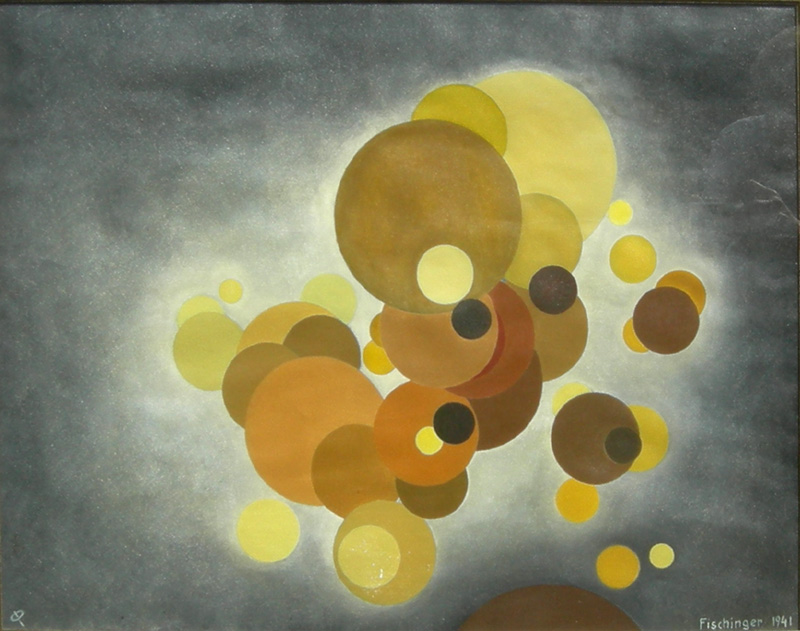
An avid painter (he produced a total of around 800 canvases), Fishinger tried to relate painting to his work on film, thus creating layers of grids and geometric forms in pulsating color, and generating a third dimension of cosmic depth in light, space and rhythm.

Oskar Fischinger, ‘Optical Ballet’ (Oil on paper, 1941)

Fischinger’s magnificent Motion Painting No. 1 (1947), set to Bach’s Brandenburg Concerto No. 3, can also be seen as a study on the act of painting; he created it by taking a single frame for each brushstroke over the course of 9 months, its multi-layered style mirroring  the elaborate structure of Bach’s music (although not strictly synchronized with it).

Fischinger’s vision and highly innovative approach to film-making influenced profoundly subsequent creative artists; one of those who followed in his footsteps was American abstract filmmaker Jordan Belson (1926 – 2011), whose own cosmic visions would be realized through projects like the legendary Vortex concerts that took place in the late 1950s at the California Academy of Science’s Morrison Planetarium in San Fransisco (featuring music by Henry Jacobs and avant-garde composers such as Karlheinz Stockhausen).

Stills from ‘Allures’ (1961), ‘Samadhi’ (1967), ‘Epilogue’ (2005) (c) Jordan Belson

Belson saw Fischinger as the man who “could turn even the simplest things into a luxurious, magical illusion of cosmic elegance.”

No small achievement indeed.