Monthly Archives: June 2013

Great moments of Greek(lish) rock, pt.3: Drunken Socrates

Socrates Drank the Conium were undoubtedly the most important exponents of the Greek rock scene throughout the 1970s and up to the early 1980s. Their name has attained a somewhat legendary status and commands considerable respect among Greek rock fans and critics up to this day.

Although the name ‘Socrates Drank the Conium’ first appeared in 1969, the story of the band goes back to the time when fellow high-school students Antonis Tourkogiorgis and Yiannis Spathas formed The Persons. The impeccable synchronization and exemplary blending of Spathas’s guitar playing with Tourkogiorgis’s distinctive use of bass was evident from early on, as was the potential for the remarkable compositions that were about to emerge.

Socrates Drank the Conium (1972)

After releasing three singles and making several live appearances as Persons, they changed their name to Socrates Drank the Conium (or simply Socrates, as friends and fans would end up calling them) and made their recording debut (Socrates Drank the Conium, 1972) as a trio, with Elias Boukouvalas behind the drums. The album is characterized by an explosive mix of blues, heavy rock and psychedelic elements much akin to the sound of bands like The Jimi Hendrix Experience and Cream. Apart from such obvious influences, other artists that had a significant impact on Socrates included Ten Years After, Fleetwood Mac, John Mayal, Free and Led Zeppelin. Despite the rather poor production and the unhelpful recording conditions, which also concern their next album (Taste of Conium, 1972), Socrates’ powerful message got through and resulted in a warm reception from both Greek public and press of the time.

The band’s biggest asset was undeniably the astonishing technique of guitarist John Spathas whose virtuosity and musicality produced results of exceptional power and expressiveness when combined with the band’s rock-solid rhythm session. In addition, the frequent incorporation of traditional Greek elements in Spathas’s guitar passages and solos would also become one of the band’s trademarks and most significant innovations.

The introduction of Live in the Country – the very first song in Socrates’ recording career – is a brilliant demonstration of Spathas’s skillful guitar playing and highly idiomatic musical language, which arises from a combination of a Hendrix-like sound and elements of Greek folk music.

SocratesBy the time their third album (On the Wings, 1973) hit the shelves, Socrates had already attained a preeminent place amongst contemporary Greek bands. Having played at most of the major venues in Greece but also elsewhere in Europe (including club Paradiso in Amsterdam), Socrates became known for the forcefulness and electrifying atmosphere of their live performances.

The creative course of Socrates culminated in the mid-1970s, when their collaboration with keyboardist and composer Vangelis Papathanassiou (who had also been a member of Aphrodite’s Child) led to the release of Phos (1976). Vangelis’s touch gave the band a more lyrical and elegiac sound that is clearly distinguishable throughout the album. Recorded in London, Phos (“light” in Greek) stands out as the crowning achievement of not just the band, but the entire Greek progressive rock scene of the era.

The album contains pieces of profound beauty such as Queen of the Universe, as well as a popular rendition of Starvation, which had appeared on the band’s debut album. The indisputable highlight, however, is Mountains (which would be re-recorded again in 1980), where Spathas embarks on an improvisatory trip of monumental scale, showcasing his exceptional guitar technique and unique assimilation of Greek folk musical idioms.

In the early 1980s, Socrates returned with two more noteworthy attempts (Waiting for Something and Breaking Through) and a couple of years later the band released its swan song (Plaza, 1983), having a last shot at international fame. Just before the turn of the millennium Socrates came together for  a series of concerts which resulted in the release of their live album Live in Concert ’99, a record that effectively summarizes their long and remarkable career.

Great moments of Greek(lish) rock, pt.2: Reflections of Genius

Manos Hadjidakis (1925 – 1994) was arguably the greatest Greek composer of the past century. Spanning across 5 decades, his voluminous creative output touches upon many diverse genres and styles, always characterized by a high degree of originality, sensitivity and expressiveness.

Greek composer Manos Hadjidakis (1925 – 1994)

Hadjidakis achieved international fame with his Never on Sunday, which won the Academy Award for Best Original Song in 1960 (a first for a foreign-language picture). The song has been covered in various languages ever since (from Yiddish to Cantonese) and its popularity does not seem to be waning, as testified by more recent versions such as the one by Pink Martini.

While in New York City, where he was living since 1966, Hadjidakis recorded Reflections together with the New York Rock & Roll Ensemble. Featuring English lyrics written by the band and Hadjidakis’s highly personal and emotional melodic lines, the result was an unprecedented fusion of classical, pop, rock, and traditional Greek music.

Released in 1970, the album contains some of Hadjidakis’s most captivating music. The elaborate orchestrations, ethereal melodies and gracefulness of the tunes have raised Reflections to a unique place among the composer’s oeuvre.

A rare musical marriage of seemingly disparate elements, the music of Reflections is characterized by hauntingly beautiful and melancholic overtones, that create a distinctive atmosphere of intimacy and warmth between the work and the listener.

The album’s popularity has always remained high and in 1993 it was re-recorded with Greek lyrics written by Nikos Gatsos, with Aliki Kayaloglou on vocals. More recently, the acclaimed Greek band Raining Pleasure released its own interpretation of the work, reaffirming its status as a timeless classic of Greek art music.

Great moments of Greek(lish) rock, pt.1: The Psychedelic Apocalypse

Here is wisdom. Let him who has understanding calculate the number of the beast, for it is the number of a man: His number is 666.

(Rev. 13:18)

Although 60s-70s Greek rock music was of no particular interest to the international public (not least because of obvious linguistic reasons), there were however some notable exceptions. Perhaps the most well-known Greek English-singing band of the era is Aphrodite’s Child (named after a song by Dick Campbell), formed in 1967 by Vangelis Papathanassiou (keyboards), Demis Roussos (bass guitar and vocals), Loukas Sideras (drums and vocals), and Anargyros “Silver” Koulouris (guitar).

Their first single Rain and Tears (1968), an adaptation of Pachelbel’s famous Canon in D, was recorded while the band was based in France. It met with considerable international success and went on to sell more than one million copies.

The band’s undisputed masterpiece, however, would be 666 (The Apocalypse of John, 13/18). Recorded between late 1970 and early 1971, 666 is considered a landmark in the history of progressive rock. An album of astonishing musical diversity, it was a powerful combination of original concept and highly innovative sound.

666 was largely Vangelis’s own musical project, as is testified by the advanced (for the time) use of synthesizers/keyboards, sound effects, and overall production. Musically, the album contains several remarkable moments (e.g. Aegean Sea, Break, The Four Horsemen), however it works best when seen as an uninterrupted, thematically-unified musical composition.

Aphrodite's Child: Best ofIts musical merits notwithstanding, the release of 666 was not unproblematic. The record company did not approve of the record’s length and largely experimental style, to say nothing about its subject matter. To top it off, the track “∞” featured Greek actress Irene Papas singing frantically “I was, I am, I am to come” in an aural simulation of female orgasm.

When the double album was eventually released in 1972 (one year after it had been completed), its blood-red cover (where the number 666 is prominently displayed) would also stir some controversy. This, however, only helped to boost the album’s sales, which exceeded 20 million copies worldwide.

Despite being the band’s greatest achievement, 666 would also be their swan song. Relationships between band members grew increasingly worse during the album’s recording, and by the time the record was out Aphrodite’s Child had already split. Both Roussos and Vangelis would follow successful solo careers, the latter achieving worldwide fame as a composer of electronic music (including the soundtracks for Blade Runner and Chariots of Fire).

Even though the children of Aphrodite had chosen to go their separate ways, they had managed to give birth (albeit a troubled one) to their psychedelic masterpiece – an everlasting monument of Greek rock music and one of the defining albums of the 70s progressive and experimental scenes.

125 years of sublime sound

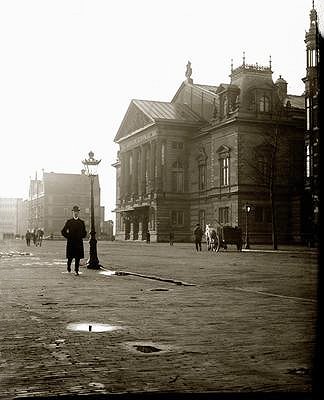
On April 11, 1888 an orchestra of 120 musicians together with a chorus of 500 singers performed works of Wagner, Handel, Bach, and Beethoven in a new building in what was then called Nieuwer-Amstel. It was the beginning of the story of the Concertgebouw, Amsterdam’s famous and much beloved concert hall. And no doubt it’s been a long, fascinating story…

This year, the city’s oldest and grandest classical music venue celebrates its 125th birthday. Due to its remarkable acoustics, the Concertgebouw is considered one of the finest concert halls worldwide – and for good reason. Anyone who’s been fortunate enough to attend a concert in the magnificent Grote Zaal (‘Big Hall’) is familiar with the unique aura and enchanting atmosphere of the venue.

The Concertgebouw in 1902

The Concertgebouw in 1902

Throughout its long -and at times turbulent- history, the Concertgebouw has been host to an astonishing string of world-renowned composers who came along to present premieres of their works, such as Gustav Mahler, Sergei Prokofiev, Richard Strauss, Maurice Ravel and Béla Bartók.

But by no means is the list confined to the classical genre alone. Legendary figures from the world of popular music have also performed in Amsterdam’s historic venue. Duke Ellington, Aretha Franklin, Ella Fitzgerald, Shirley Bassey have all been guests of the Concertgebouw, along with rock giants such as Led Zeppelin and Pink Floyd.

Personally, I always regard a visit to the Concertgebouw as a kind of pilgrimage to one of the world’s unique music temples. Along with Vienna’s Musikverein or London’s Royal Albert Hall, it ranks as one of the most beautiful concert halls I have ever visited. But more importantly, it is a place where music can be experienced most fully and intensely, and thus I think the word ‘temple’ should not ring too much out of place.

In all my years in Amsterdam, I’ve had the chance to see some truly amazing performances at the Concertgebouw. I was there for a solo piano recital by Daniel Barenboim for the celebration of Chopin’s bicentennial. I saw Earl Wild performing shortly after his ninetieth birthday, attended recitals by some of the world’s greatest pianists (Evgeny Kissin, Alfred Brendel and Grigory Sokolov to name a few) and saw celebrities like Chick Corea, Yo-Yo Ma and Lang Lang showcasing their extraordinary skills and virtuosity on stage.

One of the most-visited concert halls worldwide, the Concertgebouw seems to have not only a glorious past but also a promising future. And I look forward to being part of the experiences it yet has to offer.