This is the first recording I’ve made in quite a while. I came up with the main theme (which opens the piece and appears again in the end with a slight variation) several years ago and I started working on it again recently, adding a middle section and arranging the strings.
I always thought of this piece as the background music of some -yet unrealized- film. The title was inspired by Jack Bruce’s Theme for an imaginary western from his wonderful album Songs for a Tailor.
“You’re never really done for, as long as you got a good story and someone to tell it too.”
(Max Tooney in The Legend of 1900)
In his theater monologue Novecento, Italian writer Alessandro Baricco gives a fascinating account of the life and times of Danny Boodman T. D. Lemon 1900, a fictional piano wunderkind born on the ocean liner Virginian who was destined never to set foot on land.
Baricco’s relationship with music is intimate (he has published a book on Gioachino Rossini and worked as a music critic for La Repubblica) and his Novecento is a joy to read. I particularly enjoyed his reflections on the nature and limitless possibilities of music making:
“We were playing because the Ocean is vast and scares you, we were playing so that people could forget the passing of time, forget where they were and who they were. We were playing so as to make people dance, because if you dance you feel like God and cannot die. And we were playing ragtime, because that’s the music God dances along when nobody watches.”
“So think now: a piano. Its keys start somewhere. And end somewhere. You know they are eighty-eight, nobody can tell you otherwise. They are not infinite. You are infinite, and so is the music you can make on these keys.”
Baricco’s story was made into a film in 1998 calledThe Legend of 1900, starring Tim Roth and directed by Giuseppe Tornatore. The film’s magnificent soundtrack is composed almost entirely by Ennio Morricone and it contains some truly captivating piano music. Alongside the Italian maestro, Roger Waters also contributed to the film’s soundtrack by performing and writing the lyrics for the piece Lost Boys Calling.
In the story’s heartbreaking finale, leaving the Virginian and facing the immensity of real life proves too overwhelming for the legendary pianist. Still, his unique music lives on, if only in the memories of all those who were once blessed to be among his audience.
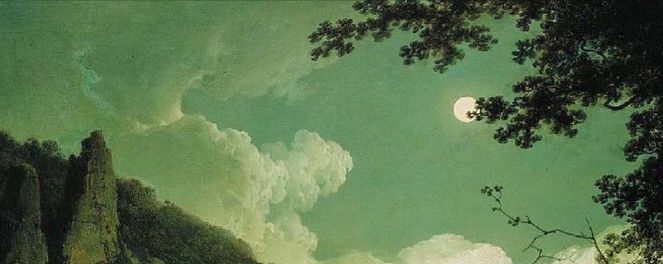
The moon has been a source of awe and admiration since times immemorial, and the fascination of man by its mysterious nature and changing phases can be shown by the multitude of lunar deities identified in mythological accounts all around the world.
It was the same fascination that would inspire the art of Romanticism, which placed new emphasis on the intense emotions arising from the confrontation with the sublimity of the natural world. Captivating depictions of the moon can be found in several romantic works, as in the paintings of Caspar David Friedrich (1774 – 1840) or the poetry of Percy Bysshe Shelley (1792 – 1822).
“Dovedale by Moonlight” (detail), by Joseph Wright of Derby (1734-1797)
In music, the most popular composition associated with the moon is most probably Beethoven’s Moonlight Sonata, written in 1801. The composer, however, would never get to know it by this name (its original title is Sonata quasi una fantasia); the nickname ”Moonlight” only came about some five years after Beethoven’s death, thanks to a description by Ludwig Rellstab, a German poet and music critic, who referred to the composition in terms of “a vision of a boat on Lake Lucerne by moonlight.” Even though Beethoven did not necessarily share Rellstab’s vision, the sonata would be thereafter associated with moonlight and its mesmerising first movement would serve as a prototype for many nocturnes during the 19th century.
It was in 1890 that Claude Debussy started to compose his Suite Bergamasque. Its third and most famous movement was inspired by Paul Verlaine’s poem Clair de Lune (French for “moonlight”) and carries the same name. Originally written for the piano, Debussy’s suite has been orchestrated by many composers including André Caplet, Lucien Cailliet (whose arrangement was used in the closing scene of Ocean’s Eleven), and Leopold Stokowski.
Stokowski’s version was actually meant to feature in Disney’s Fantasia, however the scene was eventually deleted due to length limitations.
The mystique and magical quality of moonlight have continued to inspire and fuel artistic creation up to modern times. One of the most beautiful examples can be found in Paco de Lucía’s album Fuente y Caudal, which brought him international fame. It is the wonderful granaína Reflejo de luna (“reflection of moon”), a true gem that reveals the seemingly limitless capacity of flamenco guitar for expression and color. It is, after all, no accident that the strings of the guitar have been called the “six silver moonbeams”…
Ten minutes. The time it takes to water the plants, do the dishes or read the daily news. At least in the conventional sense of “time.” Because there exists another, parallel dimension where time can be suspended indefinitely and a single moment can signify an eternity. In this dimension, which is no other than the realm of abstract music, ten minutes of “normal” time assume a new importance and are long enough to open a portal to a radically different perception of reality and the cosmos.
Ten minutes is approximately the duration of Spiegel im Spiegel (“mirror in the mirror”), a piece by Estonian composer Arvo Pärt (b. 1935) written in 1978 for piano and violin. If there was ever a musical synonym for absorbed meditation and contemplative stillness, this would have to be it.
Estonian composer Arvo Pärt
Spiegel im Spiegel is written in the compositional style of tintinnabuli (from the Latin tintinnabulum = bell), a technique invented by Pärt himself and influenced by his mystical experiences with religious music. Although his early works are characterized by a variety of styles ranging from neoclassicism to serialism, his preoccupation and study of choral music, Gregorian chant and the polyphonic music of the Renaissance eventually led Pärt to develop an idiomatic style characterized by simple harmonic structure and rhythmic patterns, alluding to the ringing of bells.
“Tintinnabulation”, says Pärt, “is an area I sometimes wander into when I am searching for answers – in my life, my music, my work. In my dark hours, I have the certain feeling that everything outside this one thing has no meaning. The complex and many-faceted only confuses me, and I must search for unity.” Of this type of music, Spiegel im Spiegel isone of the earliest and finest illustrations. It is also one of his most popular works and has been repeatedly used in films, as in Jean-Luc Godard’s In Praise of Love (2001) and Guy Ritchie’s Swept Away (2002).
That a work by Pärt such as Spiegel im Spiegel has been so well-received is a bit of a contradiction. One can hardly think of more introspective, detached and unfashionable music than this. And yet it contains a certain quality that defies time and space, speaking directly to one’s heart and inner self. As Steve Reich, one of the founding fathers of minimalism, once put it: “[Pärt’s] music fulfills a deep human need that has nothing to do with fashion.”
It is not just the ten sublime minutes of Spiegel im Spiegel. Much of Pärt’s music is of profound expressivity and unfathomable beauty (his Tabula Rasa is another case in point). The composer once compared his music to “white light which contains all colors”, its division being possible only through a prism, which could be “the spirit of the listener.” At its best, this music indeed offers that which only divine light could ever promise to reveal: a glimpse of the eternal.
Born on January 31 (the same day as Franz Schubert), Philip Glass is regarded as one of the most influential composers to emerge during the twentieth century. Although he evolved stylistically in his later works, the American composer has been mostly associated with minimal music, a style that has its origins in the underground scene and alternative spaces of San Francisco and New York of the early 1960s.
My first encounter with Glass’s music was back in the 1990s, through a compilation CD that contained key works by contemporary composers. The piece was the 1st movement of his Violin Concerto No.1, which still ranks among my favorite pieces of modern music – or any music for that matter, as I consider it a masterpiece by any standards.
Many years later, I had the chance to see Philip Glass performing with his ensemble at the Muziektheater in Amsterdam. It was one of the lengthiest and most demanding music performances I have ever attended: a total duration of 5 hours over which Glass’s large-scale work Music in Twelve Parts was executed in its entirety (a rare event).
It is true that the repetitive structure and recurring musical elements in Glass’s works and minimal music in general can be somewhat off-putting without the listener’s engagement and active participation. On the other hand, I find this style of music relatively easy to follow (at least when compared with most of atonal music) and highly rewarding for a set of persistent and appreciative ears. Glass, after all, describes himself as a “classicist”. He was trained in harmony as well as counterpoint and, under the guidance of French composer and conductor Nadia Boulanger, he has studied the compositions of J.S. Bach, W.A. Mozart and, well, Franz Schubert…
Interestingly, the relationship between the latter and Philip Glass extends far beyond a shared birthday. Glass’s fondness for Schubert’s music can be traced throughout his oeuvre, most notably in his writing for piano. According to Dutch pianist and composer Jeroen Van Veen, an example of this can be found in Glass’s Mad Rush, which alludes to the opening piano part of Schubert’s beautiful Lied Du bist die Ruh.
Glass’s appreciation and respect for the Viennese master with the iconic glasses of steel frame and spherical lenses appears, then, to be well-grounded. In all likelihood, Schubert too would approve of Glass’s creative approach in using relatively simple forms to produce works of high dynamics and powerful emotion. Not to mention his soft spot for round glasses. It’s all in the name, it seems…




 The Muser