Tag Archives: music

Music of the spheres

It was Pythagoras who first proposed that the Sun, Moon and planets all emit a unique resonance based on their orbital revolution, a theory that became known as the “Harmony of the Spheres”. In his Republic, Plato also alluded to the connection between music and astronomy: “As the eyes, said I, seem formed for studying astronomy, so do the ears seem formed for harmonious motions: and these seem to be twin sciences to one another, as also the Pythagoreans say”.

Fascinated and inspired by this idea of ‘spherical music’ (or musica universalis), British violinist Daniel Hope set out to record Spheres, which was released last February by Deutsche Grammophon. As Hope puts it: “My aim was to make an album touching on this sublime theme, while also discovering what composers nowadays might write when thinking in this context.” The final result is remarkable not only for its original concept, but also for its incorporation and imaginative combination of many diverse, yet equally intriguing, compositions.

For the purposes of this special recording, old and new composers were drawn together and some of the works appearing on the album were given their world premiere or special new arrangements. Spheres features music from a wide range of styles and composers including J.S. Bach, Gabriel Fauré, Ludovico Einaudi, Phillip Glass, Michael Nyman, and Max Richter (who also collaborated with Hope on his interpretation of Vivaldi’s The Four Seasons).

Beautiful, mysterious and captivating, the music of Spheres can be seen as an ideal companion to the visual artistry of abstract filmmakers like Jordan Belson (1926-2011), who had also made a film named Music of the Spheres in 1977 (you can watch a clip here).

Images from Music of the Spheres artwork, 1977, (c) Estate of Jordan Belson

For those who find classical music passé or contemporary composers too difficult, listening to Spheres is certainly bound to make them reconsider.

Music for the eyes

Oskar Fischinger (1900 – 1967) was one of the most visionary and innovative figures to emerge in the filmmaking world during the first half of the 20th century. Acclaimed for his abstract animation films, his work anticipated in many ways modern-day music videos and motion graphics.

Fischinger is also recognized as the father of “visual music” (Raumlichtmusik), a new art form developed in the 1920s in which he envisioned the merging of all the arts – a new kind of figurative, non-objective Gesamstkunstwerk. As he described it: “Of this art everything is new and yet ancient in its laws and forms. Plastic – Dance – Painting – Music become one.  The Master of the new Art forms poetical work in four dimensions… Cinema was its beginning… Raumlichtmusik will be its completion.”

After Hitler’s denigration of abstract art, Fishinger moved to Los Angeles in 1936, where he worked on animated films for Paramount, MGM and Walt Disney Studios (he designed the J.S. Bach Toccata and Fugue in D Minor sequence for Disney’s Fantasia, but quit without credit because his designs were rejected as too abstract). Although he faced several difficulties with his filmmaking efforts in America, he managed to create significant compositions such as An Optical Poem (1937) (set to Franz Liszt’s Hungarian Rhapsody No. 2).

An avid painter (he produced a total of around 800 canvases), Fishinger tried to relate painting to his work on film, thus creating layers of grids and geometric forms in pulsating color, and generating a third dimension of cosmic depth in light, space and rhythm.

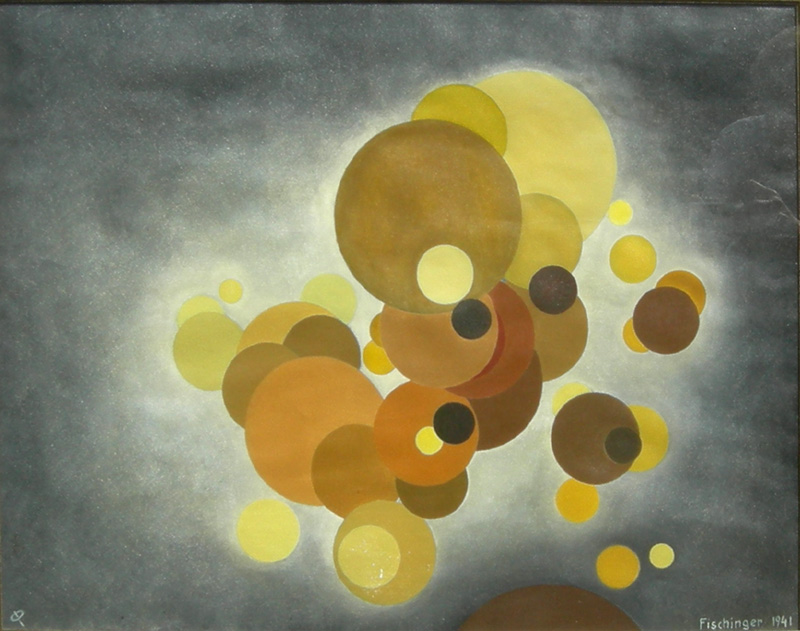
Oskar Fischinger, ‘Optical Ballet’ (Oil on paper, 1941)

Fischinger’s magnificent Motion Painting No. 1 (1947), set to Bach’s Brandenburg Concerto No. 3, can also be seen as a study on the act of painting; he created it by taking a single frame for each brushstroke over the course of 9 months, its multi-layered style mirroring  the elaborate structure of Bach’s music (although not strictly synchronized with it).

Fischinger’s vision and highly innovative approach to film-making influenced profoundly subsequent creative artists; one of those who followed in his footsteps was American abstract filmmaker Jordan Belson (1926 – 2011), whose own cosmic visions would be realized through projects like the legendary Vortex concerts that took place in the late 1950s at the California Academy of Science’s Morrison Planetarium in San Fransisco (featuring music by Henry Jacobs and avant-garde composers such as Karlheinz Stockhausen).

Stills from ‘Allures’ (1961), ‘Samadhi’ (1967), ‘Epilogue’ (2005) (c) Jordan Belson

Belson saw Fischinger as the man who “could turn even the simplest things into a luxurious, magical illusion of cosmic elegance.”

No small achievement indeed.

Bachbird singing

While also connected with the 1960s Civil Rights movement, Paul McCartney’s Blackbird is said to have been originally inspired from the experience of being woken by a blackbird’s song just before sunrise.

Musically speaking, McCartney was influenced by J.S. Bach’s Bourrée from the Suite in E minor for Lute (BWV 996), a piece often performed on the classical guitar. George Harrison and Colin Manley had taught him how to play Bach’s Bourrée at Liverpool Institute. As Sir Paul later put it: “I bastardized it, but it was the basis of how I wrote Blackbird.”

In this recording I’ve tried to bring the two pieces together, accompanied by the singing of birds on a sunny day…

Changing of the seasons

Antonio Vivaldi composed The Four Seasons (‘Le quattro stagioni’) in 1723. A work of unmatched artistry and elegance, it would become one of the most popular pieces of baroque music, if not classical music in general. It is also an early example of program music, with the four concertos named after the different seasons and following closely a set of corresponding sonnets.

The Four Seasons is an integral part of the violin repertoire, a work literally hardwired in the brain of every violinist. As might be expected, there is an abundance of recordings: approximately 1,000(!) different recorded versions of The Four Seasons have made their appearance since 1939 by various soloists and orchestras.

My personal favorites include the recording by Yehudi Menuhin and Camerata Lysy Gstaad from 1981, as well as Nigel Kennedy’s popular 1989 recording with the English Chamber Orchestra. Kennedy had studied with Menuhin as a child, and his recording of the The Four Seasons would become one of the best-selling classical works of all time. An eccentric figure, Kennedy has never hesitated to introduce improvisatory elements in his playing, which often makes his live performances electrifying.

Inevitably, some approaches to Vivaldi’s great composition have proved to be more daring and stylistically innovative than others. This is the case with French pianist and composer Jacques Loussier (b. 1934), whose main claim to fame have been his magnificent jazz adaptations of J.S. Bach. Apart from its sheer musicality, the fact that Loussier’s rendition manages to capture the essence of the original work by means of a piano trio alone is impressive.

More recently, British composer Max Richter (b. 1966) offered us a truly astonishing re-composition of Vivaldi’s The Four Seasons (its premiere was on 31 October 2012). In describing the 1st movement of his Summer, Richter talks about “relentless pulsed music”, adding that perhaps he “was also thinking about John Bonham’s drumming.” He has also referred to the connection between the harpsichord’s sound in the 2nd movement of his Autumn and the style of various pop recordings, including Abbey Road and several albums by the Beach Boys.

The metamorphoses of The Four Seasons throughout the ages show how a baroque masterpiece can survive in modern times through assuming different forms and incorporating elements from such diverse genres as jazz, pop, hard rock and minimalism. Seasons may keep changing, yet Vivaldi’s music remains.

When the Beatles met the sugar plum fairy

When I was still a little child, my acquaintance with the world of classical ballet (and I suspect not just mine) was made through The NutcrackerIt was love at first sight (and hearing), as the delightful music of Tchaikovsky coupled with a most extraordinary set of characters such as the Mouse King, the Nutcracker Prince with his soldiers, and of course the Sugar Plum Fairy.

One of Tchaikovsky’s most celebrated works, the immense popularity of The Nutcracker owes much to a tradition that started in 1954, when the New York City Ballet first performed the ballet choreographed by George Balanchine. The company has since performed the ballet every year during the Christmas season with great success, paving the way for a growing number of performances across the world by several ballet companies in the years that followed.

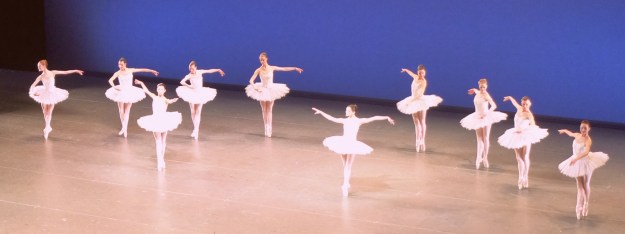
‘Best of Balanchine’, performed by the Dutch National Ballet in the Amsterdam Music Theater

In 1965, the British orchestral composer Arthur Wilkinson made a very special arrangement of music by The Beatles, blending some of their well-known tunes with movements from Tchaikovsky’s Nutcracker Suite. The result of this peculiar musical marriage was called the Beatle Cracker Suite.

A musical allusion to Tchaikovsky’s popular ballet can also be found  in the film Magical Mystery Tour. It was the Beatles’ producer George Martin who, seeing that the opening strain of All My Loving is almost identical to the melody from Nutcracker’s Pas de deux but turned upside down, decided to arrange the song à la Tchaikovsky for the film’s background music.

The most intriguing manifestation of the unique relationship between the Russian master and the British pop stars was perhaps one not made through notes. It would be, however, captured on record through the soft, rather lazy and yet mysterious-sounding voice of Lennon, as he was whispering “sugar-plum-fairy, sugar-plum-fairy” into the microphone during the intro of the epic A Day in the Life (as can be heard in the Love version of the song).

It appears the little fairy’s dance had taken her all the way from Russia’s imposing music theaters to the Abbey Road Studios in London amidst the swinging sixties. What an honor indeed to have been summoned by The Beatles on such a special day in their life. No doubt Tchaikovsky would not have minded her leaving home!