Tag Archives: music

Raising ravens

A Spanish drama

I recently had the chance to watch Cría Cuervos (‘Raise Ravens’), a 1976 drama film by Spanish director Carlos Saura. The film, which won the Special Jury Prize Award at the 1976 Cannes Film Festival, was shot as Spanish dictator Francisco Franco was lying on his deathbed. While it deals with themes like childhood and loss, one can also find subtle allusions to the contemporary political situation and the changes Spanish society was undergoing at the time.

Cría Cuervos left quite a strong impression on me. As the story unfolds Saura manages to create a miniature, fragile universe of emotional intensity and introspective -almost claustrophobic- atmosphere (most of the film is shot inside a single house).

In the center of this universe lies Ana, the little girl protagonist, played by 8-year-old Ana Torrent whose performance is absolutely mesmerizing. Ana’s father (a general in the Spanish army), her mother and two sisters (together with the rest of the characters in the film) all seem to revolve around her, like planets in orbit that occasionally draw nearer or get farther away from little Ana.

 Jeanette meets Frederic Mompou

The film’s exemplary direction and great performances aside, I was also intrigued by its music. Jeanette’s pop song Porque te vas recurs throughout the movie, adding a bittersweet feeling to the film’s imagery.

What is more, the film’s main music theme is Cançó No.6 in E-flat minor by Catalan composer Frederic Mompou (1893 – 1987), a wonderfully melancholic and haunting piano piece. Originally dedicated to Arthur Rubinstein, it was also a favorite of celebrated Italian pianist Arturo Benedetti Michelangeli.

PS: The film’s title comes from the Spanish proverb Cría cuervos y te sacarán los ojos, which literally translates as: “Raise ravens, and they’ll take out your eyes”.

125 years of sublime sound

On April 11, 1888 an orchestra of 120 musicians together with a chorus of 500 singers performed works of Wagner, Handel, Bach, and Beethoven in a new building in what was then called Nieuwer-Amstel. It was the beginning of the story of the Concertgebouw, Amsterdam’s famous and much beloved concert hall. And no doubt it’s been a long, fascinating story…

This year, the city’s oldest and grandest classical music venue celebrates its 125th birthday. Due to its remarkable acoustics, the Concertgebouw is considered one of the finest concert halls worldwide – and for good reason. Anyone who’s been fortunate enough to attend a concert in the magnificent Grote Zaal (‘Big Hall’) is familiar with the unique aura and enchanting atmosphere of the venue.

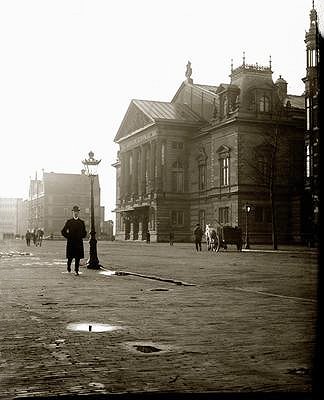
The Concertgebouw in 1902

The Concertgebouw in 1902

Throughout its long -and at times turbulent- history, the Concertgebouw has been host to an astonishing string of world-renowned composers who came along to present premieres of their works, such as Gustav Mahler, Sergei Prokofiev, Richard Strauss, Maurice Ravel and Béla Bartók.

But by no means is the list confined to the classical genre alone. Legendary figures from the world of popular music have also performed in Amsterdam’s historic venue. Duke Ellington, Aretha Franklin, Ella Fitzgerald, Shirley Bassey have all been guests of the Concertgebouw, along with rock giants such as Led Zeppelin and Pink Floyd.

Personally, I always regard a visit to the Concertgebouw as a kind of pilgrimage to one of the world’s unique music temples. Along with Vienna’s Musikverein or London’s Royal Albert Hall, it ranks as one of the most beautiful concert halls I have ever visited. But more importantly, it is a place where music can be experienced most fully and intensely, and thus I think the word ‘temple’ should not ring too much out of place.

In all my years in Amsterdam, I’ve had the chance to see some truly amazing performances at the Concertgebouw. I was there for a solo piano recital by Daniel Barenboim for the celebration of Chopin’s bicentennial. I saw Earl Wild performing shortly after his ninetieth birthday, attended recitals by some of the world’s greatest pianists (Evgeny Kissin, Alfred Brendel and Grigory Sokolov to name a few) and saw celebrities like Chick Corea, Yo-Yo Ma and Lang Lang showcasing their extraordinary skills and virtuosity on stage.

One of the most-visited concert halls worldwide, the Concertgebouw seems to have not only a glorious past but also a promising future. And I look forward to being part of the experiences it yet has to offer.

Ray Manzarek on the intro of “Light My Fire”

Ray Manzarek explaining how the introduction for “Light My Fire” came to life.  The background music is Invention No. 8, BWV 779 by Johann Sebastian Bach, which served as an inspiration for Manzarek.

The song’s distinctive organ intro has been characterized as “one of the most recognizable sounds in the history of rock music”.

Ray Manzarek (1939-2013)

In Ray’s words: “It just came out of, you know, fifteen or twenty years of music practice”.

Art under a cloudy sky

Although cloud watching seems to be reaching ever-higher levels of popularity nowadays, this noble activity has been a favorite pastime of sensitive and artistically inclined individuals long before the advent of modern photographic techniques.

In his nocturnal composition Nuages (“Clouds”), Claude Debussy tried to capture “the immutable aspect of the sky and the slow, solemn motion of the clouds, fading away in grey tones lightly tinged with white.

Debussy’s visual, descriptive language brings to mind impressionistic images of similar themes. Conversely, painters would also use music as a way to better illustrate the effects of their own art. In a letter to his brother Theo in 1888, Vincent Van Gogh wrote: “…in a picture I want to say something comforting, in the way that music is comforting.”

Vincent van Gogh, ‘Wheat Field Under Cloudy Sky’ (Oil on canvas, 1890)

A somewhat darker, and at times even disturbing, vision arises in some of Akira Kurosawa’s cinematic masterpieces, such as Rashomon (1950) and Ran (1985). Here, the depiction of imposing cloud formations serves as a symbol for the futility and the ephemeral status of human affairs, signifying the tragic dimensions of man’s passing from this world.

Ran-stills

Stills from Akira Kurosawa’s ‘Ran’ (1985)

In the dedication of Paris Spleen, one of the founding texts of literary modernism, Charles Baudelaire had dreamed “of the miracle of a poetic prose, musical, without rhythm and without rhyme” that could “adapt itself to the lyrical impulses of the soul, the undulations of reverie, the jibes of conscience.”

In the opening piece, L’étranger (“The Stranger”), Baudelaire’s enigmatic figure rejects received truths, certainties and conventions, retaining faith only to one’s self and the beauty of passing clouds…

“Tell me, enigmatical man, whom do you love best, your father, your mother, your sister, or your brother?

I have neither father, nor mother, nor sister, nor brother.

Your friends? Now you use a word whose meaning I have never known.

Your country? I do not know in what latitude it lies.

Beauty? I could indeed lover her, Goddess and Immortal.

Gold? I hate it as you hate God.

Then, what do you love, extraordinary stranger?

I love the clouds… the clouds that pass… up there… up there… the wonderful clouds!”

Theme from an imaginary soundtrack

This is the first recording I’ve made in quite a while. I came up with the main theme (which opens the piece and appears again in the end with a slight variation) several years ago and I started working on it again recently, adding a middle section and arranging the strings.

I always thought of this piece as the background music of some -yet unrealized- film. The title was inspired by Jack Bruce’s Theme for an imaginary western from his wonderful album Songs for a Tailor.