British guitarist and songwriter Richard Thompson started his long recording career in 1967 as a member of Fairport Convention. His exceptional guitar technique and songwriting skills soon earned him a highly acclaimed status among peer folk-rock musicians, and many of his songs have been subsequently covered by a wide range of artists (including Elvis Costello and David Gilmour).
Mostly known for his skilled acoustic playing, Thompson has deployed several styles over the years. He often plays bass notes using a pick between his thumb and first finger, adding the melody and extra ornamentation by plucking the treble strings with the rest of his fingers. Sometimes he also makes use of a thumb-pick, as in the motorcycle ballad 1952 Vincent Black Lightning.
A ‘folky’ power trio
His latest album Electric was released earlier this year, peaking at number 16 on the UK Album Chart (the highest charting album of his career so far). I recently had the chance to see Thompson perform live with his “electric trio” in Amsterdam, in one of the stops of his ongoing tour on both sides of the Atlantic.
It was interesting to watch such a revered acoustic player going electric, trying to emulate the sound of good old power trios like Cream or The Jimi Hendrix Experience. Towards the closing of the concert, however, Thompson made this telling confession: “You know, we are too folky to be a real power trio.”
With that, he grabbed his acoustic guitar and offered the audience a couple of excellent acoustic solo performances. He came back with his trio for a final tune: a magnificent, electrifying version of Hey Joe à laHendrix.
Whether folky, acoustic, or electric, one thing about Richard Thompson is certain: He surely remains a guitar powerhouse and a great inspiration for players worldwide.
Socrates Drank the Conium were undoubtedly the most important exponents of the Greek rock scene throughout the 1970s and up to the early 1980s. Their name has attained a somewhat legendary status and commands considerable respect among Greek rock fans and critics up to this day.
Although the name ‘Socrates Drank the Conium’ first appeared in 1969, the story of the band goes back to the time when fellow high-school students Antonis Tourkogiorgis and Yiannis Spathas formed The Persons. The impeccable synchronization and exemplary blending of Spathas’s guitar playing with Tourkogiorgis’s distinctive use of bass was evident from early on, as was the potential for the remarkable compositions that were about to emerge.
Socrates Drank the Conium (1972)
After releasing three singles and making several live appearances as Persons, they changed their name to Socrates Drank the Conium(or simply Socrates, as friends and fans would end up calling them) and made their recording debut (Socrates Drank the Conium, 1972) as a trio, with Elias Boukouvalas behind the drums. The album is characterized by an explosive mix of blues, heavy rock and psychedelic elements much akin to the sound of bands like The Jimi Hendrix Experience and Cream. Apart from such obvious influences, other artists that had a significant impact on Socrates included Ten Years After, Fleetwood Mac, John Mayal, Free and Led Zeppelin. Despite the rather poor production and the unhelpful recording conditions, which also concern their next album (Taste of Conium, 1972), Socrates’ powerful message got through and resulted in a warm reception from both Greek public and press of the time.
The band’s biggest asset was undeniably the astonishing technique of guitarist John Spathas whose virtuosity and musicality produced results of exceptional power and expressiveness when combined with the band’s rock-solid rhythm session. In addition, the frequent incorporation of traditional Greek elements in Spathas’s guitar passages and solos would also become one of the band’s trademarks and most significant innovations.
The introduction of Live in the Country – the very first song in Socrates’ recording career – is a brilliant demonstration of Spathas’s skillful guitar playing and highly idiomatic musical language, which arises from a combination of a Hendrix-like sound and elements of Greek folk music.
By the time their third album (On the Wings, 1973) hit the shelves, Socrates had already attained a preeminent place amongst contemporary Greek bands. Having played at most of the major venues in Greece but also elsewhere in Europe (including club Paradiso in Amsterdam), Socrates became known for the forcefulness and electrifying atmosphere of their live performances.
The creative course of Socrates culminated in the mid-1970s, when their collaboration with keyboardist and composer Vangelis Papathanassiou (who had also been a member of Aphrodite’s Child) led to the release of Phos (1976). Vangelis’s touch gave the band a more lyrical and elegiac sound that is clearly distinguishable throughout the album. Recorded in London, Phos (“light” in Greek) stands out as the crowning achievement of not just the band, but the entire Greek progressive rock scene of the era.
The album contains pieces of profound beauty such as Queen of the Universe,as well as a popular rendition of Starvation, which had appeared on the band’s debut album. The indisputable highlight, however, is Mountains (which would be re-recorded again in 1980), where Spathas embarks on an improvisatory trip of monumental scale, showcasing his exceptional guitar technique and unique assimilation of Greek folk musical idioms.
In the early 1980s, Socrates returned with two more noteworthy attempts (Waiting for Something and Breaking Through) and a couple of years later the band released its swan song (Plaza, 1983), having a last shot at international fame. Just before the turn of the millennium Socrates came together for a series of concerts which resulted in the release of their live albumLive in Concert ’99, a record that effectively summarizes their long and remarkable career.
The moon has been a source of awe and admiration since times immemorial, and the fascination of man by its mysterious nature and changing phases can be shown by the multitude of lunar deities identified in mythological accounts all around the world.
It was the same fascination that would inspire the art of Romanticism, which placed new emphasis on the intense emotions arising from the confrontation with the sublimity of the natural world. Captivating depictions of the moon can be found in several romantic works, as in the paintings of Caspar David Friedrich (1774 – 1840) or the poetry of Percy Bysshe Shelley (1792 – 1822).
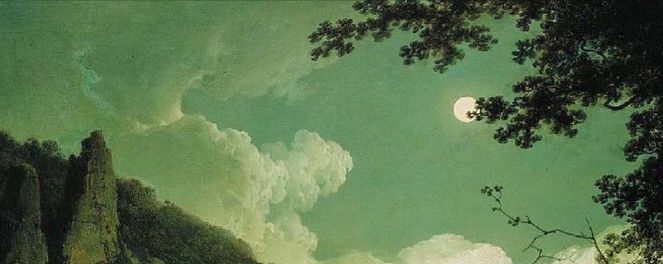
“Dovedale by Moonlight” (detail), by Joseph Wright of Derby (1734-1797)
In music, the most popular composition associated with the moon is most probably Beethoven’s Moonlight Sonata, written in 1801. The composer, however, would never get to know it by this name (its original title is Sonata quasi una fantasia); the nickname ”Moonlight” only came about some five years after Beethoven’s death, thanks to a description by Ludwig Rellstab, a German poet and music critic, who referred to the composition in terms of “a vision of a boat on Lake Lucerne by moonlight.” Even though Beethoven did not necessarily share Rellstab’s vision, the sonata would be thereafter associated with moonlight and its mesmerising first movement would serve as a prototype for many nocturnes during the 19th century.
It was in 1890 that Claude Debussy started to compose his Suite Bergamasque. Its third and most famous movement was inspired by Paul Verlaine’s poem Clair de Lune (French for “moonlight”) and carries the same name. Originally written for the piano, Debussy’s suite has been orchestrated by many composers including André Caplet, Lucien Cailliet (whose arrangement was used in the closing scene of Ocean’s Eleven), and Leopold Stokowski.
Stokowski’s version was actually meant to feature in Disney’s Fantasia, however the scene was eventually deleted due to length limitations.
The mystique and magical quality of moonlight have continued to inspire and fuel artistic creation up to modern times. One of the most beautiful examples can be found in Paco de Lucía’s album Fuente y Caudal, which brought him international fame. It is the wonderful granaína Reflejo de luna (“reflection of moon”), a true gem that reveals the seemingly limitless capacity of flamenco guitar for expression and color. It is, after all, no accident that the strings of the guitar have been called the “six silver moonbeams”…
While also connected with the 1960s Civil Rights movement, Paul McCartney’s Blackbird is said to have been originally inspired from the experience of being woken by a blackbird’s song just before sunrise.
Musically speaking, McCartney was influenced by J.S. Bach’s Bourrée from the Suite in E minor for Lute (BWV 996), a piece often performed on the classical guitar. George Harrison and Colin Manley had taught him how to play Bach’s Bourrée at Liverpool Institute. As Sir Paul later put it: “I bastardized it, but it was the basis of how I wrote Blackbird.”
In this recording I’ve tried to bring the two pieces together, accompanied by the singing of birds on a sunny day…




 By the time their third album (On the Wings, 1973) hit the shelves, Socrates had already attained a preeminent place amongst contemporary Greek bands. Having played at most of the major venues in Greece but also elsewhere in Europe (including club Paradiso in Amsterdam), Socrates became known for the forcefulness and electrifying atmosphere of their live performances.
 The Muser