
Tag Archives: Film

Music for the eyes

Oskar Fischinger (1900 – 1967) was one of the most visionary and innovative figures to emerge in the filmmaking world during the first half of the 20th century. Acclaimed for his abstract animation films, his work anticipated in many ways modern-day music videos and motion graphics.

Fischinger is also recognized as the father of “visual music” (Raumlichtmusik), a new art form developed in the 1920s in which he envisioned the merging of all the arts – a new kind of figurative, non-objective Gesamstkunstwerk. As he described it: “Of this art everything is new and yet ancient in its laws and forms. Plastic – Dance – Painting – Music become one.  The Master of the new Art forms poetical work in four dimensions… Cinema was its beginning… Raumlichtmusik will be its completion.”

After Hitler’s denigration of abstract art, Fishinger moved to Los Angeles in 1936, where he worked on animated films for Paramount, MGM and Walt Disney Studios (he designed the J.S. Bach Toccata and Fugue in D Minor sequence for Disney’s Fantasia, but quit without credit because his designs were rejected as too abstract). Although he faced several difficulties with his filmmaking efforts in America, he managed to create significant compositions such as An Optical Poem (1937) (set to Franz Liszt’s Hungarian Rhapsody No. 2).

An avid painter (he produced a total of around 800 canvases), Fishinger tried to relate painting to his work on film, thus creating layers of grids and geometric forms in pulsating color, and generating a third dimension of cosmic depth in light, space and rhythm.
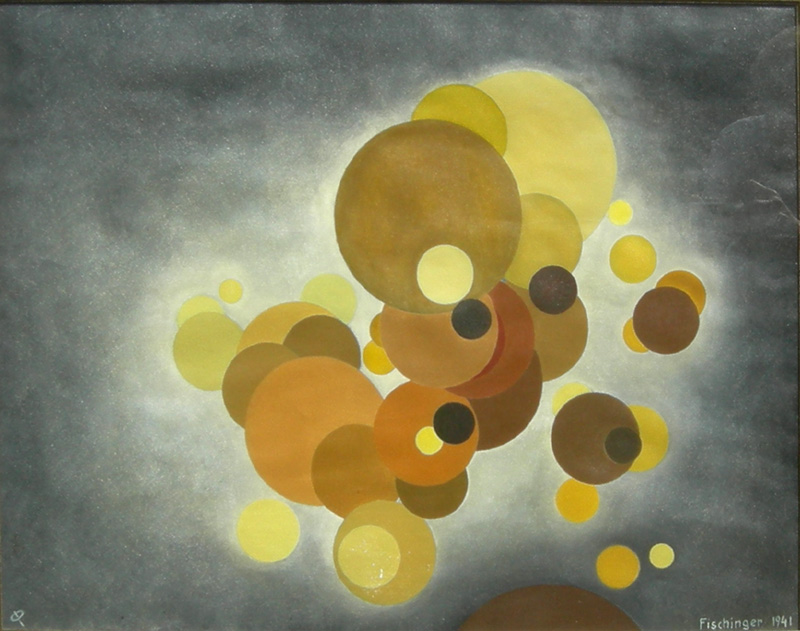
Oskar Fischinger, ‘Optical Ballet’ (Oil on paper, 1941)

Fischinger’s magnificent Motion Painting No. 1 (1947), set to Bach’s Brandenburg Concerto No. 3, can also be seen as a study on the act of painting; he created it by taking a single frame for each brushstroke over the course of 9 months, its multi-layered style mirroring  the elaborate structure of Bach’s music (although not strictly synchronized with it).

Fischinger’s vision and highly innovative approach to film-making influenced profoundly subsequent creative artists; one of those who followed in his footsteps was American abstract filmmaker Jordan Belson (1926 – 2011), whose own cosmic visions would be realized through projects like the legendary Vortex concerts that took place in the late 1950s at the California Academy of Science’s Morrison Planetarium in San Fransisco (featuring music by Henry Jacobs and avant-garde composers such as Karlheinz Stockhausen).

Stills from ‘Allures’ (1961), ‘Samadhi’ (1967), ‘Epilogue’ (2005) (c) Jordan Belson

Belson saw Fischinger as the man who “could turn even the simplest things into a luxurious, magical illusion of cosmic elegance.”

No small achievement indeed.

Buena música

It is simply impossible to overstress the enormous influence of Cuban music and its contribution to the development of various genres around the world, from jazz and salsa to the Argentine tango and the Spanish nuevo flamenco.

Known for its extensive blending of diverse styles and rhythms, Cuban music was in return also influenced by popular US music, as in the case of filín, a Cuban fashion of the 1940s and 1950s. Although Cuban jazz had also started in Havana around 1910-1930 it was not until the 1940s that the big band era arrived, owing much to great bandleaders like Armando Romeu Jr. and Damaso Perez Prado.

It was in the 1950s that Benny Moré, widely regarded as the greatest Cuban singer of all time, reached his heyday with his orchestra Banda Gigante (Big Band). Playing at the dance halls La Tropical and El Sierra in Havana, Moré and the group enjoyed immense popularity and went on to tour Venezuela, Jamaica, Haiti, Colombia, Panama, Mexico and the United States, where they performed at the Oscars.

The aftermath of the Cuban Revolution in 1959 saw the closing down of several night clubs and venues for popular music. As a result, many musicians were left without employment and emigrated to Puerto Rico, Florida and New York. Meanwhile in Cuba, artistic activity came increasingly under the control of the socialist regime, and with the movement of nueva trova music started to acquired a more political edge, combining traditional folk elements with often politicized lyrics.

A breakthrough for many legendary local musicians whose performing careers had come to a halt after the rise of Fidel Castro was the release of Buena Vista Social Club (1997). The album was the project of American guitarist and producer Ry Cooder, who visited Havana in 1996 to seek out and record these performers. Wim Wenders also captured the sessions on film, together with sell-out live performances of the group in Amsterdam and New York.

Following the album’s astonishing commercial and critical success, a number of its key performers (including singer Ibrahim Ferrer, guitarist/singer Compay Segundo, pianist Rubén González and trumpeter Manuel “Guajiro” Mirabal) set out to record solo albums, despite of their advanced age (all of them had been active in the Cuban music scene since the 1940s-50s).

Fifteen years after the release of Buena Vista Social Club, its reverberations are still felt quite strongly. As a result of its international success, younger audiences across the globe have had the chance to watch and listen live to these extraordinary musicians, while getting to know some of the younger talents of the contemporary Cuban music scene.

The Havana Lounge live in Paradiso, Amsterdam (15/02/2013)

It appears, then, that Ry Cooder’s fateful visit to Havana in 1996 managed indeed to rekindle the interest in Cuban tradition, opening a large window for international audiences with a vista to the horizon of Cuban music. A music so rich in its warmth, expression and feeling that surely makes for a most enjoyable view.

Quintessential Quentin

Regardless of whether you love or hate Quentin Tarantino (there are valid reasons for both), there’s one thing you can always count on when it comes to his films: music.

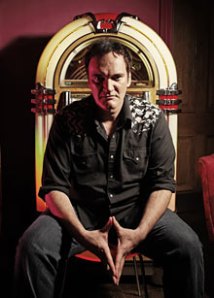
Tarantino

Tarantino’s use of music is an integral part of his creative process. Much of what’s best in his movies has to do at least as much with what we listen as with what we see. Take for example the “Misirlou” scene from Pulp Fiction or the lap dance scene from Death Proof.

His cooperation with celebrated composer Ennio Morricone has only helped to further enhance the powerful audiovisual effect of Tarantino’s movies. In his latest film Django Unchained one can hear a variety of music genres, however the Maestro’s touch is a crucial one. Tarantino could have hardly wished for someone better to work on the score of his American epic western, other than the man who composed the music for The Good, the Bad and the Ugly and Once Upon a Time in the West.

In case you already watched Django and were intrigued by its theme, I would like to point you to a 1971 Italian film by Gualtiero Jacopetti and Franco Prosperi called Goodbye Uncle Tom (original title: Addio Zio Tom). If you thought Django was somewhat shocking, then brace yourselves! And, by the way, you may well be familiar with the film’s theme song (originally written by Riz Ortolani), as it was also used by Nicolas Winding in his recent film Drive.

Loan and re-contextualization of pre-existing material have been, after all, commonplaces for the creative process in all art. Tarantino’s mash-up approach of mixing  a wide range of very different elements in his films is no exception: combined with his eclectic choice of music, it constitutes the quintessence of his art.

The music of suspended time

Ten minutes. The time it takes to water the plants, do the dishes or read the daily news. At least in the conventional sense of “time.” Because there exists another, parallel dimension where time can be suspended indefinitely and a single moment can signify an eternity. In this dimension, which is no other than the realm of abstract music, ten minutes of “normal” time assume a new importance and are long enough to open a portal to a radically different perception of reality and the cosmos.

Ten minutes is approximately the duration of Spiegel im Spiegel (“mirror in the mirror”), a piece by Estonian composer Arvo Pärt (b. 1935) written in 1978 for piano and violin. If there was ever a musical synonym for absorbed meditation and contemplative stillness, this would have to be it.

Arvo Part

Estonian composer Arvo Pärt

Spiegel im Spiegel is written in the compositional style of tintinnabuli (from the Latin tintinnabulum = bell), a technique invented by Pärt himself and influenced by his mystical experiences with religious music. Although his early works are characterized by a variety of styles ranging from neoclassicism to serialism, his preoccupation and study of choral music, Gregorian chant and the polyphonic music of the Renaissance eventually led Pärt to develop an idiomatic style characterized by simple harmonic structure and rhythmic patterns, alluding to the ringing of bells.

Tintinnabulation”, says Pärt, “is an area I sometimes wander into when I am searching for answers – in my life, my music, my work. In my dark hours, I have the certain feeling that everything outside this one thing has no meaning. The complex and many-faceted only confuses me, and I must search for unity.” Of this type of music, Spiegel im Spiegel is one of the earliest and finest illustrations. It is also one of his most popular works and has been repeatedly used in films, as in Jean-Luc Godard’s In Praise of Love (2001) and Guy Ritchie’s Swept Away (2002).

That a work by Pärt such as Spiegel im Spiegel has been so well-received is a bit of a contradiction. One can hardly think of more introspective, detached and unfashionable music than this. And yet it contains a certain quality that defies time and space, speaking directly to one’s heart and inner self. As Steve Reich, one of the founding fathers of minimalism, once put it: [Pärt’s] music fulfills a deep human need that has nothing to do with fashion.”

It is not just the ten sublime minutes of Spiegel im Spiegel. Much of Pärt’s music is of profound expressivity and unfathomable beauty (his Tabula Rasa is another case in point). The composer once compared his music to “white light which contains all colors”, its division being possible only through a prism, which could be “the spirit of the listener.” At its best, this music indeed offers that which only divine light could ever promise to reveal: a glimpse of the eternal.

Music in colors

I often associate music up to the early sixties with film noir. All these black and white photographs from jazz artists performing in smokey bars, people sweating it off on the dance floor, Elvis with his guitar, The Beatles in Hamburg – they appear before my eyes just like sequences of a great two-color movie starring the biggest names of pop culture, plus countless of less known actors in side roles or as mere extras. Some more important than others, but all of them part of the bigger picture.

A picture that was about to be painted with a seemingly inexhaustible range of colors, over the course of the fateful decade that would culminate in the psychedelic frenzy of the Summer of Love and the social unrest of the Parisian May. Alongside the explosion of colors in the movie theatres, the visual representation of art and artists would also become part of this revolution through posters, photographs and highly imaginative album covers. A new world had arrived, a world seen as through a giant kaleidoscope, full of colorful patterns and magical reflections. Black and white was being pushed irrevocably to the kingdom of nostalgia, becoming its official ambassador.

And what about the music? Were all the black and white notes on the music sheet also painted in fresh, vibrant colors for the first time? Not quite. Music contained its color -or rather colors, countless colors- since its very inception. Every musical sound that can be produced has always had its match in a parallel, imaginary palette of endless color variety. Still, it takes a skillful composer to meaningfully arrange the different sounds, not unlike the master painter who organizes his paint across an empty canvas as he sets out to produce a true work of art.

Colors, thus, do not only exist in order to please our eyes, but can also appeal to our sense of hearing. For this to happen, all their unique, subtle and infinitesimally different shades need to find their aural counterpart from a similarly endless variety of sounds. Being able to appreciate and listen to all these extraordinary, enchanting tone colors blending together in something meaningful is a special, and somewhat miraculous, sort of synaesthesia only made possible thanks to one thing: music.