Tag Archives: Bach

Ryuichi Sakamoto and the “erosion of technology”: An epic odyssey in sound and nature

A musical pioneer

This year was sadly marked by the loss of acclaimed Japanese composer Ryuichi Sakamoto (1952 – 2023). A truly multifaceted artist, Sakamoto was a pianist, record producer, pioneer of electronic music (both as solo artist and founder of technopop super group Yellow Magic Orchestra), as well as an actor and film composer – remarkably, he both scored and acted in Merry Christmas Mr. Lawrence (1983) alongside David Bowie, as well as in Bernardo Bertolucci’s The Last Emperor (1987), for which he won an Oscar for original score.

At home in a diverse range of styles and genres, Sakamoto was a pivotal figure in electronic, pop, world and film music, throughout his long career from the late 1970s to his moving farewell performance in late 2022 and his last solo album 12, which was released in January 2023, two months before his death from cancer. In 2017, the documentary Ryuichi Sakamoto: Coda was released, following the composer’s struggle with cancer and the creative challenges during the slow, yet fulfilling, process of creating new and meaningful music.

A scene from Ryuichi Sakamoto: Coda. © Neo Sora/MUBI

From Bach to Tarkovsky

One of the things that quickly become apparent while watching Coda is Sakamoto’s admiration of film director Andrei Tarkovsky. Greatly influenced by Tarkovsky’s work, Sakamoto was particularly fascinated by the way the Russian director used sound to create unique and rich “auditory textures”. As he puts it: “Tarkovsky’s soundtracks create intimate soundscapes. In a sense, he was a musician.” Inspired by Tarkovsky’s use of Bach chorales, Sakamoto went on to compose solari, his own piece in the spirit of Tarkovsky.

In fact, Sakamoto’s mesmerizing album async (2017) can be viewed as a soundtrack for a nonexistent movie by Tarkovsky. In Life, Life we hear the words from the wonderfully meditative poem And this I dreamt, and this I dream by Arseny Tarkovsky (Andrei’s father):

To one side from ourselves, to one side from the world                                                  Wave follows wave to break on the shore                                                                               On each wave is a star, a person, a bird                                                                                Dreams, reality, death - on wave after wave.

Raising awareness

A dedicated environmentalist and activist, Sakamoto was a member of the anti-nuclear organization Stop Rokkasho and supported the closing down of nuclear power plants following the Fukushima nuclear disaster, actively participating in related protests. In 2012, Sakamoto also organized the No Nukes 2012 concert, which featured performances by several groups including Yellow Magic Orchestra and Kraftwerk.

Sakamoto’s environmental concerns intensified during the last decades of his life. As he relates: “My awareness of environmental crises started to trouble me around 1992. I began to sense danger, feel alarm. The environment wasn’t worsening on its own. There was a link to human activity, which means it could be fixed. But it all depends on the choices humans make. […] The Japanese people need to speak up to those in power. We can’t allow ourselves to get discouraged or complacent. We Japanese have kept too quiet for the past 40-50 years.”

These concerns were an important influence on his work, as exemplified by his work LIFE (1999), which combines music with footage of Hiroshima’s bombing during WWII and the famous line from the Hindu sacred text Bhagavad Gita (“Now I am become Death, the destroyer of worlds”) spoken by J. Robert Oppenheimer, the “father” of the atomic bomb himself.

In tune with nature

According to Sakamoto, the world is full of sounds which we don’t normally hear as “music”. However, he adds, “the sounds are very interesting, musically. So, I have a strong desire to incorporate them into my work, mix them with instruments into one soundscape. A sonic blending that is both chaotic and unified.” Such sonic amalgamate can also take on a metaphysical dimension: “I’m fascinated by the notion of a perpetual sound, one that won’t dissipate over time. I suppose in literary terms it would be like a metaphor for eternity.”

Sakamoto’s profound attunement with the natural world took him on an epic journey from recording sounds in Lake Turkana in northern Kenya (used in his song Only Love Can Conquer Hate) to “fishing the sound” of melting snow in the Arctic Circle, while making numerous other field recordings and visiting key sites like Fukushima’s restricted contamination zone.

In the end, it’s the return to a more natural state of being that seemed to appeal to Sakamoto, in sharp contrast to the unhalted, rapid technological progress. As the composer reveals: “I’m interested in the erosion of technology, such as errors or noises.” His thoughts are illuminating: “Nature is forced into shape. Interestingly, the piano requires re-tuning. We humans say it falls out of tune. But that’s not exactly accurate. Matter is struggling to return to a natural state. […] In short, the piano is tuned by force to please our ears or ideals. It’s a condition that feels natural to us humans. But from nature’s perspective, it’s very unnatural. I think deep inside me somewhere, I have a strong aversion to that.”
AI and the music of the mind: Revisiting Douglas R. Hofstadter’s Gödel, Escher, Bach

The art of thinking

A truly remarkable and one-of-a-kind work of nonfiction, Godel, Escher, Bach: An Eternal Golden Braid was first published in 1979, winning the Pulitzer Prize. In this overly stimulating and mind-blowing book, American scholar Douglas R. Hofstadter draws inspiration from music and mathematics to art and biology, while delving into elusive notions such as consciousness, self-reference, recursion, isomorphism, and “strange loops”, in order to investigate the deeper essence and nature of intelligence itself.   

In his extensive and wide-ranging study of the inner workings of mind and cognitive processes, Hofstadter examines various properties of intelligence, such as being able to jump out of the system or breaking out of predetermined patterns. Especially appealing in Hofstadter’s approach is the way he constantly draws intriguing analogies from various fields of art in order to better illustrate complex notions and concepts. 

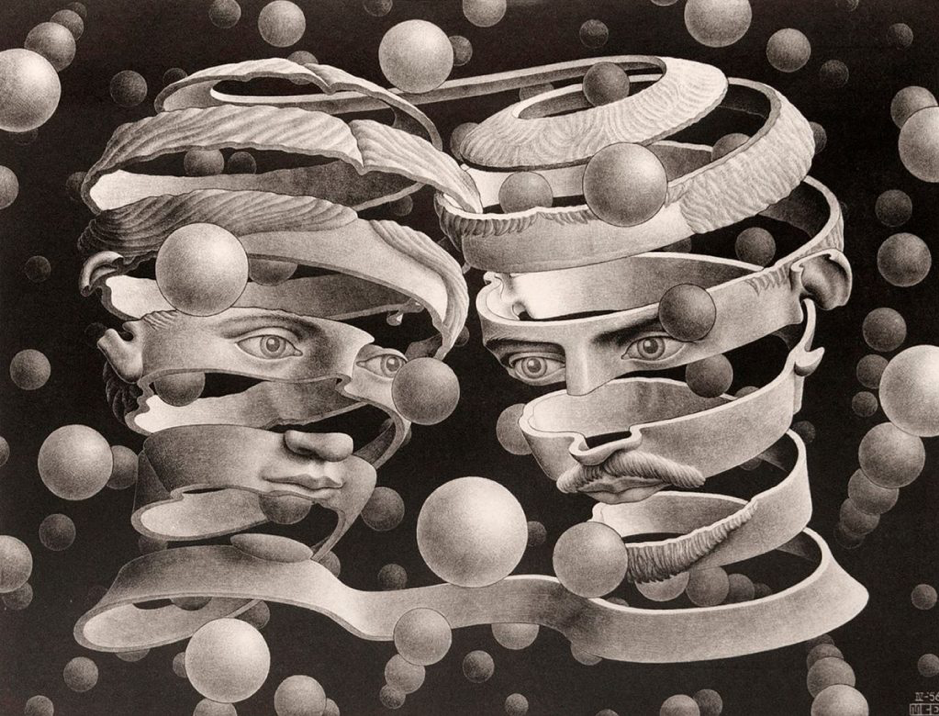
M.C. Escher, Bond of Union (1956). © The M.C. Escher Company, The Netherlands

Bach’s fugue in mind and space

Music, and specifically J.S. Bach’s music, is particularly prominent throughout the book as a vehicle through which Hofstadter offers many valuable insights about cognition, reasoning and creativity. “Intelligence loves patterns and balks at randomness”, he writes, while comparing Bach’s “self-contained” music with the random processes and aleatoric nature of John Cage’s works. As he puts it in a short but illuminating passage on codes and decipherment: “In form, there is content”.

In his landmark book, Hofstadter offers another beautiful analogy when he mentions “an inner tension, very much like the tension in a piece of music caused by chord progressions that let you know what the tonality is, without resolving. […] The mathematician’s sense of tension is intimately related to his sense of beauty, and is what makes mathematics worthwhile doing.” He also goes on to liken analogies to chords using the concept of an imaginary “keyboard of concepts”: superficially similar ideas – like physically close notes – are often not deeply related, whereas deeply related ideas are often superficially disparate, just like harmonically close notes are physically distant.

While discussing the cultural context and emotional appeal of music, Hofstadter wonders: “Will beings of an alien civilization have emotions? Will their emotions – supposing they have some – be mappable, in any sense, onto ours?” Questions such as this become particularly intriguing in relation to experiments like the Voyager Golden Record time capsule, a pair of two identical phonograph records included aboard the two Voyager spacecraft launched in 1977 that are still travelling through deep space carrying music from – among others –  J.S. Bach.

In any case, music, as all art in general, retains its aura of mystique and sense of wonder. As Hofstadter puts it: “Do you really understand Bach because you have taken him apart? Or did you understand it that time you felt the exhilaration in every nerve of your body?”

AI, music, and creativity

In his discussion of computer-generated music, Hofstadter notes that “in most circumstances, the driving force behind such pieces is a human intellect, and the computer has been employed, with more or less ingenuity, as a tool for realizing an idea devised by the human. The program which carries this out is not anything which we can identify with. It is a simple and simple-minded piece of software with no flexibility, no perspective on what it is doing, and no sense of self.”

Indeed, as in the case of recent attempts to emulate the style of J.S. Bach with the help of ChatGPT and MIDI technology, it seems that technology is still in the service of human intellect, a tool rather than the guiding force behind the creative process. However, as technology evolves and AI becomes increasingly self-aware, Hofstadter suggests that there will come a time “to start splitting up one’s admiration: some to the programmer for creating such an amazing program, and some to the program itself for its sense of music.”

As he writes: “Creativity is the essence of that which is not mechanical. Yet every creative act is mechanical. […] Perhaps what differentiates highly creative ideas from ordinary ones is some combined sense of beauty, simplicity, and harmony.” It is exactly these qualities that will, in the long run, prove to be crucial: “AI, when it reaches the level of human intelligence – or even if it surpasses it – will still be plagued by the problems of art, beauty, and simplicity, and will run up against these things constantly in its own search for knowledge and understanding.”

The eclipse of man: A terrifying prospect

While attempting to crack the mysteries of consciousness and intelligence, Hofstadter’s penetrative analysis offers some deep revelations about our own human nature. “Contradiction is a major source of clarification and progress in all domains of life”, he argues, adding that “we all are bundles of contradictions, and we manage to hang together by bringing out only one side of ourselves at a given time.” 

Moreover, the awareness of human fallibility and imperfection appears in sharp contrast to the rise of superintelligence. As Hofstadter put it in a recent interview: “It’s like a tidal wave that is washing over us in unprecedented and unimagined speeds… And, to me, it’s quite terrifying because it suggests that everything that I used to believe was the case is being overturned. […] It’s a very traumatic experience when some of your most core beliefs about the world start collapsing. Especially when you think that human beings are soon going to be eclipsed… It feels as if the entire human race is going to be eclipsed and left in the dust. Soon.”  

Echoing the concerns of other important scholars and thinkers such as Geoffrey Hinton and Noam Chomsky, Hofstadter is cautious about AI-powered language models such as ChatGPT. As he wrote recently: “It makes no sense whatsoever to let the artificial voice of a chatbot, chatting randomly away at dazzling speed, replace the far slower but authentic and reflective voice of a thinking, living human being. [..] To fall for the illusion that vast computational systems “who” have never had a single experience in the real world outside of text are nevertheless perfectly reliable authorities about the world at large is a deep mistake, and, if that mistake is repeated sufficiently often and comes to be widely accepted, it will undermine the very nature of truth on which our society — and I mean all of human society —is based.”

Music of splendid isolation

Depending on external conditions, as well as one’s state of mind, listening to music can be a very intimate, self-reflective process. Some pieces of music, partly due to their esoteric nature, work especially well when experienced in private and attentively, with as little distraction as possible.

Below is a list of such works that are very dear to me personally, works I often turn to when seeking comfort and consolation – things particularly precious in days of self-isolation and “social distancing”…

Federico Mompou – Música Callada (Silent Music)

Grandson of a bell maker, Catalan composer Federico Mompou was fond of imitating the meditative sound of bells, something that can be heard in his masterful Musica Callada, a collection of 28 miniature pieces for piano based on the mystical poetry of Saint John of the Cross. Mompou’s magnum opus, this enigmatic work is reminiscent of Eric Satie in its crystalline simplicity and serene beauty.

Max Richter – The Blue Notebooks

Featuring readings from Kafka’s fragmented The Blue Octavo Notebooks and recorded in the aftermath of the protests against the 2003 invasion of Iraq, The Blue Notebooks was described by Richter as “a protest album” and a “meditation on violence”. A work fragile yet powerful and moving, it invites to confront our innermost feelings, doubts, and thoughts.

Arvo Pärt – Spiegel im Spiegel

A magnificent example of Pärt’s uniquely evocative style, Spiegel im Spiegel, like much of his music, seems somehow to make time stand still, offering us a glimpse of the eternal.

George Gurdjieff – Sacred Hymns

Written by Greek-Armenian mystic and philosopher George Gurdjieff in collaboration with Russian composer Thomas de Hartmann, this genuinely spiritual music is better understood as part of Gurdjieff’s greater philosophical system, known as the Fourth Way or “The Work”. According to Gurdjieff’s teachings, musical structures parallel cosmic structures, music being thus able to to significantly affect and benefit individuals.

Keith Jarrett – The Köln and Vienna Concerts

Both of Jarrett’s great recitals (called simply The Köln Concert and Vienna Concert) are wonderful examples of his masterful improvisational skills. Moreover, one gets the impression that during these intriguing performances Jarrett is completely surrendered to the music, inviting us to follow him in his daring excursions as active listeners.  As Jarrett himself (who has also made an excellent recording of Gurdjieff’s music) has claimed, his goal when improvising is to “wake up” and keep listeners “alert”.

Bach, Pericles, and open culture: Yo-Yo Ma in Athens

The Bach Project

Taking on “Bach’s ability to speak to our common humanity at a time when our civic conversation is so often focused on division”, celebrated Chinese-American cellist Yo-Yo Ma recently launched The Bach Project, which involves live performances and actions in 36 selected locations across the globe.

In the musician’s own words: “I believe that culture – the way we express ourselves and understand each other – is an essential part of building a strong society. My hope is that together we can use Bach’s music to start a bigger conversation about the culture of us.”

Yo-Yo Ma in Kipseli

Prior to his big recital at the Odeon of Herodes Atticus, Yo-Yo Ma had a busy schedule including various stimulating discussions and actions around Athens. One of these included an impromptu performance at Kanari Square in the neighborhood of Kipseli, where the cello virtuoso shared the stage with local musicians and jammed with them, much to the surprise of an enthusiastic audience.

Ma went on about the influence of Africa on classical music and gave a short history lesson on the origins of the Sarabande, a dance form used widely by Baroque musicians (Bach wrote a Sarabande for each of his 6 cello suites). He then quoted from Thucydides’s famous Funeral Oration of Pericles (ca. 404 B.C.): “We throw open our city to the world and never by alien acts exclude foreigners from any opportunity of learning or observing”.

After giving an intimate performance of Bach’s Sarabande from his Cello Suite No.3 in C Major, the great musician left the stage addressing the audience with a message of encouragement: “Stay open, stay courageous!”


Bach meets Epirus in Herodion

On the last day of June, during a warm summer evening, Ma performed all of Bach’s six cello suites in one go without intermission at the ancient Odeon of Herodes Atticus under the imposing shadow of the Athenian Acropolis. For about 2,5 hours the crowd stood still listening to the sound of Bach’s timeless music delivered by Ma’s inspired, masterful playing.

This slideshow requires JavaScript.

Accompanied at times by singing cicadas, Ma’s performance was moving and powerful. His playing was elegant and spirited, in tune with the surroundings and the special ambience. The concert was concluded with a joint performance by Yo-Yo Ma and a vocal ensemble specialized in polyphonic music from the region of Epirus in northwestern Greece.

Following a sober and reflective instrumental introduction, Ma accompanied the singers on Αλησμονώ και χαίρομαι (“Forgetful, I am truly glad”), a striking example of Epirotic polyphonic song, whose lyrics and melody still resonate with remarkable force to this day:

Forgetful I am truly glad, but mindful I am saddened;
remembering those foreign lands, I want to set out for them.

Nigel Kennedy meets Bach and Gershwin in Athens

From child prodigy to -super- stardom

Born in 1956 into a family of distinguished musicians, Nigel Kennedy started out his remarkable career in music as a boy prodigy (he became a pupil at the Yehudi Menuhin School of Music at the age of 7), and soon developed a highly individual style along with an unconventional approach that made him one of the truly unique -and controversial- violinists of his generation.

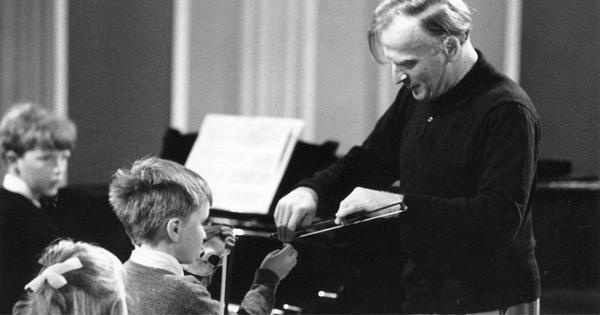
Yehudi Menuhin teaching young Nigel Kennedy

While still 16 years old, Kennedy was invited by legendary jazz violinist Stéphane Grappelli to play with him at Carnegie Hall in New York (which he did, successfully, against the advice of his classical teachers). His debut record featured Elgar’s Violin Concerto, while his 1989 recording of Vivaldi’s The Four Seasons with the English Chamber Orchestra became one of the best-selling classical recordings in history, with total sales of over three million units.

Fusing classical, jazz and rock

Over the last decades, Kennedy has made a name as one of classical music’s most (in)famous mavericks, regularly crossing over different music genres while developing his signature, unorthodox performing style and idiosyncratic playing. His tastes and influences vary from baroque and classical to jazz and rock (he has recorded an album with improvisational covers of Jimi Hendrix), and next to many of the world’s leading orchestras he has also collaborated with musicians such as Paul McCartney, Kate Bush, Robert Plant and The Who.

Regarding his departure from classical “orthodoxy” and standard practices,  Kennedy’s response has been revealing: ‘I suppose I took a bit of flak for taking the jazz attitude into the classical world. But so many people from the classical establishment are stuck in closets on top of their ivory towers.’

It was Kennedy’s acquaintance and apprenticeship with Grappelli that led him to a deeper appreciation and understanding of Gershwin’s music, which features in his latest album Kennedy Meets Gershwin.

A Greek premiere

Kennedy’s first live appearance in Greece took place earlier this week at the ancient Odeon of Herodes Atticus stone theater in Athens. Together with his ensemble (Peter Adams – cello, Yaron Stavi – double bass, Rolf Bussalb – electric guitar, Howard Alden – guitar), the English violinist performed a varied program in front of a warm and enthusiastic crowd.

After opening the concert with an original and absolutely breathtaking interpretation of Bach’s fugue from the first violin sonata in G minor, the highly energetic Kennedy carried on with some recent works by “one of his favorite composers” (i.e. himself), before moving on to a selection from his new album featuring his refreshing and lively arrangements of Gershwin’s classics Rhapsody in Blue and Porgy & Bess.

Nigel Kennedy performing at the Odeon of Herodes Atticus theater in Athens

Kennedy’s seemingly inexhaustible energy and high spirits led to a prolonged (nearly 3-hour-long) concert full of pleasant musical surprises, including Kennedy’s piano playing and an absolutely thrilling performance of the popular Csárdás, showcasing his astonishing virtuosity, improvisational skills, and… sense of humor (there were several moments when his comments caused loud laughter across the theater).

Kennedy’s sensational performance closed with an electrifying rendition of Minor Swing by Django Reinhardt and Stéphane Grappelli – indeed, a perfect ending to the evening and a testament to the musician’s ability to roam seamlessly through baroque, classical, gypsy, klezmer, and jazz music.