Category Archives: Various

A hymn to unfulfilled love

In most cases, books are admittedly better than the movies they serve as a basis for.  But can the same be said about music adaptations? What about all those cases where novels and poems become a chief source of inspiration for great composers, leading to the creation of some of their most stunning and everlasting masterpieces?

I remember reading Pushkin’s verse novel Eugene Onegin when I was still in highschool, my teenage mind trying to reconstruct the novel’s theatrical setting and visualize its vivid characters. I would picture Onegin as a proud, fine-looking dandy kindly rejecting the love and pure feelings of young Tatyana, a landowner’s charming and shy daughter of introspective nature. Furthermore, I would try to follow how a silly quarrel could end with the fatal duel between Onegin and his good friend Lensky and how, finally, Onegin’s feelings for Tatyana would change when they would meet again many years later, their roles now having been reversed.

These fading images and scarce recollections of Pushkin’s novel came back to me recently, after watching Tchaikovsky’s Eugene Onegin performed by the Stanislavski Opera at the Royal Theater Carré in Amsterdam.
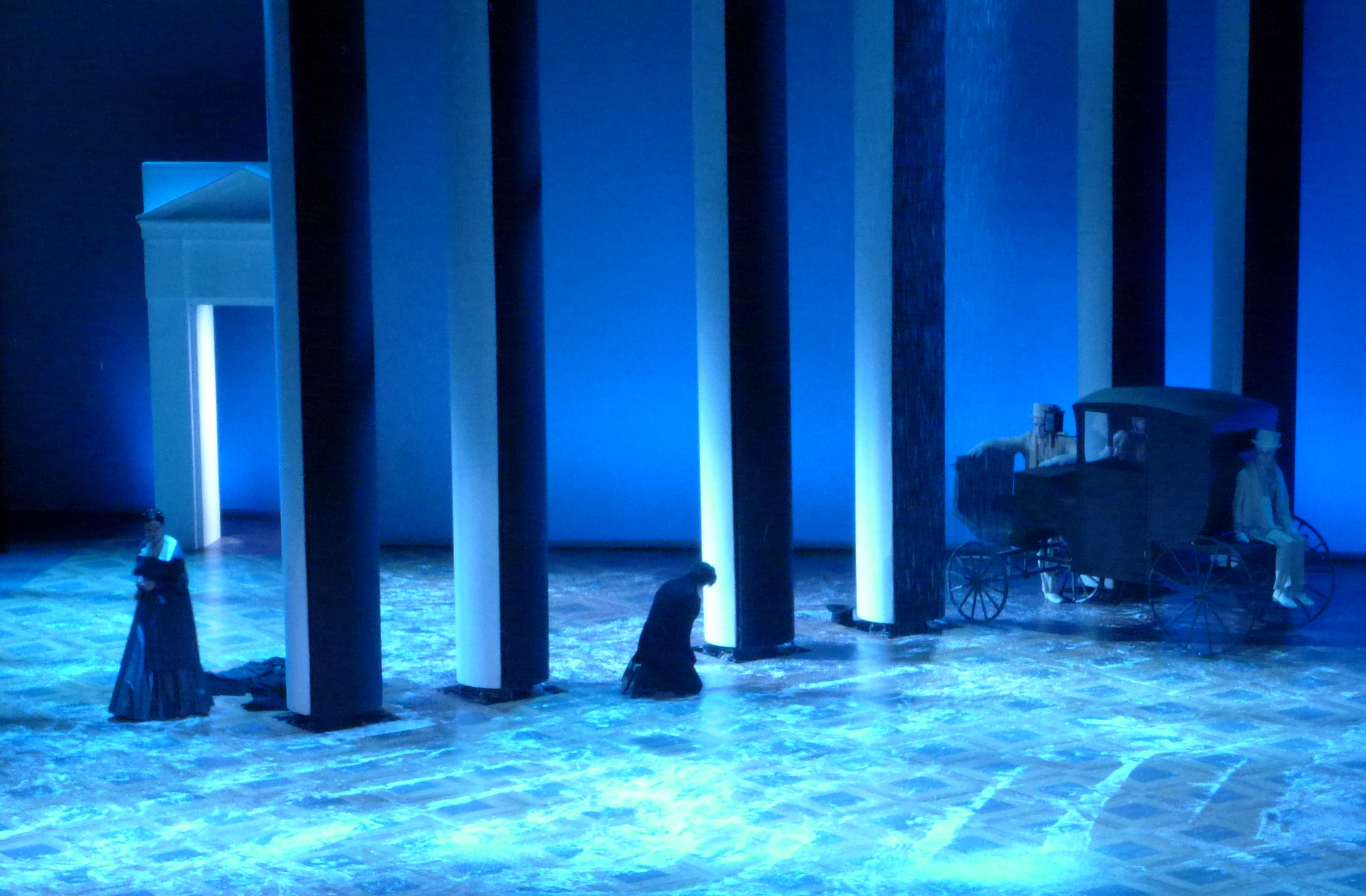
P1000729-001

I’ve never been a big opera enthusiast, but works such as this always make me think of the considerably powerful effect opera can have when performed convincingly and given the right context. In the case of Eugene Onegin, Tchaikovsky’s beautiful music adds a whole new dimension to the familiar story, and it feels as if Pushkin’s masterpiece has been translated into a universal language that brings out its very essence, making it accessible to anyone with enough sensitivity and eagerness to partake in the dramatic events happening on stage.

Although Eugene Onegin touches upon several intriguing themes such as social conventions and the link between reality and fiction, it is ultimately a tragic story about unfulfilled love. It is evocative of the very human cry of desperation on behalf of the broken-hearted that has been repeatedly expressed through art since antuiquity, as in Sappho’s prayer in Hymn to Aphrodite:

Hear and heal a suppliant’s pain:

Let not love be love in vain!

Unlike Pushkin’s dark finale, Sappho’s hymn ends with Aphrodite’s promise to resolve the intense pain and the goddess’s assurance that the reluctant lover will soon know love as intense as that suffered by the poet:

Soon, thro’ long reluctance earn’d,

Love refused be Love return’d.

In Tchaikovsky’s Eugene Onegin, it is the sheer magic and moving power of music that serves as a substitute for such divine intervention, bringing thus consolation and a much-needed catharsis to the agony of the audience.

The music of suspended time

Ten minutes. The time it takes to water the plants, do the dishes or read the daily news. At least in the conventional sense of “time.” Because there exists another, parallel dimension where time can be suspended indefinitely and a single moment can signify an eternity. In this dimension, which is no other than the realm of abstract music, ten minutes of “normal” time assume a new importance and are long enough to open a portal to a radically different perception of reality and the cosmos.

Ten minutes is approximately the duration of Spiegel im Spiegel (“mirror in the mirror”), a piece by Estonian composer Arvo Pärt (b. 1935) written in 1978 for piano and violin. If there was ever a musical synonym for absorbed meditation and contemplative stillness, this would have to be it.

Arvo Part

Estonian composer Arvo Pärt

Spiegel im Spiegel is written in the compositional style of tintinnabuli (from the Latin tintinnabulum = bell), a technique invented by Pärt himself and influenced by his mystical experiences with religious music. Although his early works are characterized by a variety of styles ranging from neoclassicism to serialism, his preoccupation and study of choral music, Gregorian chant and the polyphonic music of the Renaissance eventually led Pärt to develop an idiomatic style characterized by simple harmonic structure and rhythmic patterns, alluding to the ringing of bells.

Tintinnabulation”, says Pärt, “is an area I sometimes wander into when I am searching for answers – in my life, my music, my work. In my dark hours, I have the certain feeling that everything outside this one thing has no meaning. The complex and many-faceted only confuses me, and I must search for unity.” Of this type of music, Spiegel im Spiegel is one of the earliest and finest illustrations. It is also one of his most popular works and has been repeatedly used in films, as in Jean-Luc Godard’s In Praise of Love (2001) and Guy Ritchie’s Swept Away (2002).

That a work by Pärt such as Spiegel im Spiegel has been so well-received is a bit of a contradiction. One can hardly think of more introspective, detached and unfashionable music than this. And yet it contains a certain quality that defies time and space, speaking directly to one’s heart and inner self. As Steve Reich, one of the founding fathers of minimalism, once put it: [Pärt’s] music fulfills a deep human need that has nothing to do with fashion.”

It is not just the ten sublime minutes of Spiegel im Spiegel. Much of Pärt’s music is of profound expressivity and unfathomable beauty (his Tabula Rasa is another case in point). The composer once compared his music to “white light which contains all colors”, its division being possible only through a prism, which could be “the spirit of the listener.” At its best, this music indeed offers that which only divine light could ever promise to reveal: a glimpse of the eternal.

Philip Glass and Schubert’s glasses

Born on January 31 (the same day as Franz Schubert), Philip Glass is regarded as one of the most influential composers to emerge during the twentieth century. Although he evolved stylistically in his later works, the American composer has been mostly associated with minimal music, a style that has its origins in the underground scene and alternative spaces of San Francisco and New York of the early 1960s.

My first encounter with Glass’s music was back in the 1990s, through a compilation CD that contained key works by contemporary composers. The piece was the 1st movement of his Violin Concerto No.1, which still ranks among my favorite pieces of modern music – or any music for that matter, as I consider it a masterpiece by any standards.

Many years later, I had the chance to see Philip Glass performing with his ensemble at the Muziektheater in Amsterdam. It was one of the lengthiest and most demanding music performances I have ever attended: a total duration of 5 hours over which Glass’s large-scale work Music in Twelve Parts was executed in its entirety (a rare event).

It is true that the repetitive structure and recurring musical elements in Glass’s works and minimal music in general can be somewhat off-putting without the listener’s engagement and active participation. On the other hand, I find this style of music relatively easy to follow (at least when compared with most of atonal music) and highly rewarding for a set of persistent and appreciative ears. Glass, after all, describes himself as a “classicist”. He was trained in harmony as well as counterpoint and, under the guidance of French composer and conductor Nadia Boulanger, he has studied the compositions of J.S. Bach, W.A. Mozart and, well, Franz Schubert…

Schubert - Glass.png

Interestingly, the relationship between the latter and Philip Glass extends far beyond a shared birthday. Glass’s fondness for Schubert’s music can be traced throughout his oeuvre, most notably in his writing for piano. According to Dutch pianist and composer Jeroen Van Veen, an example of this can be found in Glass’s Mad Rush, which alludes to the opening piano part of Schubert’s beautiful Lied Du bist die Ruh.

Glass’s appreciation and respect for the Viennese master with the iconic glasses of steel frame and spherical lenses appears, then, to be well-grounded. In all likelihood, Schubert too would approve of Glass’s creative approach in using relatively simple forms to produce works of high dynamics and powerful emotion. Not to mention his soft spot for round glasses. It’s all in the name, it seems…

Ray(s) of genius

Pondering on the special relationship between music and colors I remembered an interview of Ray Charles for Rolling Stone (published in 1973),  where he speaks -among other things- about his loss of sight, his memories of colors, the notion of beauty and, of course, music. Below are some excerpts offering us an insight into the personal universe of this truly unique artist:

“Each day for two years my sight was less and less. (…) I guess I was too small to really care that much. I knew there were things I liked to watch. I used to love to look at the sun. (…) I used to love to look at the moon at night. I would go out in the backyard and stare at it. It just fascinated the hell out of me.”

Ray Charles“And there were colors. I was crazy about red. Always thought it was a beautiful color.”

“And naturally I remember my mother, who was pretty. God, she was pretty. (…) To me [physical] beauty is probably about the same thing that it means to most people. You look at them and the structure of their face, the way their skin is, and say like, a woman, the contour of her body, you know what I mean?”

“I guess you could call me a sentimentalist, man, really. I like Chopin or Sibelius. People who write softness, you know, and although Beethoven to me was quite heavy, he wrote some really touching songs, and I think that Moonlight Sonata -in spite of the fact that it wound up being very popular- it’s somethin’ about that, man, you could just feel the pain that this man was going through.”

“Gospel and the blues are really, if you break it down, almost the same thing. It’s just a question of whether you’re talkin’ about a woman or God.”

In the track that follows, you can listen to excerpts from a conversation between Ray Charles and Dick Cavett that took place in June 1972.  Ray’s astonishing response when asked if he would welcome the prospect of having his sight restored (assuming such an option was available) is both  incredibly sincere and extremely topical…