Category Archives: Film & Music

Music of the spheres

It was Pythagoras who first proposed that the Sun, Moon and planets all emit a unique resonance based on their orbital revolution, a theory that became known as the “Harmony of the Spheres”. In his Republic, Plato also alluded to the connection between music and astronomy: “As the eyes, said I, seem formed for studying astronomy, so do the ears seem formed for harmonious motions: and these seem to be twin sciences to one another, as also the Pythagoreans say”.

Fascinated and inspired by this idea of ‘spherical music’ (or musica universalis), British violinist Daniel Hope set out to record Spheres, which was released last February by Deutsche Grammophon. As Hope puts it: “My aim was to make an album touching on this sublime theme, while also discovering what composers nowadays might write when thinking in this context.” The final result is remarkable not only for its original concept, but also for its incorporation and imaginative combination of many diverse, yet equally intriguing, compositions.

For the purposes of this special recording, old and new composers were drawn together and some of the works appearing on the album were given their world premiere or special new arrangements. Spheres features music from a wide range of styles and composers including J.S. Bach, Gabriel Fauré, Ludovico Einaudi, Phillip Glass, Michael Nyman, and Max Richter (who also collaborated with Hope on his interpretation of Vivaldi’s The Four Seasons).

Beautiful, mysterious and captivating, the music of Spheres can be seen as an ideal companion to the visual artistry of abstract filmmakers like Jordan Belson (1926-2011), who had also made a film named Music of the Spheres in 1977 (you can watch a clip here).

Images from Music of the Spheres artwork, 1977, (c) Estate of Jordan Belson

For those who find classical music passé or contemporary composers too difficult, listening to Spheres is certainly bound to make them reconsider.

Music for the eyes

Oskar Fischinger (1900 – 1967) was one of the most visionary and innovative figures to emerge in the filmmaking world during the first half of the 20th century. Acclaimed for his abstract animation films, his work anticipated in many ways modern-day music videos and motion graphics.

Fischinger is also recognized as the father of “visual music” (Raumlichtmusik), a new art form developed in the 1920s in which he envisioned the merging of all the arts – a new kind of figurative, non-objective Gesamstkunstwerk. As he described it: “Of this art everything is new and yet ancient in its laws and forms. Plastic – Dance – Painting – Music become one.  The Master of the new Art forms poetical work in four dimensions… Cinema was its beginning… Raumlichtmusik will be its completion.”

After Hitler’s denigration of abstract art, Fishinger moved to Los Angeles in 1936, where he worked on animated films for Paramount, MGM and Walt Disney Studios (he designed the J.S. Bach Toccata and Fugue in D Minor sequence for Disney’s Fantasia, but quit without credit because his designs were rejected as too abstract). Although he faced several difficulties with his filmmaking efforts in America, he managed to create significant compositions such as An Optical Poem (1937) (set to Franz Liszt’s Hungarian Rhapsody No. 2).

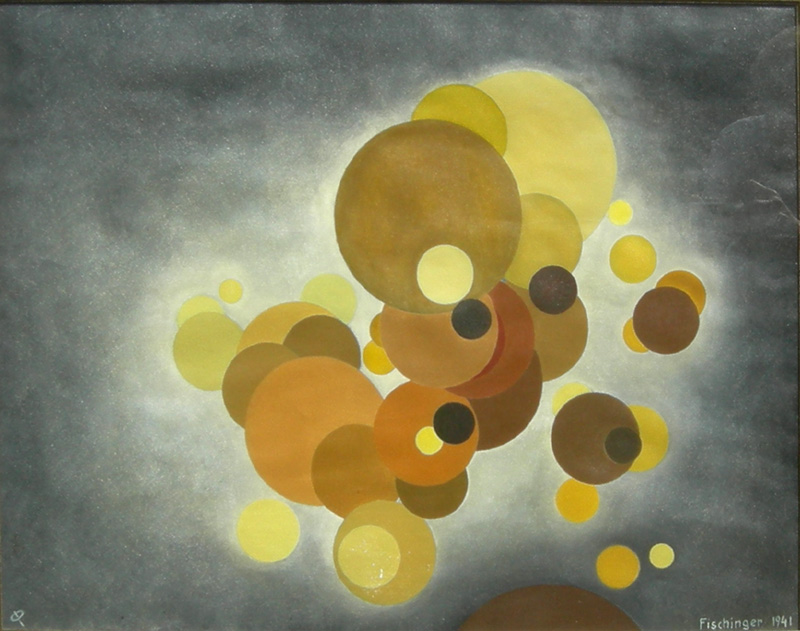
An avid painter (he produced a total of around 800 canvases), Fishinger tried to relate painting to his work on film, thus creating layers of grids and geometric forms in pulsating color, and generating a third dimension of cosmic depth in light, space and rhythm.

Oskar Fischinger, ‘Optical Ballet’ (Oil on paper, 1941)

Fischinger’s magnificent Motion Painting No. 1 (1947), set to Bach’s Brandenburg Concerto No. 3, can also be seen as a study on the act of painting; he created it by taking a single frame for each brushstroke over the course of 9 months, its multi-layered style mirroring  the elaborate structure of Bach’s music (although not strictly synchronized with it).

Fischinger’s vision and highly innovative approach to film-making influenced profoundly subsequent creative artists; one of those who followed in his footsteps was American abstract filmmaker Jordan Belson (1926 – 2011), whose own cosmic visions would be realized through projects like the legendary Vortex concerts that took place in the late 1950s at the California Academy of Science’s Morrison Planetarium in San Fransisco (featuring music by Henry Jacobs and avant-garde composers such as Karlheinz Stockhausen).

Stills from ‘Allures’ (1961), ‘Samadhi’ (1967), ‘Epilogue’ (2005) (c) Jordan Belson

Belson saw Fischinger as the man who “could turn even the simplest things into a luxurious, magical illusion of cosmic elegance.”

No small achievement indeed.

Quintessential Quentin

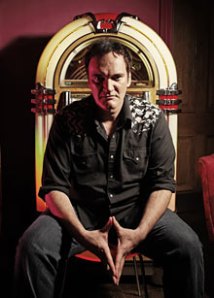
Regardless of whether you love or hate Quentin Tarantino (there are valid reasons for both), there’s one thing you can always count on when it comes to his films: music.

Tarantino

Tarantino’s use of music is an integral part of his creative process. Much of what’s best in his movies has to do at least as much with what we listen as with what we see. Take for example the “Misirlou” scene from Pulp Fiction or the lap dance scene from Death Proof.

His cooperation with celebrated composer Ennio Morricone has only helped to further enhance the powerful audiovisual effect of Tarantino’s movies. In his latest film Django Unchained one can hear a variety of music genres, however the Maestro’s touch is a crucial one. Tarantino could have hardly wished for someone better to work on the score of his American epic western, other than the man who composed the music for The Good, the Bad and the Ugly and Once Upon a Time in the West.

In case you already watched Django and were intrigued by its theme, I would like to point you to a 1971 Italian film by Gualtiero Jacopetti and Franco Prosperi called Goodbye Uncle Tom (original title: Addio Zio Tom). If you thought Django was somewhat shocking, then brace yourselves! And, by the way, you may well be familiar with the film’s theme song (originally written by Riz Ortolani), as it was also used by Nicolas Winding in his recent film Drive.

Loan and re-contextualization of pre-existing material have been, after all, commonplaces for the creative process in all art. Tarantino’s mash-up approach of mixing  a wide range of very different elements in his films is no exception: combined with his eclectic choice of music, it constitutes the quintessence of his art.

Music in colors

I often associate music up to the early sixties with film noir. All these black and white photographs from jazz artists performing in smokey bars, people sweating it off on the dance floor, Elvis with his guitar, The Beatles in Hamburg – they appear before my eyes just like sequences of a great two-color movie starring the biggest names of pop culture, plus countless of less known actors in side roles or as mere extras. Some more important than others, but all of them part of the bigger picture.

A picture that was about to be painted with a seemingly inexhaustible range of colors, over the course of the fateful decade that would culminate in the psychedelic frenzy of the Summer of Love and the social unrest of the Parisian May. Alongside the explosion of colors in the movie theatres, the visual representation of art and artists would also become part of this revolution through posters, photographs and highly imaginative album covers. A new world had arrived, a world seen as through a giant kaleidoscope, full of colorful patterns and magical reflections. Black and white was being pushed irrevocably to the kingdom of nostalgia, becoming its official ambassador.

And what about the music? Were all the black and white notes on the music sheet also painted in fresh, vibrant colors for the first time? Not quite. Music contained its color -or rather colors, countless colors- since its very inception. Every musical sound that can be produced has always had its match in a parallel, imaginary palette of endless color variety. Still, it takes a skillful composer to meaningfully arrange the different sounds, not unlike the master painter who organizes his paint across an empty canvas as he sets out to produce a true work of art.

Colors, thus, do not only exist in order to please our eyes, but can also appeal to our sense of hearing. For this to happen, all their unique, subtle and infinitesimally different shades need to find their aural counterpart from a similarly endless variety of sounds. Being able to appreciate and listen to all these extraordinary, enchanting tone colors blending together in something meaningful is a special, and somewhat miraculous, sort of synaesthesia only made possible thanks to one thing: music.