Author Archives: The Muser

Defending an identity: An interview with Algerian guitar legend Lotfi Attar

Founding member of the celebrated Algerian band Raïna Raï back in the 1980s, guitarist and composer Lotfi Attar has acquired a somewhat legendary status in Algerian music circles. A multifaceted artist, Attar has done much to revolutionize the folk genre known as raï, extending its musical vocabulary as well as its audience.

Moreover, Attar boasts a broader understanding of North African music and culture, bringing together elements from various regions and experimenting with different styles. Apart from a unique and innovative musician, he is also a man with a deep passion and love for his country and its culture.

I recently had the opportunity to ask him some questions about his music, his development as a guitarist, and his overall career so far (his answers have been translated from French):

When did you first get seriously involved with music?

My brother Kamel also played the guitar. I started playing in 1962 when I was 10 years old, and in 1969 I joined the group Les Aigles Noirs playing western pop music and performing at parties and weddings. This type of music, however, was not very popular in the smaller villages.

Who are the musicians who had the biggest influence on you?

First of all, The Shadows and their distinctive way of guitar playing, but also American jazz guitarist Wes Montgomery, Brazilian bossa nova composer Sergio Mendes, The Beatles, Carlos Santana with his song Jingo… And then everything my older brothers would listen to. I particularly like the sound of the Gibson and Fender guitars as played by The Shadows or Jimi Hendrix. The first guitar I bought was a Fender Duo-Sonic Mustang.

Apart from guitar players like Hendrix and Santana, when I was a teenager I would also listen to classical composers such as Strauss or Beethoven, and even played some pieces by Mozart.

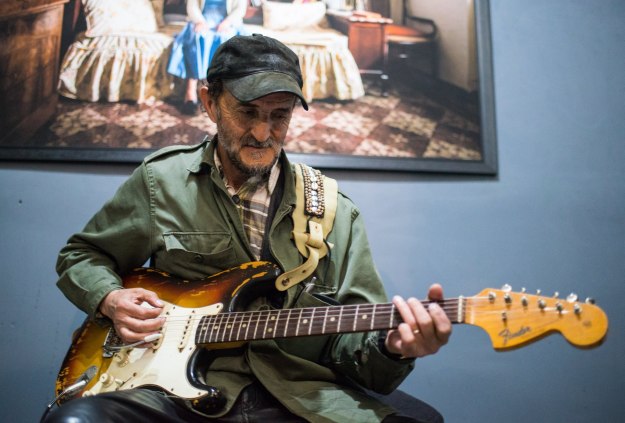
Algerian guitarist Lotfi Attar / Photo: Nadjib Bouznad

What do you consider the most important moments in you career so far?

First of all, the formation of Raïna Raï in 1980 and the release of the album Hagda (1983), which included the song Ya Zina [the group’s biggest success]. Then, the formation of Amarna in the mid-1980s. For the group’s first album I composed the music while Hamida [Lotfi’s wife] wrote the lyrics in the form of lyric poetry. The group’s vocalist was Djillali Rezkallah [better known as Djillali Amarna], a singer with a beautiful voice coming from a rural vocal culture. I tried to create harmonies to accompany the vocal melodies using instruments like bass guitar, drums, and saxophone [the work stands out for its habitual use of unison, and includes the hit song Khalouni Nabki].

In more recent years, I have developed the “Goumb-Guits” style, where I sing a melody and try to approximate the sound of the gumbri [traditional 3-stringed instrument, also known as sintir] with my guitar. The Tuareg people have their proper style, I only adjust and transform it. So in the Goumb-Guits style, we find a mix of modern instruments (drums, bass guitar, piano, electric guitar) and traditional percussion instruments (karkabous, kallouz, guellal).

What have been your latest projects?

I try to evolve in the domain of musical research and bring forth elements from other world cultures that are often not valued, like Asian music for instance, through the use of the guitar. As I said, I have developed the Goumb-Guits style, but I am not limited to that. I also try to play in other styles such as Orient-Guits, Andaluz-Guits, Alaoui-Guits, and Tergui-Guits. I would also like to work with a European pianist, as I am curious to see how he or she would adapt to my style.

How would you describe your way of playing?

I don’t know… It’s natural. I am defending an identity. I am trying to be different from other guitarists. I would say mostly “Algerian.”

In what ways has Algerian music influenced you?

The Algerian musical influence on my style can be seen in the use of traditional instruments such as the reed flute, the ghaita [North African double reed instrument also known as rhaita], and percussion instruments like the bendir, the gallal, and the karkabous. I have also been influenced by the west-Algerian rural folklore we call trab [the word means “soil”], the alaoui style in my rock playing, as well as the rhythm of saf [a women’s dance], the diwan [similar to gospel], and the tergui [Touareg music related to the blues].

I chose to stay in my native Sidi Bel Abbès in Algeria in order to defend the Algerian identity and try to inspire the future generations. What is more, Algeria inspires me; I cannot see myself living in another place.


More info:

Bach Brazil Barcelona

Johann Sebastian Bach and Brazilian music have always enjoyed an intimate relationship. This is evident from the towering figure of Heitor Villa-Lobos and his magnificent Bachianas Brasileiras to subsequent Brazilian musicians (such as guitarist Baden Powell) who also found inspiration in Bach’s music and combined it with their own distinctive style.

Originally scored for soprano and an orchestra of cellos, the Bachianas Brasileiras No. 5 suite is probably Villa-Lobos’s best-known work. A special rendition of the suite’s famous Aria (which has been also arranged for soprano and guitar by the composer) was recently made by singer Ilona Schneider and guitarist Diego Caicedo. Based in Barcelona, the duo delivers an emotionally charged and delicate performance, which is further enhanced by the atmosphere of the  accompanying video.

In fact, Barcelona claims a very special connection to Bach. This is largely due to legendary Catalan cellist Pablo Casals: In 1890, when he was still 13 years old, Casals chanced upon a copy of Bach’s six Cello Suites in a second-hand sheet music store in Barcelona. Several years later, after having studied them laboriously, Casals would perform Bach’s suites  in public and record them between 1936 and 1939.  They have since been performed and recorded extensively, and are now considered to be among Bach’s most important works.

A highly original take on Bach’s famous Prelude from Cello Suite No.1 can be heard from Armonipiano, a duo formed by harmonicist Rodrigo G Pahlen and pianist Gilles Estoppey. Also based in Barcelona, the two musicians perform a fresh and eclectic blend of jazz, tango, and Brazilian music. And a little bit of Bach, that is.

As shown by such brilliant and novel approaches, the mix of Bach, Brazil and Barcelona makes indeed for an exciting musical cocktail: A sort of baroque-flavored caipirinha, served in the music bars of the Catalan capital.

Going underground behind the Iron Curtain

I recently came across the very interesting book “X-Ray Audio” – The Strange Story of Soviet Music on the Bone by Stephen Coates. Focusing on the underground culture of Roentgenizdat, also known as “music on ribs” or “jazz on bones”, it tells the fascinating story of bootleg and pirated X-ray music discs that were circulated illegally in Soviet Russia during the immediate post-war era through the 1960s.

Made from medical X-rays that were subsequently cut into 7-inch discs with the aid of special machines, these discs featured music by officially censored artists such as the “King of Russian Tango” Pyotr Leshchenko or Western jazz and rock’n’roll musicians like Bill Haley, Ella Fitzgerald, and The Beatles.

A sort of musical parallel to the samizdat (the underground publication and distribution of dissident literature), the history of these Soviet bone discs is truly incredible as well as illuminating: it reveals how far people were willing to go in order to obtain, enjoy and share the forbidden fruit of inaccessible music. The risks involved were serious: Sound engineer Ruslan Bogoslovsky (1928-2005), a true hero of Soviet underground record production, was sent to prison camps no less than three times throughout his life for cutting Western music onto records that originally contained speeches of Soviet leaders.

Eventually the X-ray record production was eclipsed by the emergence of reel-to-reel tape recorders which became available in the early 1960s and soon grew enormously popular. This in turn sparked the process known as magnitizdat, i.e. the re-copying and self-distribution of audio tape recordings that were not available commercially. According to leading Russian music journalist and critic Artemy Troitsky, “the overall quantity of X-ray records ever produced in the Soviet times would not exceed a million, whereas with reel-to-reel tapes we would be talking about tens if not hundreds of millions.”

In his book Back in the USSR: The True Story of Rock in Russia (first published in 1987, shortly before the collapse of the Soviet Union), Troitsky provides a compelling account of the evolution of the Soviet rock scene since its birth in the 1960s. An insider, Troitsky offers an abundance of first-hand information and anecdotes related to the foremost Soviet rock musicians and groups that are little, if at all, known in the West, such as Time Machine (the “Russian Beatles”) and their founder Andrey Makarevich, Aquarium and their leader Boris Grebenshchikov, guitarist Alexander Lyapin (“closer to Hendrix than any other Soviet rock guitarist”), or the iconic post-punk band Kino and their singer Viktor Tsoi.

Starting with the crucial influence of The Beatles on the genesis of Soviet rock, Troitsky goes on to describe key events, places and moments of its history, such as  the hippie gatherings in Tallin and Crimea (“something of a Soviet California”), the Leningrad and Moscow scenes, the “intense though fairly isolated” rock culture of Estonia, the 1980 Tbilisi festival, the emergence of home-made albums in the early 1980s, and the “Account 904” concert (organized in 1986 by Troitsky and others to raise funds for the victims of the Chernobyl disaster).

Troitsky’s commentary is at times both funny (“punk rock with us is something exotic, like an avocado – everyone has heard the name, but very few know what it actually is”) and penetrating: “Meanwhile, nothing at all was happening in Lithuania (…) nothing, that is, if we don’t count having the best jazz and the prettiest girls in the country. Perhaps these circumstances hindered the development of rock music there.”

Apart from its purely historical value, Troitsky’s account also offers some stimulating remarks on the nature of Russian culture and its differences from the West. For example, he writes: “[T]he purely literary level of our rock lyrics is higher, on the average, than in the West. Rock lyrics here have a direct tie to our poetic tradition and reflect its lexical and stylistic heritage.” I find this assertion particularly interesting in the light of the recent Nobel award to Bob Dylan and the related discussion on the relationship between music and literature.

Troitsky’s book closes with a somewhat disheartening remark: “[T]oo few rock bands dare to test glasnost (…) And this is sad. It seems that the long-awaited sunlight has blinded most of the creatures crawling out of the underground.” Thirty years on, the Iron Curtain having long been lifted, the question of cultural and political dissent remains as urgent as ever, both in Russia and the rest of the world. And music can play a crucial role in this respect. As cultural critic Edward Said once put it: “Music, in some profound way, is perhaps the final resistance to the acculturation and the commodification of everything.”

Gil Shaham, Greece and an old Chinese legend

I recently had the chance to meet and talk with American violinist Gil Shaham in Barcelona, on the occasion of his performance of Alban Berg’s Violin Concerto in L’Auditori (you can read the full interview here).

Towards the end of our conversation we talked a bit about Greece and the soloist’s only visit there so far, which he seemed to remember very vividly:

3

Gil Shaham with his ‘Countess Polignac’ Stradivarius, backstage in L’Auditori

“I have never been in Athens, but I’ve been in Thessaloniki. I performed there around 10 years ago with a very good Greek orchestra. We played a piece called the Butterfly Lovers’ Violin Concerto. I love this piece. It’s a sort of tone poem, and it tells a traditional story from the Chinese opera, very similar to Romeo and Juliet but in ancient Chinese style.

According to the story, the heroine, Zhu Yingtai, is forced to marry a noble man and she agrees to do so only if the wedding procession passes by the grave of her true love, Liang Shanbo. As the traditional Chinese wedding procession goes by the grave of young Shanbo, the earth shakes and lightning strikes and the earth shallows her up, and she throws herself into the grave of Shanbo. And in the end they are both resurrected as butterflies.

The piece is a symphonic version of a traditional Chinese opera, and it was composed in 1959 by two students at the Shanghai Conservatory of Music, Chen Gang and He Zhanhao. It became extremely successful; it is the single most often performed symphonic work ever!”

It appears Shaham’s Greek visit was quite special, and he still has fond memories of it:

“So we played this piece in Thessaloniki. It was a very nice experience and and I have a beautiful memory of it. My whole family was with me, including my daughter who was just one year old at the time.”

We also talked about Greek violinist Leonidas Kavakos, for whom Shaham has a deep appreciation. The two artists also share some common experiences:

“We went to the same music school with Leonidas in New York. He was a little bit older. We live parallel lives so we never see each other, but then around 2 years ago we were in Munich at the same time and we had dinner together. That was very nice. I love his playing.”

Shaham, like Kavakos, has been one of the foremost violinists of his generation and it would be quite an occasion if their parallel routes also intersected in the concert hall – and it would be hard to think of a more fitting location for such a meeting to take place than Greece.

Listening to Frank Zappa

Frank Zappa (1940 – 1993) was one of these rare geniuses that are simply impossible to classify. Composer, singer, multi-instrumentalist, lyricist, producer, as well as filmmaker and actor, he switched with ease from one genre or style to another, blending various disparate influences into a highly original musical idiom.

An accomplished guitarist, Zappa also left a rich legacy of dazzling guitar work, such as his electrifying solo in Willie the Pimp from his early masterpiece Hot Rats (1969).

His virtuosity aside, it is evident that Zappa’s unique, and constantly evolving, musical language was only one part of his multifaceted artistic expression and creative vision. His often provocative stage presence, caustic -and at times censored- lyrics, as well as controversial role as a public figure were equally important aspects of his artistic persona.

Bust of Frank Zappa in Vilnius

There are, thus, various ways of listening to Frank Zappa. First, through his innovative and unconventional music. Then, through his sharp, sarcastic, and often infuriating lyrics. Last but not least, through his public commentary and interventions.

The latter is the focus of the recent documentary Eat That Question: Frank Zappa in His Own Words. Featuring numerous excerpts from interviews and TV appearances, it provides a general overview of Zappa’s ideas and views on a variety of topics such as music, politics, education, religion, drugs, censorship, and freedom of speech.

Not unlike his music, Zappa’s talk and language are playful yet always well structured; his remarks can be humorous and sarcastic, yet extremely serious.

Unsurprisingly, many of his views, such as his stance on American culture and foreign policy, ring the same as timely and poignant today.

It is perhaps no coincidence that Zappa’s influence in Europe has been arguably greater than in his native US. The subversive character of his art had a particularly big impact in the avant-garde and underground scenes of Central and Eastern Europe during the 1970s and 1980s.

Notably, Zappa went to Czechoslovakia following an invitation by president Václav Havel in January 1990. Havel was a fan of Zappa, and would later refer to him as “one of the gods of the Czech underground.” The two men developed a friendship, further consolidating the special connection between Frank Zappa and the Czech Republic that endures to this day.

Another, more tangible, testament to Zappa’s lasting and far-reaching influence can be found in downtown Vilnius, Lithuanian’s capital city. It is a bronze bust of the American musician erected in 1995, which has since become one of the city’s most visited sights (I took a photo of it myself when I visited Vilnius some years ago).

Listening to Frank Zappa, then, has been quite tricky: his attitude towards the status quo and established processes always remained critical, his iconoclastic art causing great provocation all the way from the US (where he fought a long battle against music censorship) to Soviet countries (where his music was banned and his records had to be smuggled illegally).

Be it Zappa’s groundbreaking music or thought-provoking commentary on society and culture, it is a listen most definitely worth having.