
Author Archives: The Muser

Aspects of cinematic love (and their soundtrack)

There are of course countless films that deal with love, romantic or otherwise. Some, however, have managed to capture this so popular and overused of themes in a completely new light, utilizing both image and sound in an original and captivating way.

Here are some of my favorites:

I. Silent love: Kubrick meets Schubert

Never has the art of seduction been so skillfully delivered on the big screen as in this scene from Stanley Kubrick’s masterpiece Barry Lyndon. Shot by using actual candlelight, not a single word is exchanged between the two lovers throughout the whole scene – some meaningful looks are enough for the romance to be born. And no other music could fit the sequence more perfectly than Schubert’s sublime piano trio with its haunting theme.

Film: Barry Lyndon (1975), directed by Stanley Kubrick
Music: Franz Schubert, Piano Trio in E-Flat, Op. 100 – II. Andante con moto


II. Wise love: The rabbi meets Jefferson Airplane

There are many brilliant moments to be found in the Coen brothers film A Serious Man, however the scene where Danny meets senior rabbi Marshak is by far my favorite. It has suspense, philosophical and religious undertones, pop culture references, subtle irony as well as that unmistakable, dark Coen humor. When 60s hippie idealism meets disillusioned religious skepticism, you better find somebody to love!

Film: A Serious Man (2009), directed by Joel and Ethan Coen
Music: Jefferson Airplane, Somebody to Love

III. Religious love: St. Paul meets Beethoven

I kept the best for last. Anyone who has watched Sono’s 4-hour long epic Love Exposure knows that this is no ordinary film. And this scene is perhaps the best proof: Two Japanese youngsters on a remote shore grappling with each other, releasing their sexual frustration while arguing about metaphysics. A truly explosive mix of religious fervour, existential agony and adolescent tension building up to a dramatic climax masterfully synced to Beethoven’s awe-inspiring music.

Film: Love Exposure (Ai no mukidashi, 2008), directed by Sion Sono
Music: Ludwig van Beethoven,  Symphony No. 7 in A major, Op. 92 – II. Allegretto
All of Bach, Bach for all

Bach’s complete works recorded and filmed

In September 2013 the Netherlands Bach Society, in view of the upcoming celebration for its first 100 years, embarked on a remarkable and highly ambitious project: the performance and recording of every single note penned by Johann Sebastian Bach.

Since the first recordings were made available on 2 May 2014, a new Bach recording is released every single Friday. In this way, the complete corpus of Bach’s music is slowly but surely being made available to the public through a series of excellent performances and videos of outstanding quality.

The pieces are performed in a variety of locations, always according to the nature and original intent of the music: cantatas in churches, chamber music in living rooms, and so on.

The Netherlands Bach Society

The Netherlands Bach Society is the oldest ensemble for Baroque music in the Netherlands and one of the oldest in the world. It was founded in 1921 for a performance of Bach’s St Matthew Passion in the Grote Kerk in Naarden and has performed the work annually since then in the Grote of Sint-Vituskerk (Great Church or St Vitus Church). It has played a prominent role in Dutch cultural life for many years, giving around 50 concerts all over the Netherlands as well as abroad each season.


All of Bach

You can learn more about All of Bach and check out the new recordings as they are being released on the project’s website and Facebook page.

Old, slow and popular

Just a couple of years after the release of Old Ideas, Leonard Cohen (who recently celebrated his 80th birthday) is back with a new album. It’s been almost 45 years since the legendary Canadian songwriter and poet embarked upon his musical career – one with much to reflect upon.

New songs for the old ceremony

'Popular Problems' was release in September 2014Popular Problems is Cohen’s 13th studio album and though the total length is just under 36 minutes, the album’s 9 tracks more than make up for its short duration.

Cohen has always liked to take his time the album’s opening track (Slow) reminds us, setting the tone for what is about to follow. Track after track, Cohen’s mature, relaxed and confident voice takes us through a musical journey of introspection and confession in what ultimately becomes a cathartic experience for both singer and listener.

Popular themes

Some of the principal themes Cohen has dealt with over the years such as love, religion, and politics are all present and treated with sincerity, humour as well as profound feeling. In some of the album’s best moments, as in the last verse of Almost Like the Blues, self-reflection, existential agony and sarcasm intermingle:

“There is no God in heaven / And there is no Hell below / So says the great professor of all there is to know / But I’ve had the invitation that a sinner can’t refuse / And it’s almost like salvation; it’s almost like the blues.”

Most of the songs feature discreet -at times almost imperceptible- orchestrations, while Cohen’s distinctive singing is surrounded by angelic-sounding choruses and female background vocals that strike a sharp contrast to his deep, hoarse voice. Besides, and not surprisingly, the album’s lyrics are of high literary quality. In fact, the words to some of the songs (e.g. A Street and Nevermind) were previously published as poems before finding their way into the album.

With Popular Problems Leonard Cohen offers us one more token of his seemingly exhaustless creative urge and spiritual yearning. And judging from You Got Me Singing, the album’s closing track, it appears the Canadian troubadour’s quest isn’t drawing to a close quite yet:

“You got me singing / Though the world is gone / You got me thinking / I’d like to carry on.”

Instruments of sorrow

Moreover, from a musical standpoint, it is interesting to trace the direct influence of such instrumental treatments on subsequent non-folk Greek music, as in the case of Socrates and their popular song Mountains.

The clarinet’s mourning

In neighboring Turkey, the song “Yemen Türküsü” mourns the death of Turkish soldiers in Yemen during the First World War. The well known folk song can be found in several different versions, and it has been also performed by Taksim Trio, a band of accomplished instrumentalists (Hüsnü Şenlendirici – clarinet, Aytaç Doğan – qanun, İsmail Tunçbilek – baglama) that has been part of Istanbul’s diverse and vibrant music scene.

The guitar’s outcry

One of the oldest and most despondent forms of flamenco music, siguiriyas is characterized by its profound, expressive style and tragic nature. When sung, the lyrics reflect the suffering of human relationships, love and death; however, it is also encountered as an instrumental piece with great potential for emotional outlet in the hands of the capable and sensitive artist – as in this performance by flamenco composer and guitarist Manolo Sanlúcar.

The -vinyl- music challenge

I was recently challenged to come up with a list of my 10 favorite records. No easy task, especially as one’s musical taste tends (and ought) to change along with -and because of- one’s life experiences and influences. In fact, any such list is essentially a moment frozen in time: no doubt my choices will be different if I try this exercise again in a month, year or decade from now.

Having said that, I tried to think how I could make my -inevitably arbitrary and ephemeral- selection a bit more meaningful. I wanted to make a point and so I decided to consider only records from my vinyl collection. Vinyl still persists amidst today’s technological frenzy, and for a good reason: apart from its full, warm sound it brings with it a whole culture, from the process surrounding its purchase to the actual listening experience and the sheer pleasure of enjoying its artwork.

So here’s some of the most memorable vinyl records I have acquired over the last few years (arranged à la Nick Hornby in chronological order of acquisition):

1) Sviatoslav Richter – J.S. Bach: The Well-Tempered Clavier

The world’s greatest pianist meets the world’s greatest composer. Amen.

2) Neville Marriner – Amadeus [Original Soundtrack Recording]

As if Mozart’s sublime music wasn’t rewarding enough, listening to this record reminds me of Milos Forman’s epic masterpiece, one of my favorite movies ever.

3) The Beatles – Rubber Soul

Someone once said there are three great Bs in music: Bach, Beethoven and… The Beatles. He was right.

4) Jacque Loussier Trio – Play Bach No. 1

I’ve hinted at the artistry of French pianist Jacque Loussier in an earlier post about Vivaldi, but it was with his inspired take on Bach that he made his breakthrough.

5) Baden Powell – Poema on Guitar

I love everything about this record: its title, its beautiful cover, and above all Baden Powell’s tuneful guitar sound and dreamy compositions.

P1030279-001

6) Simon & Garfunkel – The Concert in Central Park

I still get goose bumps every single time I listen to this. Timeless.

7) Led Zeppelin – IV

I bought this in a vinyl shop in Istanbul. Like the Quran in mosques or the Bible in churches, I think it should be freely available at all conservatories and music schools.

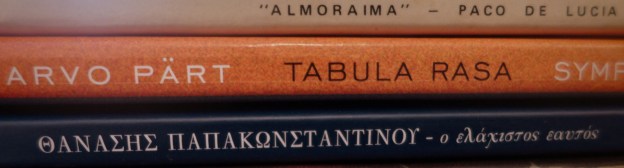
8) Arvo Pärt – Tabula Rasa

A deeply evocative work by a remarkable and highly idiosyncratic composer whose music truly makes time stand still.

9) Thanasis Papakonstantinou – Ο Ελάχιστος Εαυτός (The Minimal Self)

The finest and most original composer that has emerged in the last 20 years in Greece. His records are like rays of light amidst a vast darkness…

10) Paco de Lucía – Almoraima

A true miracle of technique, composition, and expression – the more I listen to it, the more I admire Paco’s astonishing skill as both guitarist and musical innovator.