
It was 200 years ago today when Henriette Pressburg, a Jewish woman from a well-to-do family that would later found Philips Electronics, and Heinrich Marx, distant cousin of German Romantic poet Heinrich Heine, welcomed their third child. His name was Karl, and he would soon become one of the most influential thinkers human history has ever known.
So influential, in fact, that his figure features in the iconic album cover of The Beatles’ Sgt. Pepper’s Lonely Hearts Club Band – there he is, squeezed in between American comic actor Oliver Hardy and English writer H. G. Wells (the latter hailed as the “Shakespeare of science fiction”). And since, to quote the German philosopher himself, “history repeats itself, first as tragedy, second as farce”, it is quite fitting that Marx would find his place between a comedian and a tragedian of sorts.

But, cover art and quips aside, what kind of views did Karl Marx have with regards to music?
To begin with, Marx was clearly less versed in the inner workings of music than his close collaborator Friedrich Engels, who had studied harmony and even tried his hand at composing during his youth (albeit with no great results). Moreover, Marx’s writings on music are scarce, although some of the relevant fragments can help in giving us a clearer idea as to his attitude and thoughts on the subject.
An early example can be found in one of his unpublished poems, which Marx wrote as a teenager and dedicated to his father. In the poem, inspired by Christoph Willibald Gluck’s opera Armide and titled Sir (G)luck’s Armide, young Marx recounts how he ostensibly “sat, lost in the music’s spell.”
In his later work, Marx mostly refers to music in the wider context of his economic and sociopolitical analysis. In the economic and philosophical manuscripts written in Paris (1844-45), for example, he refers to “a musical ear” in relation to the cultivation of human senses and the richness of human sensibility.
Furthermore, it appears that Marx nurtured a genuine appreciation for the act of composing, which he considered a serious and laborious activity. In the Grundrisse (1857-58), he refers to musical composition as an example of free, unalienated labor:
Really free labor, the composing [of music] for example, is at the same time damned serious and demands the greatest effort. The labor concerned with material production can only have this character if (1) it is of a social nature and (2) it has a scientific character and at the same time is general work, i.e. if it becomes the activity of a subject controlling all the forces of nature in the production process.
Next to such “organic” uses of musical examples, Marx would also occasionally comment on the musical life of his time. In a letter to Engels from Karlsbad in 1876, he makes a sardonic allusion to Wagner: “Everything here is ‘the Future’ since the rumbling of ‘the music of the future’ in Bayreuth.”
One of the most characteristic remarks by Marx in relation to music comes from an account by Wilhelm Liebknecht, principal founder of the Social Democratic Party of Germany and lifelong friend of Marx. In the course of a pub crawl or Bierreise in April 1854, during his stay in London, Marx appears to have reacted to the snobbish comments by some Englishmen with an outburst of musical-nationalist pride. In Liebknecht’s own words:
Marx launched into an enthusiastic eulogy on German science and music — no other country, he said, would have been capable of producing such masters of music as Beethoven, Mozart, Händel and Haydn, and the Englishmen who had no music were in reality far below the Germans who had been prevented hitherto only by the miserable political and economical conditions from accomplishing any great practical work, but who would yet outclass all other nations. (Wilhelm Liebknecht, Karl Marx zum Gedächtnis, Nuremberg, 1896)
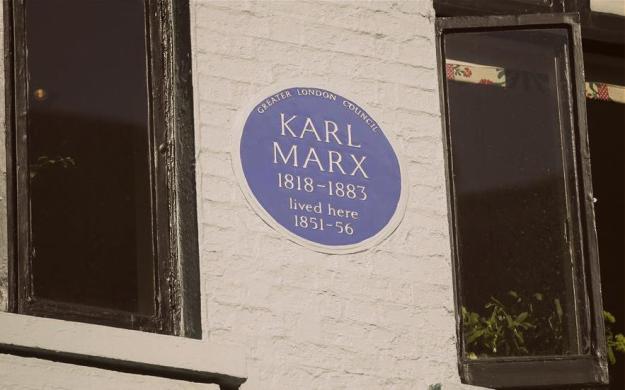
28 Dean Street, London. Karl Marx lived there in the 1850s with his family in dire conditions.
Marx had moved to London in 1849 and ended up staying there until the end of his life. During the first half of the 1850s, he lived with his family on 28 Dean Street under very difficult conditions. Incidentally, an 8-year-old Wolfgang Amadeus Mozart had given a recital at number 21 of that very same street in 1764 during one of his long concert tours as child prodigy.
In The German Ideology (1845-46), Marx had mentioned Mozart in response to Max Stirner’s argument that no one can compose music on behalf of someone else. “It was not Mozart himself”, Marx writes, “but someone else who composed the greater part of Mozart’s Requiem and finished it”. Although this might sound quite unflattering for the Viennese composer, Marx was basically trying to show (employing, along with Mozart, the example of High Renaissance master painter Raphael) that whether an individual artist succeeds in developing his talent “depends wholly on demand, which in turn depends on the division of labor and the conditions of human culture resulting from it”.
Meanwhile, Mozart’s remains have been resting inside a common unmarked grave at the St. Marx Cemetery of Vienna. History, it seems, is not only tragic or comical, but also ironic.
 The Muser