
Monthly Archives: September 2013

Raising ravens

A Spanish drama

I recently had the chance to watch Cría Cuervos (‘Raise Ravens’), a 1976 drama film by Spanish director Carlos Saura. The film, which won the Special Jury Prize Award at the 1976 Cannes Film Festival, was shot as Spanish dictator Francisco Franco was lying on his deathbed. While it deals with themes like childhood and loss, one can also find subtle allusions to the contemporary political situation and the changes Spanish society was undergoing at the time.

Cría Cuervos left quite a strong impression on me. As the story unfolds Saura manages to create a miniature, fragile universe of emotional intensity and introspective -almost claustrophobic- atmosphere (most of the film is shot inside a single house).

In the center of this universe lies Ana, the little girl protagonist, played by 8-year-old Ana Torrent whose performance is absolutely mesmerizing. Ana’s father (a general in the Spanish army), her mother and two sisters (together with the rest of the characters in the film) all seem to revolve around her, like planets in orbit that occasionally draw nearer or get farther away from little Ana.

 Jeanette meets Frederic Mompou

The film’s exemplary direction and great performances aside, I was also intrigued by its music. Jeanette’s pop song Porque te vas recurs throughout the movie, adding a bittersweet feeling to the film’s imagery.

What is more, the film’s main music theme is Cançó No.6 in E-flat minor by Catalan composer Frederic Mompou (1893 – 1987), a wonderfully melancholic and haunting piano piece. Originally dedicated to Arthur Rubinstein, it was also a favorite of celebrated Italian pianist Arturo Benedetti Michelangeli.

PS: The film’s title comes from the Spanish proverb Cría cuervos y te sacarán los ojos, which literally translates as: “Raise ravens, and they’ll take out your eyes”.
Wagner’s 200th and the adventures of the Ring

I was first introduced to the Nibelungenlied (‘The Song of the Nibelungs’) through Fritz Lang’s magnificent Die Nibelungen, a series of two silent fantasy films (I. Siegfried & II. Kriemhild’s Revenge). Based on an epic poem written around 1200 AD, the screenplay follows the story of dragon-slayer Siegfried, his murder by Burgundian warrior Hagen of Tronje, and finally the revenge of his wife Kriemhild.

File:Nibelungen film1.jpg

Siegfried on horseback with Alberich, king of the dwarfs (still from Die Niebelungen by Fritz Lang)

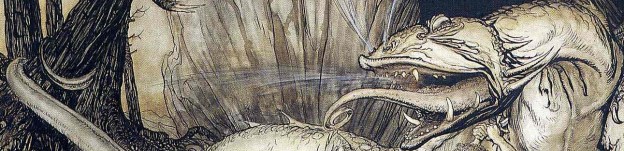
Wagner’s famous opera cycle Der Ring des Nibelungen (‘The Ring of the Nibelung’) is also based, however loosely, on characters from the Nibelungenlied and the Norse sagas. Not long ago, I happened to come across a wonderful 2-volume edition of Wagner’s Ring with some exquisite illustrations by Arthur Rackham that date back to 1910-11.

‘Siegfried awakens Brünnhilde’, illustration by Arthur Rackham

Lang’s visual artistry and Rackham’s captivating images notwithstanding, the most remarkable and ambitious work of art related to the Ring and the myth of the Nibelungs by far remains Wagner’s monumental opera cycle itself. I have wanted to watch Wagner’s operas on stage for a long time, and the opportunity finally arose this year on the occasion of the composer’s bicentennial. So far, I’ve had the chance to watch Siegfried in Amsterdam’s Muziektheater, which also stages the Ring cycle in its entirety.

Wagner’s 200th birthday was celebrated through a series of events and festivities booth within and outside Germany. Meanwhile, the composer’s strong anti-Semitic views and later association with the Nazis have continued to spark controversy up to this day. Same goes for the staging of his works, as it was made apparent this year in Bayreuth. Powerful as Wagner’s music may be, it seems to carry with it such a heavy load of historical allusions and connotations it often becomes impossible to be freed thereof.